

0 引言
空间探索活动的不断深入极大增加了空间任务的复杂性和多样性。航天器的任务规划对空间任务的执行至关重要,其是否有效将影响航天器执行任务过程的安全性、稳定性以及执行效果[1]。面向航天器未来的空间探索任务需求,任务规划技术面临着许多亟待解决的新问题,诸如提升轨迹规划过程的鲁棒性以使航天器能够适应和应对不同任务场景、调节路径规划策略以提高航天器任务执行效率和处理复杂的运动约束、改进航天器目标调度算法的复杂度以满足星载算力下的轻量化要求。
近年来,国内外学者提出了各类任务规划方法,提升了航天器的复杂任务执行能力。但是在空间碎片处置、太空运输、在轨组装和其他高风险太空任务中[2-4],航天器需要面对各种多任务场景,其任务规划需要满足动力学、避障、边界条件等基本约束,还需根据任务要求满足非线性机动[5]、视线角[6]、小推力[7-8]、时间窗口[9-11]等各种任务约束。综合来看,现有的航天器多目标任务规划主要基于任务的收益评估模型,包括能量模型[12-14]、时效模型[15-16]等,在任务收益评估的基础上运用优先级方法[17]、禁忌搜索算法[18]、遗传算法[19]、模拟退火算法[20]等进行任务规划问题的求解。但是,针对单一标准的收益评估模型往往不能充分表征太空任务的复杂性,任务之间存在的任务耦合也使得任务分配和路径规划的规划过程并不相互独立,航天器的前序任务集决定了当前任务轨迹的起点状态和终点状态,生成轨迹将反过来影响任务调度方案的有效性[21],这种任务耦合关系极大地提升了航天器任务规划问题的复杂程度[22]。所以,需要通过基于高维张量化的数学结构才能充分地描述各种因素及耦合关系对任务规划方案的影响,从而获得精确有效的规划结果。而从公开的研究成果可知,现有的方法都属于非张量方法,在处理具有复杂任务耦合的航天器任务规划问题存在性能上的局限性。
针对复杂轨迹约束和任务耦合下的航天器任务规划问题,本文提出了基于任务效能评价张量进化的航天器任务规划方法,利用张量形式来描述任务规划中任务点间转移轨迹与前序任务集的耦合关系,精确地评价不同任务规划方案下的转移轨迹代价和任务收益,从而提高任务规划效能,并极大缩减了任务规划的计算量,为航天器执行复杂空间探索任务的任务规划提供了有效方法。
1 航天器任务规划问题模型
航天器任务规划问题包括轨迹规划模型和任务规划模型两个部分。
1.1 轨迹规划模型
式中,广义坐标$ {\boldsymbol q} = {[\begin{array}{*{20}{c}} {\boldsymbol{r}_{\text{b}}^{\text{T}}}&{\boldsymbol{w}_{\text{b}}^{\text{T}}} \end{array}]^{\text{T}}} $ ;$ {\boldsymbol{r}_{\text{b}}} \in {\mathbb{R}^3} $ 为航天器的坐标向量;$ {\boldsymbol{w}_{\text{b}}} \in {\mathbb{R}^3} $ 为航天器的姿态;控制量$ {\boldsymbol u} = {[\begin{array}{*{20}{c}} {{\boldsymbol F}_{\text{b}}^{\text{T}}}&{\tau _{\text{b}}^{\text{T}}} \end{array}]^{\text{T}}} $ ,$ {\boldsymbol{F}_{\text{b}}} \in {\mathbb{R}^3} $ 为航天器的控制力;$ {\tau _{\text{b}}} \in {\mathbb{R}^3} $ 为控制力矩;$ {\boldsymbol D}\left( {\boldsymbol q} \right) \in {\mathbb{R}^{6 \times 6}} $ 和$ {\boldsymbol C}\left( {\boldsymbol{q},{\boldsymbol{\dot q}}} \right) \in {\mathbb{R}^{6 \times 6}} $ 分别为航天器的惯性矩阵和Coriolis矩阵。基于式(1),我们建立了状态变量$ {\boldsymbol X}\left( t \right) = {[\begin{array}{*{20}{c}} {{\boldsymbol{q}^{\text{T}}}}&{{{\boldsymbol{\dot q}}^{\text{T}}}} \end{array}]^{\text{T}}} $ 和控制变量$ {\boldsymbol U}\left( t \right) = {\boldsymbol u} $ ,得到航天器运动的状态方程为:
式中,$ {\boldsymbol E} $ 为$ 6 \times 6 $ 的单位矩阵。
假定$ {\boldsymbol{X}_1} $ 和$ {\boldsymbol{X}_2} $ 分别是航天器的起点状态和终点状态,$ {t_{{{X}_1}}} $ 和$ {t_{{{X}_2}}} $ 分别是起点状态和终点状态对应的时间点,这样可以得到航天器轨迹规划的边界条件:
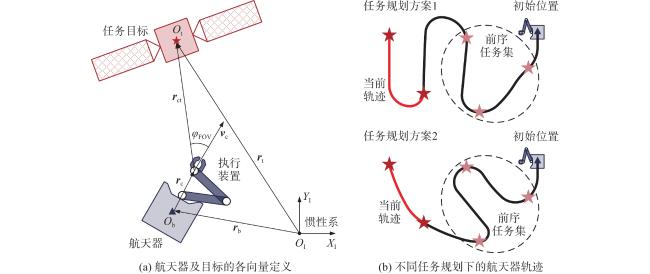
令$ {{\boldsymbol {r}}_{\text{t}}} $ 为任务目标的坐标向量。航天器根据其任务类型搭载执行装置,以空间碎片抓取任务为例,执行装置为空间机械臂。令$ {{\boldsymbol {r}}_{\text{c}}} $ 为航天器执行装置相对体坐标系的位置向量,$ {{\boldsymbol {v}}_{\text{c}}} $ 为航天器执行装置的方向向量,$ {{\boldsymbol {r}}_{{\text{ct}}}} $ 为航天器执行装置指向目标的视线向量,${\varphi _{{\text{FOV}}}}$ 为执行装置的视线角,各向量定义如图1 (a)所示。假定$ {{\boldsymbol {r}}_{\text{c}}} $ 和$ {{\boldsymbol {v}}_{\text{c}}} $ 相对体坐标系固定,${\varphi _{{\text{FOV}}\max }}$ 为执行装置的视线角上限,则有视线角上限约束:
考虑运动中的避障过程,$ {\boldsymbol{r}_{{\text{obs }}q}} $ 为航天器指向第${\boldsymbol q}$ 个障碍物的最近距离向量;$ {{\boldsymbol d}_{{\text{obs }}q\min }} $ 为航天器到第${\boldsymbol q}$ 个障碍物的距离下限,避障约束如下:
此外,状态$ {X} $ 和控制$ {U} $ 的上限和下限为:
考虑以减少航天器的控制力/力矩来优化轨迹,建立以下优化指标:
式中,$ {\boldsymbol{W}_{\text U}} $ 为权重矩阵。
由此,我们可以得到轨迹优化问题:
该优化问题满足式(2)~式(8),基于此从$ {{X}_1} $ 到$ {{X}_2} $ 的最优控制为:
1.2 任务规划模型
在轨迹规划模型的基础上,建立任务规划模型。假定航天器要逐个到达任务点执行任务$ 1,\cdots,{ M} $ ,任务规划可以建立为以下优化问题:
其中
式中,$s$ 为航天器的任务规划结果,即为航天器执行任务的顺序;$ s(m) $ 为任务$m$ 的后续任务序号;$0$ 为航天器起始状态的序号;$ \varPhi \left( {m,s(m),s} \right) $ 为航天器在规划$s$ 下执行任务$m$ 后续任务的收益。
考虑任务完成的时效性,设计$ \varPhi \left( {m,s(m),s} \right) $ 与到达目标时间为负指数关系,计算如下:
式中,$ R $ 为任务的基本收益系数;$ \alpha $ 为收益的递减系数;$ {\text{TOA}}\left( {\left. {{\boldsymbol{U}_{m,s(m)}}} \right|s} \right) $ 为控制$ \left. {{\boldsymbol{U}_{m,s(m)}}} \right|s $ 下到达目标的时间。
规划$s$ 下的控制$ \left. {{\boldsymbol{U}_{m,s(m)}}} \right|s $ 基于轨迹规划模型给出:
式中,$ {\boldsymbol{X}_0} $ 为航天器在执行所有任务前的起始状态;$ \left. {{\boldsymbol{X}_m}} \right|s $ 为规划$s$ 下航天器在任务点$m$ 的状态。
根据式(17)~式(18),在不同的任务规划$s$ 下,相同任务点的前序任务集不同,其作为起点的状态也会有所不同,导致起点到终点的转移轨迹不同,局部任务收益也会有所不同,如图1 (b)所示。因此,任务规划问题的求解必须充分考虑在规划方案下各任务与其前序任务的耦合关系,精确地估计任务收益,以确保规划结果的有效性。
2 任务效能评价张量进化方法
针对各任务与其前序任务的耦合关系,建立面向航天器多任务执行规划的效能评价张量进化方法。
2.1 任务效能评价张量
要解决复杂耦合关系下的任务规划问题,其核心在于对任务效能的评价,针对此,本节建立了状态预测张量和任务效能评价张量。
航天器在任务$ {m_1} $ 处出发,前往任务$ {m_2} $ 的位置执行任务,此过程中到达任务$ {m_2} $ 时的状态将受到任务$ {m_1} $ 处的状态及$ {m_1} $ 前序任务的影响。越充分考虑$ {m_1} $ 的前序任务,就越能对任务$ {m_2} $ 处状态进行准确的预测。如果只考虑任务$ {m_1} $ 处的状态,不考虑前序任务,此时称为任务执行状态的$1$ 阶状态预测;如考虑任务$ {m_1} $ 处的状态以及任务$ {m_1} $ 的$K - 1$ 个前序任务的状态,则称为任务执行状态的${K}$ 阶状态预测。首先给出从任务$ {m_1} $ 到任务$ {m_2} $ 的$1$ 阶状态预测:
式中,$ {\widehat S_1}\left( {{m_1},{m_2}} \right) $ 为只考虑任务$ {m_1} $ 和任务$ {m_2} $ 的规划方案:
将${ M}$ 个任务相互之间转移执行的所有$1$ 阶状态预测存储在状态预测张量$ {\text{EASP}}{{\text{T}}_1} $ (状态预测矩阵$ {\text{EASPM}} $ )中,其定义如下:
在$1$ 阶状态预测的基础上,对从任务$ {m_1} $ 到任务$ {m_2} $ 的收益进行预测,预测模型建立如下:
式中,$ {\widehat {\boldsymbol U}_1}\left( {{m_1},{m_2}} \right) $ 为从任务$ {m_1} $ 到任务$ {m_2} $ 的$1$ 阶控制预测:
将$M$ 个任务相互之间转移执行的所有$1$ 阶任务收益预测存储在状态预测张量$ {\text{ETUP}}{{\text{T}}_1} $ (状态预测矩阵$ {\text{ETUPM}} $ )中,定义为:
令$ {\text{EASPM}} $ 和$ {\text{ETUPM}} $ 中的各元素的更新计算基于计算控制量表$ {\Lambda _1} $ 、$ {\Lambda _1} $ 与$ {\text{EASPM}} $ 和$ {\text{ETUPM}} $ 的维度完全相同,其元素为$1$ 时,$ {\text{EASPM}} $ 和$ {\text{ETUPM}} $ 的对应元素进行更新计算;元素为$0$ 时,对应元素维持不变。
在$1$ 阶状态预测和$1$ 阶任务收益预测的基础上,考虑从任务$ {m_K} $ 到任务$ {m_{K + 1}} $ ,$ {m_K} $ 的前序任务为$ {m_1},\cdots,{m_{K - 1}} $ ,这样,任务$ {m_{K + 1}} $ 的$K$ 阶状态预测为:
式中,$ {\widehat S_K}\left( {{m_1},{m_2},\cdots,{m_{K + 1}}} \right) $ 为考虑任务$ {m_1} $ 到任务$ {m_{K + 1}} $ 的规划方案,表示为
将$M$ 个任务相互之间转移执行的所有$K$ 阶状态预测存储在状态预测张量$ {\text{EASP}}{{\text{T}}_K} $ 中,令其前序任务$ {m_1},\cdots,{m_{K - 1}} $ 取$ {i_1},\cdots,{i_{K - 1}} $ ,对应状态预测张量的第$({i_1},\cdots,{i_{K - 1}})$ 页定义如下:
在$K$ 阶状态预测的基础上,对从任务$ {m_K} $ 到任务$ {m_{K + 1}} $ 的收益进行预测,预测模型建立如下:
对航天器起始位置到任务$ m $ 的收益进行预测,
预测模型$ {\widehat {\boldsymbol U}_K}\left( {0,m} \right) $ 表示从航天器起始位置到任务$ m $ 的$K$ 阶控制预测:
将$M$ 个任务相互之间转移执行的所有$K$ 阶收益预测存储在收益预测张量$ {\text{ETUP}}{{\text{T}}_K} $ 中,令其前序任务$ {m_1},\cdots,{m_{K - 1}} $ 取$ {i_1},\cdots,{i_{K - 1}} $ ,对应收益预测张量的第$({i_1},\cdots,{i_{K - 1}})$ 页定义如下:
令$ {\text{EASP}}{{\text{T}}_K} $ 和$ {\text{ETUP}}{{\text{T}}_K} $ 中的各元素的更新计算基于计算控制量表$ \Lambda _K^{({i_1},\cdots,{i_{K - 1}})} $ 、$ \Lambda _K^{({i_1},\cdots,{i_{K - 1}})} $ 与$ {\text{EASP}}{{\text{T}}_K} $ 和$ {\text{ETUP}}{{\text{T}}_K} $ 的维度完全相同,其元素为$1$ 时,$ {\text{EASP}}{{\text{T}}_K} $ 和$ {\text{ETUP}}{{\text{T}}_K} $ 的对应元素进行更新计算;元素为$0$ 时,对应元素维持不变。
2.2 基于张量进化的任务规划
在任务效能评价张量基础上,建立基于张量进化的任务规划方法,流程如图2 所示。首先对迭代索引$m$ 和${n}$ 进行初始化,并初始化控制量表$ {\Lambda _K} $ 。如果初始化控制量表$ {\Lambda _K} $ 的所有元素均取$1$ ,则称为效能张量方法,在规划开始时对预测张量的所有元素进行穷举计算,在后续的规划中不会对收益预测张量进行迭代进化;如果初始化控制量表$ {\Lambda _K} $ 的所有元素均取$0$ ,则称为效能张量进化方法,根据后续的任务规划对效能张量进行迭代进化计算。

完成初始化后,根据控制量表$ {\Lambda _K} $ 的取值,基于航天器初始状态、任务位置坐标信息、障碍物状态信息,基于前序任务配置$ {n} $ 预测局部轨迹起点和当前任务$m$ 预测局部轨迹终点,对航天器进行局部轨迹规划,并对张量信息进行更新。完成更新后,基于任务效能张量进行航天器任务规划方案生成,并在此基础上进行全局精细化轨迹规划。然后将任务效能预测与精细轨迹规划结果进行比较,如果所有任务规划局部收益预测与实际值偏差在阈值$\xi $ 以内,则任务规划结束;如果有任务规划局部收益预测超过进化控制阈值$\xi $ ,则阈值的元素对应控制量表值更新为$1$ ,其余更新为$0$ ,并返回初始阶段。
效能张量方法能够充分地考虑任意任务与前序任务之间的耦合关系,对任意任务规划方案中的任务收益进行精确预测,从而获得具有高收益的航天器任务规划结果。但是效能张量方法本身基于对各种任务耦合关系的穷举,将导致算法的复杂度随问题维度提升呈指数上升。而引入效能张量进化方法,可以避免初始阶段对各种任务规划方案的收益进行穷举预测,只在收益预测结果与精细规划结果出现较大偏差时进行更新计算,在维持精确预测的同时保证了算法的轻量化。
3 试验验证
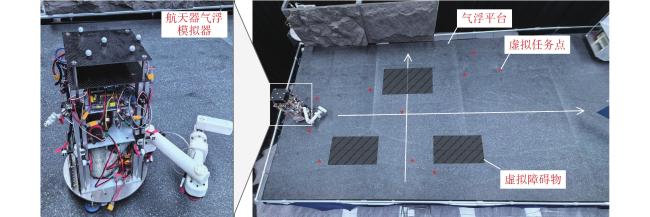
以航天器的多空间碎片目标规避抓取任务为例,利用本文所提出的任务效能评价张量进化方法进行试验验证。如图3 所示,任务场景中预设$10$ 个虚拟的空间碎片抓取任务点和$3$ 个抓取过程中需要规避的虚拟障碍物,航天器的执行装置为空间机械臂,以航天器机动到一个虚拟任务点表示该任务的执行。航天器的初始位置及虚拟任务点的位置如表1 所示。受限于试验条件,采用三自由度运动模拟器和气浮平台模拟航天器的运动过程。试验气浮平台的尺寸为$3{\text{ m}} \times 6{\text{ m}}$ ,航天器模拟器的尺寸为${\text{0}}{\text{.2 m}} \times {\text{0}}{\text{.2 m}}$ ,质量为$ 12.731{\text{ kg}} $ ,绕回转轴的转动惯量为$ 0.085{\text{ kg/}}{{\text{m}}^2} $ 。航天器模拟器搭载的计算机采用Ubuntu 20系统,配备i5-1135G7处理器和16G内存。
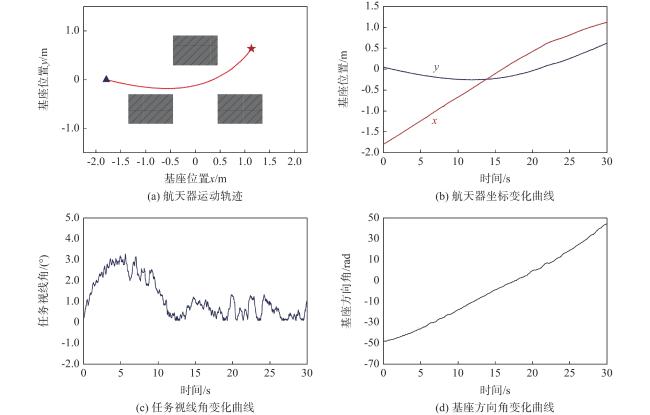
航天器在任意起点和终点之间的转移过程满足式(1)~式(11),航天器的轨迹生成基于Radau伪谱法实现,式(8)中权重矩阵$ {{W}_{\rm U}} $ 取$ 6 \times 6 $ 的单位矩阵。图4 给出了基于Radau伪谱法生成的航天器从起始位置运动至虚拟任务1位置的运动轨迹。从图中可以看出,航天器的运动轨迹在优化的机动下有效地避开障碍,且执行装置视线角在±4°范围内始终朝向任务目标。
表 1 航天器的初始位置及虚拟任务点位置Table 1 Inital position of spacecraft and virtual mission point position |
| 位置 | x/m | y/m | 位置 | x/m | y/m | |
| 起始位置 | −1.80 | 0.00 | 任务6 | −0.65 | 0.39 | |
| 任务1 | 1.11 | 0.65 | 任务7 | −1.53 | −0.79 | |
| 任务2 | 0.43 | −1.05 | 任务8 | −0.12 | 0.06 | |
| 任务3 | 0.12 | −0.82 | 任务9 | 1.64 | 0.85 | |
| 任务4 | 1.19 | 1.16 | 任务10 | −1.77 | 0.17 | |
| 任务5 | −1.76 | −0.14 |
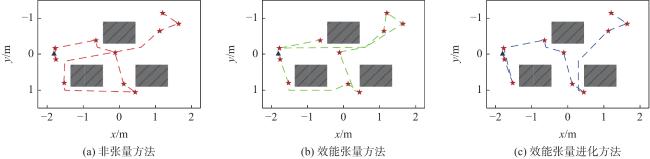
在Radau伪谱法轨迹生成的基础上进行航天器任务规划试验验证,任务规划的效能预测分别基于非张量方法、效能张量方法、效能张量进化方法,运用遗传算法进行任务规划方案生成。在非张量方法中,效能预测的目标到达时间基于起点到终点的Euclidean距离和平均运动速度计算而得;效能张量方法和效能张量进化方法中的状态预测和收益预测均为$2$ 阶,收益计算式(16)中的$R = 100$ ,$\alpha = 0.05$ ,效能张量进化方法的进化控制阈值$\xi = 0.1{\text{ m}}$ 。三种方法的航天器任务规划结果如图5 所示。
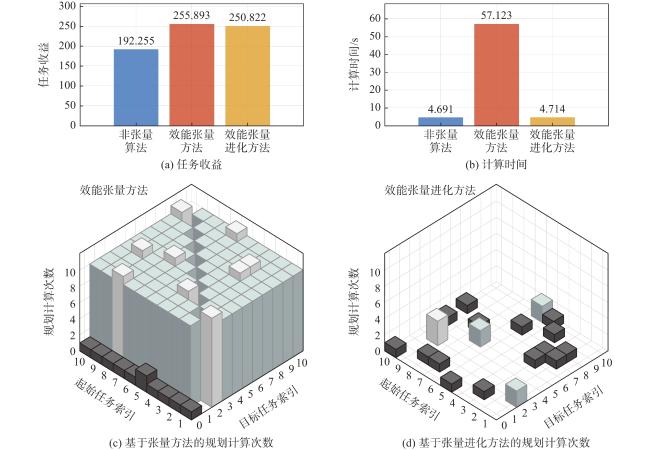
在航天器模拟器搭载的计算机上部署效能张量方法、效能张量进化方法、非张量方法,并分别采用这三种方法进行任务规划,生成的任务规划方案效能及计算量如图6 所示。由图6 (a)可以看出,在任务收益方面,效能张量方法(255.893)和效能张量进化方法(250.822)均显著优于非张量方法(192.255);由图6 (b)可以看出,在计算时间方面,效能张量方法(57.123 s)远慢于效能张量进化方法(4.714 s)和非张量方法(4.691 s)。这说明效能张量进化方法在维持了任务收益的前提下,通过迭代进化显著降低了运算时间,而与非张量算法的计算时间处于同一水平。图6 (c)~(d)给出了用于获取任务效能评价张量的轨迹验证次数,可以看出,张量方法通过类似于穷举的方式计算了效能评价张量的所有分量,总运算量为110次轨迹验证;而张量进化方法对于效能评价张量的各分量计算都进行了控制,有效降低了任务规划的计算量,总运算量仅为24次轨迹验证,运算量降低了78.18%。


4 结论
本文针对航天器的多任务执行规划,提出了基于任务效能评价张量进化的任务规划方法,利用张量形式来描述任务规划中任务点间转移与前序任务的耦合关系,精确地评价了不同任务规划方案下的转移轨迹代价和局部任务收益,从而有效地提高任务规划效能。提出的效能评价张量的迭代进化方法,极大缩减了任务规划的计算量。试验结果证明了效能张量进化方法在规划效能和运算量上的优势。在未来的工作中,将进一步研究面向复杂异构空间任务的航天器任务规划问题。