Space Science

Research Progress in the Detection and Investigation of Sulfates on the Martian Surface

  • Zongcheng LING 1, 2, 3 ,
  • Enming JU 1
Expand
  • 1. School of Space Science and Physics, Shandong University , Weihai 264209, China
  • 2. Institute of Space Sciences , Shandong University, Weihai 264209, China
  • 3. Shandong Provincial Key Laboratory of Optical Astronomy Solar-Terrestrial Environment, Weihai 264209, China

Online published: 2024-07-31

Copyright

Copyright © 2024 Journal of Space Science and Experiment. All rights reserved.

Abstract

As one of the solar terrestrial planets with environment most similar to Earth, Mars has been the major target planet for deep-space explorations as well as space immigrant. The history of Martian exploration is more than 60 years, and a total of 47 missions have explored Mars and made many important discoveries. Sulfates, as an important product of Martian aqueous alteration/water-rock interaction, can be studied to understand the evolutionary history of Martian water, reveal the climate change of Mars, and assess the possibility of biosignature preservation and the habitability of surface environment. In this paper, we review the exploration history of Martian sulfates, and discuss the importance of laboratory sulfate modeling studies, and the implications of sulfates for future resource utilizations on Mars. We hope our study would contribute to the future Mars explorations as well as the construction of Martian research station.

Cite this article

Zongcheng LING , Enming JU . Research Progress in the Detection and Investigation of Sulfates on the Martian Surface[J]. Journal of Space Science and Experiment, 2024 , 1(1) : 40 -53 . DOI: 10.19963/j.cnki.2097-4302.2024.01.005

0 引言

火星是人类自有文字记载的历史以来在科学上最受关注的天体之一。火星引起人们的兴趣是因为它是太阳系中环境最类似地球的行星,而且是未来人类最有可能移居的星球之一[1]。自20世纪60年代以来,人们对火星开展了大量的研究,对火星的基本情况和演化历史有了深入的认识。火星的地质历史大概分为前诺亚纪、诺亚纪、西方纪、亚马逊纪四个阶段。前诺亚纪时期可能形成了火星的二分性特征。诺亚纪时期主要由火山活动、水蚀变等过程主导,并在诺亚纪后期积累了大量的层状硅酸盐和硫酸盐等。西方纪时期的火星环境发生变化,各种地质活动也逐渐减弱。火星进入亚马逊时期开始变得寒冷干燥,演变为现在观测到的红色星球[2]。尽管火星当前地质活动并不活跃,但是火星极冠的周期性变化表明火星至今仍然存在着活跃的大气循环[3]。火星过去和现在巨大的气候条件差异为人们提供了解类地行星地质和气候演化过程的宝贵机会。通过研究火星的气候演变,可以了解过去火星的环境特征和宜居性,并推测地球未来可能发生的各种气候变化和地质过程。此外,火星也为人类开展深空探测、寻找地外生命、利用火星资源、建立火星基地提供了重要机遇。本文总结了火星的探测历程,回顾了火星地表硫酸盐的重大发现和主要的模拟实验研究,并展望了硫酸盐在未来火星资源利用中的潜在作用。

1 火星探测历程

美国和苏联自20世纪60年代起开始了以火星为目标的深空探测,至今已有60多年的历史。表1图1总结了到2024年的火星探测任务,共计47次探测,其中包括飞掠探测、轨道环绕探测、着陆器就位与巡视探测等。在20世纪60至70年代,火星探测主要以飞掠任务为主,获得了大量火星表面图像以及大气数据。1975年海盗(Viking) 1号和海盗(Viking)2号成功着陆火星并返回探测数据,发现火星表面物质富含铁、镁、钙、硫等元素[4],指示现在的火星可能不是一个宜居性的星球,之后火星探测进入了停滞期(1975—1988年)。1996年,McKay等在火星陨石ALH 84001中发现了疑似火星化石[5],重新点燃了探测火星生命的激情,推动火星探测进入高速发展阶段,使得人们对火星内部结构、表面物质成分、演化历史等有了更加深入的认识。目前共开展了21次探测任务,成功(包括部分成功)占比76%,相比于1996年前的26次探测的成功率(27%)有极大的提高,然而到目前为止火星探测总体的成功率仍不足一半。
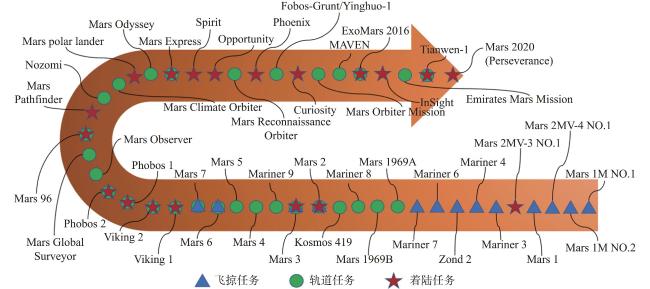
图 1 火星探测任务

Fig.1 Mars exploration missions

表 1 火星探测历程总结

Table 1 Summary of Mars exploration

探测任务名称 发射时间和国家 主要科学任务 备注
Mars 1M No.1/Marsnik 1 1960.10.10 苏联 调查地火行星际空间,返回火星表面影像等 Mars 1M No.2是Mars 1M No.1的备份星,均失败
Mars 1M No.2/Marsnik 2 1960.10.14 苏联
Mars 2MV-4 No.1/Sputnik 22 1962.10.24 苏联 携带了紫外光谱仪、辐射光谱仪以及宇宙射线探测器 在地球轨道破碎
Mars 1/ Sputnik 23 1962.11.1 苏联 拍摄火星表面照片,获取宇宙射线、火星大气等信息(空间站) 获得了行星际 数据,
途中通信中断
Mars 2MV-3 No.1/Sputnik 24 1962.11.4 苏联 首次火星着陆任务 滞留在地球轨道
Mariner 3 1964.11.5 美国 在火星附近开展探测,拍摄火星照片并传回地球 仪器未能打开
Mariner 4 1964.11.28 美国 在火星附近开展探测,并将数据传回地球 火星探测首次实际上的成功
Zond 2 1964.11.30 苏联 飞掠任务,探测甲烷等 途中通信中断
Mariner 6 1969.2.25 美国 探测火星表面与大气 成功
Mariner 7 1969.3.27 美国 探测火星表面与大气 成功
Mars 1969A/Mars M-69 No.521 1969.3.27 苏联 对火星表面进行成像,探测大气中的水蒸气等 发射失败
Mars 1969B/Mars M-69 No.522 1969.4.2 苏联 同上 发射失败
Mariner 8 1971.5.8 美国 前往环火星轨道并返回数据 发射失败
Kosmos 419 1971.5.10 苏联 开展遥感轨道探测 滞留在地球轨道
Mars 2 1971.5.19 苏联 对火星大气和地表开展探测 轨道器成功,着陆器坠毁
Mars 3 1971.5.28 苏联 对火星大气和地表开展探测 轨道器成功,软着陆成功
Mariner 9 1971.5.30 美国 对火星大气开展研究 首颗火星轨道探测器
Mars 4 1973.7.21 苏联 携带大量载荷,在环火星轨道开展研究 未按计划进入环火星轨道
Mars 5 1973.7.25 苏联 携带大量载荷,在环火星轨道开展研究 进入环火星轨道
Mars 6 1973.8.5 苏联 对火星大气和地表开展探测 着陆失败
Mars 7 1973.8.9 苏联 对火星大气和地表开展探测 着陆失败
Viking 1 1975.8.20 美国 寻找火星生命 成功
Viking 2 1975.9.9 美国 寻找火星生命 成功
Phobos 1 1988.7.7 苏联 探索地火行星际空间,在环火星轨道研究火星和火卫一,
接近火卫一并开展实验
通信中断
Phobos 2 1988.7.12 苏联 通信中断
Mars Observer 1992.9.25 美国 探索火星大气、表面、磁场和气候 通信中断
Mars Global Surveyor 1996.11.7 美国 对火星进行全球制图、研究大气 成功
Mars 96 1996.11.16 俄罗斯 研究火星大气、表面和内部的演化历史 发射失败
Mars Pathfinder 1996.12.4 美国 研究火星大气、土壤成分等 成功
Nozomi 1998.7.3 日本 研究火星上层大气并与太阳风的相互作用 未能到预定轨道
Mars Climate Orbiter 1998.12.11 美国 研究火星大气、气候和地表过程 切入错误轨道导致坠毁
Mars Polar Lander/
Deep Space 2
1999.1.3 美国 研究火星水冰、南极平原的土壤和气候等 撞击到火星表面
Mars Odyssey 2001.4.7 美国 研究火星环境的宜居性以及对未来宇航员潜在的危险等 成功
Mars Express 2003.6.2 欧洲空间局 对火星的内部、地下、表面和大气等开展研究 轨道器成功,着陆器失联
Spirit 2003.6.10 美国 研究火星曾经的水活动,了解火星的气候和地质特征等 成功
Opportunity 2003.7.8 美国 成功
Mars Reconnaissance Orbiter 2005.8.12 美国 研究火星大气环流,寻找火星上的水等 成功
Phoenix 2007.8.4 美国 研究火星水的地质历史,评估宜居性 成功
Fobos-Grunt/Yinghuo-1 2011.11.8 俄罗斯、中国 对火卫一土壤开展采样返回 失败
Curiosity 2011.11.26 美国 从生物、地质和地球化学、地质过程和地表辐射等
角度探究火星宜居性
成功
Mars Orbiter Mission 2013.11.5 印度 探测火星地表与大气 成功
MAVEN 2013.11.8 美国 研究火星大气特性 成功
ExoMars 2016 TGO 2016.3.14欧洲空间局 寻找过去火星可能存在对生命特征,研究表面环境等 部分成功
InSight 2018.5.5 美国 研究火星内部 成功
Emirates Mars Mission 2020.7.19 阿联酋 研究火星大气和气候 成功
Tianwen-1 2020.7.23 中国 研究火星地质结构、演化历史,表面物质组成,
大气、磁场等
成功
Perseverance 2020.7.30 美国 寻找早期火星适宜居住环境,微生物生命或生物特征 成功
当前,火星探测进入了黄金时代。火星探测轨道器和着陆器会搭载能谱仪和光谱仪载荷,从而可以在特定的波段,以遥感或原位方式探测火星表面元素(如铁、氢等)的丰度和矿物(例如主要成岩矿物、含水硫酸盐、水等)的含量与分布,进而研究火星表面的地质过程和地质演化历史。行星能谱仪和光谱仪作为太阳系行星物质成分探测中最重要的科学载荷,几乎在历次行星探测中均有应用,并已经带来了很多重大的科学发现。
21世纪以来,火星探测的科学目标已从探测火星空间环境、火星大气、火星表面环境发展到探测研究火星地质历史、表面矿物组分、次表层结构,再到当前的找寻火星生命痕迹、宜居环境等方面。火星表面的硫酸盐记录了过去和现在有关火星表面和次表层的重要环境信息。火星表面至今已经发现了大量硫酸盐,这意味着火星表面的硫循环(包括固体、液体、气体)在火星表面和次表层的演化过程中起着重要作用,这包括阳离子的迁移、水演化过程等[6]。本文将主要回顾火星硫酸盐的探测历程和研究进展,为我国后续火星探测任务(如天问三号)和火星科研站建设提供参考。

2 火星硫酸盐的轨道遥感与就位探测

1975年,海盗号(Viking)着陆器返回了火星表面物质的第一批元素分析数据,并通过分析这些数据发现火星土壤中含有大量的硫(约3.8 %),大约是地球地壳中硫含量的100倍,而且硫元素含量与镁等元素的含量呈正相关性[7-9]。这个发现被20年后的火星探路者号(Mars Pathfinder)上的APXS(Alpha Proton X-ray Spectrometer)实验所证实[10-11]。探路者号上的APXS具有比海盗号上的X射线荧光谱仪更高的灵敏度,而且APXS安装在一个移动平台之上,既可以分析岩石表面,也可以分析土壤。火星土壤与岩石相比具有更高的Fe和Mg含量,这预示火星土壤成分不是完全由原地岩石风化形成[12-14]。海盗号和探路者号都有安装多光谱成像仪[15-16],探测的结果证实了轨道和地基观测中三价铁的吸收带,证明了火星具有强氧化性的环境。
美国国家航空航天局(NASA)的火星奥德赛(Mars Odyssey)飞船通过其中子谱仪(Neutron Spectrometer)探测到火星赤道附近的两个区域的氢浓度很高。而这两个区域包含了火星车的两个着陆点:子午线平原(Meridiani Planum)和古瑟夫撞击坑(Gusev Crater)。由于水冰不可能稳定存在于当前火星赤道附近的环境中,这些氢被认为是矿物中结构水,但地下冰也不能被完全排除在外[17-19]。火星硫酸盐的轨道探测发现了硫酸钙和硫酸镁广泛分布于火星表面,其中包括欧洲航天局发射的火星快车(Mars Express)轨道飞行器。搭载在火星快车的OMEGA光谱仪通过识别近红外(NIR)波段的吸收峰发现了包括子午线平原区域在内的硫酸盐信号特征[20-21]。OMEGA的一些光谱被明确指认为水镁矾(Kieserite,MgSO4·H2O),石膏(Gypsum,CaSO4·2H2O)和烧石膏(Bassanite,CaSO4·0.5H2O)的典型吸收特征,如图2所示。其中最特别的是火星北极地区的石膏沙丘,这些富含石膏的沙丘与火星上其他地区的硫酸盐形成条件和时期均不相同,可能是晚亚马逊时期富含硫化物和高钙辉石的沙丘原位蚀变产生的石膏沉积[22]。而另外一些光谱被指认为多水硫酸盐(Polyhydrated sulfates)和混合阳离子的硫酸盐,其中泻利盐(Epsomite,MgSO4·7H2O)、叶绿矾[Copiapite,Fe2+Fe3+4(SO4)6(OH)2·20H2O]、毛晶[Halotrichite,Fe2+Al2(SO4)4·22H2O]等矿物的光谱比较匹配[23-24]。火星水手峡谷内部存在大量浅色沉积物(light-toned deposits)或内部层状沉积(Interior Layered Deposits)。近红外的数据研究表明这些沉积物主要是硫酸盐和铁氧化物的沉积[25]。大多数硫酸盐,特别是多水硫酸盐呈厚厚的层状分布,如阿拉姆混杂地(Aram Chaos)附近厚度达200~400 m,在盖尔撞击坑(Gale Crater)达2 km厚,在卡普里深谷(Capri Chasma)附近约400 m厚[26-30],这一现象在地球上并不常见。硫酸盐沉积层是火星表面的重要地质特征,记录着火星过去的气候变化、水文活动和地质事件,具有重要的科学价值。对这些硫酸盐沉积层开展系统研究,可以了解火星过去的水资源情况、气候变化和地球化学环境,推断火星的地质演化历史和环境条件,也为未来的火星资源利用和可能的生命探测奠定基础。
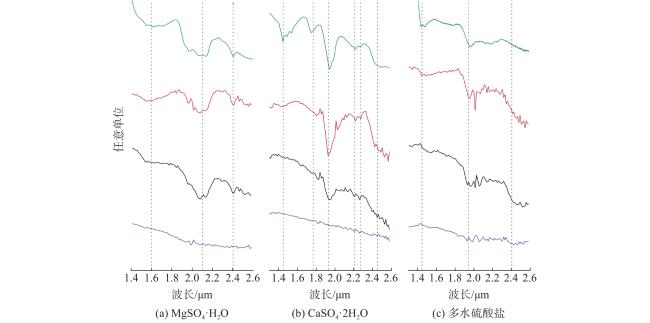
图 2 OMEGA识别到的硫酸盐光谱[23]

(a)MgSO4·H2O; (b)CaSO4·2H2O; (c)多水硫酸盐

Fig.2 The sulfate spectrum identified by OMEGA[23]

2004年1月,勇气号(Spirit)和机遇号(Opportunity)分别在火星古瑟夫撞击坑和富含赤铁矿的子午线平原地区着陆。勇气号在古瑟夫撞击坑附近的一些地区发现了钙和硫并且铁与硫的含量具有正相关性[31-32]。在后期的探测中勇气号发现特洛伊地区(Troy)和哥伦比亚山(Columbia Hills)地区的土壤次表层是由硫酸盐以及玄武质的砂岩组成,并且表层土壤为富含硫酸盐的壳,这表明次表层(地表下几厘米内)水的存在[33]。机遇号在子午线平原通过穆斯堡尔谱仪发现了黄钾铁矾的存在,表明火星曾经存在酸性流体环境[34],之后又在奋进号撞击坑(Endeavour Crater)发现了硫酸钙岩脉,这些岩脉可能是在撞击坑形成后流体多次循环沉淀形成[35]
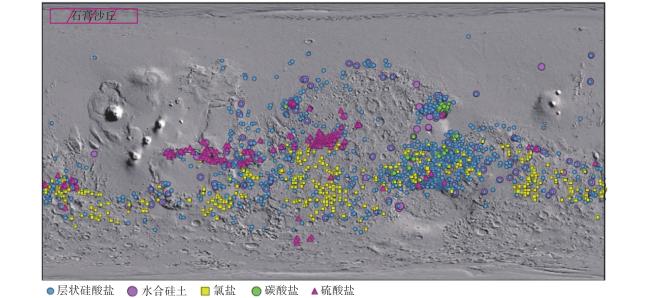
搭载在火星快车上的OMEGA光谱仪以及2005年8月发射的火星勘测轨道器(Mars Reconnaissance Orbiter,MRO)是迄今最成功的火星轨道遥感高光谱载荷。依据其返回的数据,人们对火星的黏土和含水硫酸盐等矿物的识别和分布开展了全球尺度的研究[36-38]。火星轨道遥感探测发现火星硫酸盐多分布在水手谷(Valles Marineris)、子午线平原以及一些地层露头,如图3所示。凤凰号(Phoenix)也在着陆区发现了硫元素的存在,硫信号可能来自于可溶性的硫酸盐,如硫酸钙、硫酸镁等[39]
图 3 火星次生矿物分布图[38]

Fig.3 Map of secondary minerals on Mars[38]

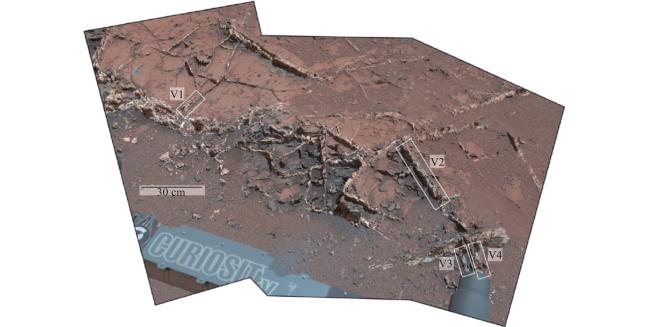
2012年8月6日,好奇号(Curiosity)于盖尔撞击坑(Gale Crater)成功着陆,从此翻开了火星探测的新篇章。好奇号携带了大量先进的科学载荷,致力于以寻找火星生命为主的科学探测。目前好奇号仍然在工作,并取得了丰富的科学成果。在盖尔撞击坑内好奇号观测到大量的次生矿物,包括层状硅酸盐、硫酸盐以及铁氧化物[40]。搭载在好奇号的CheMin分析了湖相沉积和风成沉积地层的钻取样品,当主要的次生矿物质量分数归一为100%时,硫酸盐的质量占比大概在10 %[40]。轨道遥感光谱探测表明,盖尔撞击坑内部的中央峰/夏普山(Mount Sharp)富含黏土和硫酸盐等次生矿物。在夏普山硫酸盐单元地区,Mg和SO3呈现出很好的相关性,并且结晶性的四水硫酸镁(MgSO4·4H2O)被首次在火星探测[41]。尽管硫酸镁在海盗号着陆区探测时就被推测可能存在[42],并且之后通过OMEGA遥感探测也观察到了一水硫酸镁的光谱特征[23],但是关于硫酸镁具体的含水相多为推测结果。此外,在盖尔撞击坑也发现了大量的硫酸钙岩脉,如图4所示,并且通过地层分析表明岩脉形成于当地沉积地层形成之后[43]。岩脉的主要成分为石膏或烧石膏,烧石膏的存在表明后期环境可能发生埋藏或撞击等作用,并指示火星可能存在过宜居环境[44]
图 4 好奇号桅杆相机观测到的硫酸钙岩脉[45]

Fig.4 A vein of calcium sulfate as seen by Curiosity's mast camera[45]

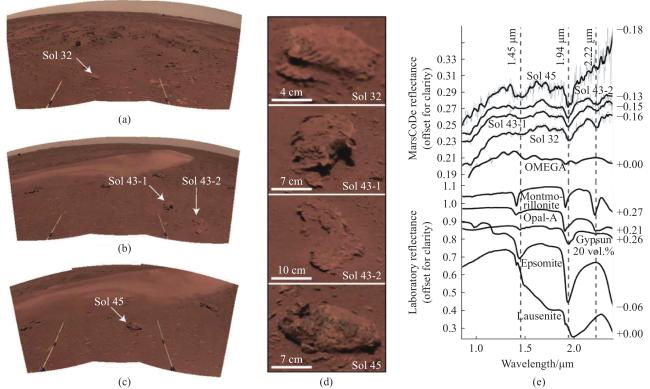
天问一号(Tianwen-1)是我国首次火星探测任务,一次性实现了火星“绕、落、巡”的探测目标。2021年5月15日,天问一号着陆于乌托邦平原南部并释放祝融号火星车,开展了火星地质结构、演化历史、表面物质组成等研究,并获得了诸多科学发现。搭载在祝融号上的MarSCoDe仪器利用激光诱导击穿光谱仪(Laser-Induced Breakdown Spectrometer, LIBS)和短波红外光谱仪(Short-Wave Infrared Spectrometer, SWIR)技术对着陆区的表面物质组成开展了相关探测。研究表明,着陆区多为火成矿物并且没有经历强烈的化学蚀变过程[46-47],但仍然存在一定的水活动以及水活动产生的次生矿物(水铝英石、蛋白石和硫酸盐),如图5所示[46, 48-50]
图 5 祝融号在着陆区识别到的含水矿物的光谱[48]

Fig.5 Spectra of hydrous minerals identified by Zhurong in the landing zone[48]

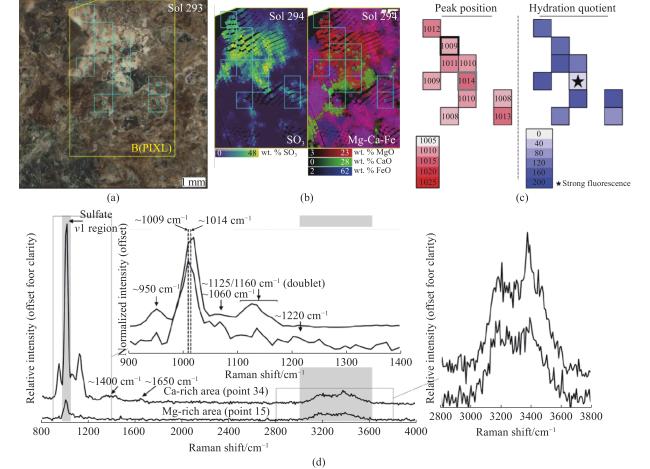
毅力号(Perseverance)作为美国火星取样返回任务的重要环节,于2021年2月18日着陆于杰泽罗撞击坑(Jezero Crater),对火星表面的地质过程开展研究,评估过去火星的宜居环境和生命存在的可能性,并采取、保存一系列样品为后续样品返回任务做准备[51]。值得一提的是,毅力号携带了两台拉曼光谱仪(SHERLOC,SuperCam),可以精细探测有机物和矿物学信息。杰泽罗撞击坑中硫酸镁和硬石膏的发现揭示了富含硫酸盐的流体蚀变事件的存在,如图6所示[52],并且硫酸盐既有沉积特征也有成岩特征[53]。丰富的次生矿物特别是硫酸盐的存在为保存潜在生物特征和古环境条件记录提供了可能。
图 6 SHERLOC探测到的硫酸盐光谱[52]

Fig.6 The spectrum of sulfate detected by SHERLOC[52]

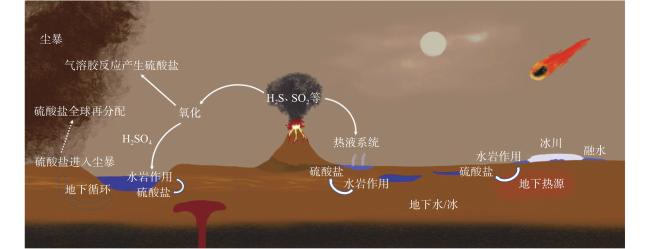
与硫循环有关的含硫矿物在火星演化和水文历史中起着重要作用。火星过去可能存在大量的地表水,这些水经历了蒸发沉积过程,产生了包括硫酸盐等的含水矿物的沉积层。研究表明,大量的硫可能来自火山喷发形成的H2S或SO2,这些气体被火星大气氧化形成SO32-,HSO4-,或H2SO4降落到火星表面[54-56]。在火星温暖潮湿的时期,这些气相溶解于水形成酸性水溶液。这些酸性溶液可能与火成岩反应被中和,释放Mg,Ca、Fe、Al等阳离子。此外,硫元素还可能来源于富硫的矿物或者硫化物以及陨石中[57-58]
随着火星液态水的丢失,低水岩比和低pH值的蚀变过程在火星表面发生,而在子午线平原地区观察到的黄钾铁矾很可能来自类似的蚀变作用,并经过了后期的氧化。在高度蚀变情况下,即使硫在火成岩矿物中少量存在也可以被氧化并释放到溶液中。一些低温、中性pH值的水蚀变可能发生在冰/雪融化产生的液态水并与火成岩相互作用的环境中,如图7所示。富硫的水溶液也可能来自水热蚀变,这些溶液蒸发,进入地下或被地表水带走,最终沉积产生了硫酸盐等次生矿物[59- 60]。中性pH值以及适宜温度的液体环境是火星生命物质产生和保存的重要条件,生命痕迹的寻找与探测也应聚焦于类似的水热环境。
图 7 火星硫酸盐形成以及迁移过程

Fig.7 Sulfate formation and migration on Mars

尘暴过程是亚马逊纪火星活跃的地质过程之一。火星表面的细粒土壤具有均质性和全球分布性,并且富含硫、氯等元素[61]。尘暴作用下,一些火星表面暴露的次生矿物在全球尺度进行了重新分配,同时尘暴过程中的放电作用也对硫酸盐等物质的结晶性和含水状态产生了显著影响[62]

3 火星含水硫酸盐的模拟实验研究

对火星科学问题可以从行星尺度(火星轨道器)、就位研究(着陆器、火星车)、样品研究、火星地面模拟场野外考察、模拟实验以及数值模拟等多角度回答。由于目前没有返回样品,火星陨石仍是当前火星演化历史研究的主要实验样品依据。经过60多年的探测,火星探测数据也可以为我们研究火星地质演化提供全球性关键信息。火星环境较地球环境有很大的区别,火星大气稀薄且以CO2为主,昼夜温差大,通过模拟实验可以为火星的研究提供坚实的数据支撑,进而从模拟实验角度认识火星的演化历史。
相关模拟实验研究从开展火星探测任务之后开始。海盗号最初的探测结果指示了硫酸盐和氯盐的存在,卤水在火星上的稳定性研究也随之开展。实验结果表明,含硫酸盐和氯盐的卤水可以在火星表面存在[63- 64]。火星表面多为火成岩矿物,因此玄武岩的风化速率、硫酸盐的来源等问题也能通过实验手段进行评估和约束[60, 65]
火星玄武岩的酸性蚀变研究表明火星表面次生矿物的丰富性[66-67],并且低pH值的酸性蚀变中发现了黄钾铁矾,从实验角度支持了子午线平原地区发生过的酸性流体蚀变事件。火星过去和现在的大气环境有所不同,早期的火星由于活跃的火山活动释放出大量的SO2、HCl、CO2等气体导致酸性环境,玄武岩蚀变产生的阳离子相对丰度与火星后期产生的蚀变结果不同,从而可以指示次生矿物生成时的火星环境[68]。溶液的pH值不仅影响玄武岩和富硫矿物的蚀变速率,还对硫酸盐的形成(特别是Fe-硫酸盐)有重要影响。例如,黄钾铁矾的形成需要溶液具有酸性条件(pH值 < 4.5),而施威特曼石则需要一个偏中性的环境[69- 70]。pH值对硫酸盐的影响程度不亚于温度与离子浓度,这一观点在不同pH值和离子浓度的实验中得以验证[71-72]。硫酸盐的形成过程中,环境的氧化性对Fe2+和硫的价态影响较大,容易将FeSO4和H2S氧化为Fe2(SO4)3和H2SO4[73-74]
将从SNC陨石的模拟物与水混合后在模拟火星大气的环境下进行反应,得到的卤水中的离子种类与海盗号观察的结果类似,表明火星风化层中的次生矿物可能是玄武岩与地下或地表水长时间作用的结果[75]。黏土与卤水接触时会有离子交换效应,硫酸盐在这种情况下也很容易形成[76]。含有不同离子(Ca2+、K+、Fe3+、Mg2+、SO42-、Cl-等)的液态卤水能够更加稳定地存在于火星表面,通过对火星初始溶液体系的模拟研究可以预测盐类的沉淀顺序[77]。而卤水蒸发沉淀的产物不仅受到离子种类、浓度的影响,还会受到温度的影响。实验表明,火成岩的酸性蚀变过程会产生Ca-、Mg-、Al-硫酸盐以及无定形硅[59-60],但高温蚀变过程没有明确观察到黄钾铁矾的存在,这可能是由于温度或者溶液中离子浓度的影响导致[78]
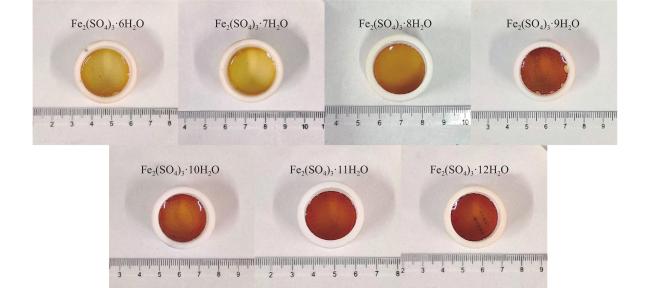
如上节所述,大量的硫酸盐已通过轨道遥感(OMEGA/Mars Express,CRISM/MRO)和火星表面就位探测(Viking、Mars Pathfinder、Curiosity、Zhurong、Perseverance)在火星上被发现。在古瑟夫撞击坑地区的哥伦比亚山附近,含盐土壤被“勇气号”的车轮挖掘出来[32]。Pancam光谱分析表明次表层土壤主要含有高铁叶绿矾(Ferricopiapite)、水化黄钾铁矾(Hydronium Jarosite)、纤铁矾(Fibroferrite)、板铁矿(Rhomboclase)和副针绿矾(Paracoquimbite)等矿物[79]。虽然遥感光谱以及就位元素分析等手段可以约束硫酸盐的种类,但是对于硫酸盐具体的含水相、稳定性研究仍需实验支撑。勇气号火星车Pancam的观测数据发现,在Tyrone附近的次表层几十厘米厚的土壤中,存在着短暂的光谱学变化,这种变化可能来自于火星含水硫酸铁的失水过程[80],从而说明火星表面和次表层的环境(温度、相对湿度)存在一定的差异。不同含水相的硫酸盐在土壤次表层和表面可能会有一定的不同,这取决于硫酸盐的稳定性以及火星表面的环境条件。而实验室对于硫酸铁、硫酸镁以及硫酸钙在模拟火星环境下的稳定性研究为火星就位数据的解译提供了参考[6, 81-84]。实验研究表明,硫酸镁与硫酸钙存在一定的联系,但硫酸钙结构中的水分子比硫酸镁中的水分子更稳定[82]。硫酸铁的结晶性受环境影响较大,容易形成不同含水相的无定形硫酸铁。如图8所示[85]。硫酸盐稳定性相图的建立能够用于预测和解释火星上硫酸盐的变化[6, 86-87],因此硫酸盐可以作为火星环境变化的指示矿物[88-89]
图 8 不同含水相的无定形硫酸铁[85]

Fig.8 Amorphous ferric sulfate of different aqueous phases[85]

在奋进号撞击坑和盖尔撞击坑以及杰泽罗撞击坑均发现了硫酸钙岩脉,盖尔撞击坑的岩石裂隙可能是埋藏造成的[90],并且经过后期多次富含硫酸盐的流体事件在裂隙中形成了硫酸钙岩脉[91]。尽管岩脉的组成通过化学元素分析识别为不同含水相的硫酸钙[43-44],但流体的来源、离子种类浓度和pH值等有待进一步约束。对湖相沉积地层中硫酸钙岩脉的探测揭示了在其他离子(Fe、Mg、Sr等)的存在[92],表明硫酸钙岩脉中可能存在其他种类的硫酸盐。实验研究发现,这些硫酸盐可能不仅仅为单一阳离子硫酸盐,硫酸钙复盐或混合阳离子硫酸盐可能会以微量的形式存在于硫酸钙岩脉[93-94]。当前只有黄钾铁矾作为混合阳离子硫酸盐在火星被明确探测到,其他混合阳离子硫酸盐尚无直接的证据支持它们的存在,但玄武岩酸性蚀变实验揭示了包括Na-Al硫酸盐复盐在内的多种次生矿物[59, 66]。这无疑从模拟实验角度有力地支持了混合阳离子硫酸盐的存在,尽管可能因为它们在土壤中含量较少等没有被直接探测到。无定形硫酸盐的光谱特征会发生变化[85],影响遥感和就位探测对该类硫酸盐的有效识别。此外,环境的快速变化以及尘暴过程都会导致无定形硫酸盐的形成[62, 95],这增加了对硫酸盐识别的难度。拉曼光谱技术能够较好地识别硫酸盐的存在,搭载在毅力号的SHERLOC和SuperCam仪器为混合阳离子硫酸盐的识别提供了契机[93]
火星不同含水硫酸盐的形成和很多因素有关(水溶液化学、温度、酸碱度、氧化还原电位、相对湿度等),通过模拟实验获得硫酸盐在火星环境下的稳定场以及相变速率等信息将有助于认识火星的环境变化。关于火星硫酸盐仍有很多未解之谜,特别是详细的矿物成分、水合状态、矿物组合,以及它们的原始起源、在火星表面条件下的稳定机制等。在火星高轨道倾角期间或当前火星中等轨道倾斜角的冬季或晨间等条件下,火星水蒸气容易在矿物颗粒间凝结造就高湿度的环境[80],这可能为亚稳态盐类的存在提供了条件,因此研究含水硫酸盐的相变路径和中间相也非常重要。利用实验室研究硫酸盐的基本性质,包括稳定场、相变路径、反应速率等对于更好地解译来自火星探测的观测结果,加深对于火星演化的认识都具有重要意义。

4 硫酸盐对火星资源利用的启示

火星的资源利用旨在支撑人类参与的探测任务,包括原位获取氧气、水、燃料,以及建筑材料的生产和农作物的培育,是未来火星科研站建设和火星移民的必要前提工作。含水硫酸盐作为火星重要的次生矿物,其价值不仅是火星演化的指示矿物,也是火星水资源的重要储库。通过对硫酸盐的研究可以了解硫酸盐对当今火星上水(冰)的库存量的贡献和硫酸盐在火星水文历史中所扮演的角色等,对于评估火星资源种类和价值也有重要意义。
OMEGA发现火星表层土壤中存在少量的吸附水,光谱主要表现在:(1)3μm吸收带在每一条光谱中都存在;(2)3µm吸收带的强度与火星相关区域的反照率成正比[96]。此外,OMEGA与CRISM探测表明,在浅层表面具有质量分数大于10%的水含量来自于含水硫酸盐[97]。好奇号在Gale Crater对样品加热分析发现大概会有质量分数约2 %的水会释放出来[98]。此外水的其他来源还包括地下水冰、大气中的水等。但地下的水冰以及大气中的水的获取难度较大,其存在形式受到了纬度分布、含量等因素的影响。搭载在奥德赛上的伽马中子谱仪(Gamma Ray Spectrometer)探测表明,火星的水冰主要分布于极区[99],而未来的火星基地建设可能主要在低纬度地区,因此硫酸盐等含水矿物中的水是未来火星水资源利用的重要对象。含水硫酸盐的脱水温度较低且分布较为广泛[38, 100],部分硫酸盐(如无水CaSO4和MgSO4)具有强吸水性[81, 101],可以捕捉火星大气中的水甚至获取地下的水冰。
未来的火星农业发展是支撑火星载人探测乃至火星移民的重要环节。Na、K、S、Ca、Mg、Fe、P等元素是植物生长的必需元素[102-103],而以硫酸钾为代表的硫酸盐作为无机肥可以为植物的生长提供这些必要元素,改善土壤环境。因此含水硫酸盐是未来火星资源利用中的重要对象之一,值得深入开展相关研究。

5 结语

火星探测经历了60多年的发展,已经取得了丰富的研究成果。火星上的含水硫酸盐是火星地质演化的重要地质标记,火星硫酸盐的研究可以提供火星水的演化历史,揭示火星的气候变化,寻找火星上适宜生命存在的条件或遗迹等。本文回顾了火星硫酸盐的探测和实验室研究历史与进展,并探讨了硫酸盐对于火星资源利用的研究意义。目前人类还未实现火星取样返回,火星真实样品的研究仅限于火星陨石的研究。而通过研究地球上的各种硫酸盐矿物,并结合实验室模拟实验的结果能够深化对火星科学问题的认识,支撑火星就位数据的解译。通过火星遥感、就位以及实验室样品等多角度的研究,可以极大地推进对火星演化历史的认识。硫酸盐在获取火星水资源、火星农产品培育等未来火星资源利用方面也具有关键意义。
1
MELOSH H J. Planetary surface processes [M]. London:Cambridge University Press,2011.

2
CARR M H, HEAD J W. Geologic history of Mars[J]. Earth and Planetary Science Letters, 2010, 294 (3/4): 185- 203.

3
BROWN A J, CALVIN W M, BECERRA P, et al. Martian north polar cap summer water cycle[J]. Icarus, 2016, 277, 401- 15.

DOI

4
BAIRD A, TOULMIN III P, CLARK B C, et al. Mineralogic and petrologic implications of Viking geochemical results from Mars: Interim report[J]. Science, 1976, 194 (4271): 1288- 1293.

DOI

5
MCKAY D S, GIBSON JR E K, THOMAS-KEPRTA K L, et al. Search for past life on Mars: possible relic biogenic activity in Martian meteorite ALH84001[J]. Science, 1996, 273 (5277): 924- 930.

DOI

6
WANG A, LING Z, FREEMAN J J, et al. Stability field and phase transition pathways of hydrous ferric sulfates in the temperature range 50℃ to 5℃: Implication for martian ferric sulfates[J]. Icarus, 2012, 218 (1): 622- 643.

DOI

7
CLARK B C, BAIRD A K, WELDON R J, et al. Chemical composition of Martian fines[J]. Journal of Geophysical Research: Solid Earth, 1982, 87 (B12): 10059- 10067.

DOI

8
TOULMIN III P, BAIRD A, CLARK B, et al. Geochemical and mineralogical interpretation of the Viking inorganic chemical results[J]. Journal of Geophysical Research, 1977, 82 (28): 4625- 4634.

DOI

9
CLARK III B C, BAIRD A, ROSE JR H J, et al. The Viking X ray fluorescence experiment: Analytical methods and early results[J]. Journal of Geophysical Research, 1977, 82 (28): 4577- 4594.

DOI

10
GOLOMBEK M, COOK R, ECONOMOU T, et al. Overview of the Mars Pathfinder mission and assessment of landing site predictions[J]. Science, 1997, 278 (5344): 1743- 1748.

DOI

11
RIEDER R, WÄNKE H, ECONOMOU T, et al. Determination of the chemical composition of Martian soil and rocks: The alpha proton X ray spectrometer[J]. Journal of Geophysical Research: Planets, 1997, 102 (E2): 4027- 4044.

DOI

12
BISHOP J L, MURCHIE S L, PIETERS C M, et al. A model for formation of dust, soil, and rock coatings on Mars: Physical and chemical processes on the Martian surface[J]. Journal of Geophysical Research: Planets, 2002, 107 (E11): 7- 1-7-17.

13
BRÜCKNER J,DREIBUS G,RIEDER R,et al. Refined data of Alpha Proton X-ray Spectrometer analyses of soils and rocks at the Mars Pathfinder site:Implications for surface chemistry[J/OL]. Journal of Geophysical Research:Planets,2003,108(E12)[2024-02-15]. https://doi.org/10.1029/2003JE002060.

14
FOLEY C N,ECONOMOU T,CLAYTON R N. Final chemical results from the Mars Pathfinder alpha proton X-ray spectrometer [J]. Journal of Geophysical Research:Planets,2003,108(E12): E007019.

15
SMITH P, BELL III J, BRIDGES N, et al. Results from the Mars Pathfinder camera[J]. Science, 1997, 278 (5344): 1758- 1765.

DOI

16
HUCK F O, JOBSON D J, PARK S K, et al. Spectrophotometric and color estimates of the Viking lander sites[J]. Journal of Geophysical Research, 1977, 82 (28): 4401- 4411.

DOI

17
BOYNTON W, FELDMAN W, SQUYRES S, et al. Distribution of hydrogen in the near surface of Mars: Evidence for subsurface ice deposits[J]. Science, 2002, 297 (5578): 81- 85.

DOI

18
FELDMAN W,PRETTYMAN T,MAURICE S,et al. Global distribution of near-surface hydrogen on Mars [J]. Journal of Geophysical Research:Planets,2004,109(E9): E002160.

19
FELDMAN W, PRETTYMAN T, MAURICE S, et al. Topographic control of hydrogen deposits at low latitudes to midlatitudes of Mars [J/OL]. Journal of Geophysical Research: Planets,2005,110(E11)[2024-02-15]. https://doi.org/10.1029/2005JE002452.

20
BIBRING J-P, LANGEVIN Y, GENDRIN A, et al. Mars surface diversity as revealed by the OMEGA/Mars Express observations[J]. Science, 2005, 307 (5715): 1576- 1581.

DOI

21
ARVIDSON R E, POULET F, BIBRING J-P, et al. Spectral reflectance and morphologic correlations in eastern Terra Meridiani, Mars[J]. Science, 2005, 307 (5715): 1591- 1594.

DOI

22
FISHBAUGH K E,POULET F,CHEVRIER V,et al. On the origin of gypsum in the Mars north polar region [J]. Journal of Geophysical Research:Planets,2007,112(E7): E002862.

23
GENDRIN A, MANGOLD N, BIBRING J P, et al. Sulfates in Martian layered terrains: the OMEGA/Mars Express view[J]. Science, 2005, 307 (5715): 1587- 1591.

DOI

24
LANE M D. Spectroscopic evidence for hydrous iron sulfate in the Martian soil [J/OL]. Geophysical Research Letters, 2004,31(19)[2024-02-15].https://doi.org/10.1029/2004GL021231.

25
CHOJNACKI M, HYNEK B M. Geological context of wateraltered minerals in Valles Marineris, Mars [J/OL]. Journal of Geophysical Research:Planets,2007,113(E12)[2024-02-15]. https://doi.org/10.1029/2007JE003070.

26
LICHTENBERG K A, ARVIDSON R E, MORRIS R V, et al. Stratigraphy of hydrated sulfates in the sedimentary deposits of Aram Chaos,Mars [J/OL]. Journal of Geophysical Research,2010,115[2024-02-15]. https://doi.org/10.1029/2009JE003353.

27
MILLIKEN R,FISCHER W,HUROWITZ J. Missing salts on early Mars [J]. Geophysical Research Letters,2009,36(11): L11202-L11206.

28
ROACH L,MUSTARD J,MURCHIE S,et al. Testing evidence of recent hydration state change in sulfates on Mars [J]. Journal of Geophysical Research:Planets,2009,114(E2): E00D02-E00D15.

29
ROACH L H, MUSTARD J F, SWAYZE G, et al. Hydrated mineral stratigraphy of ius chasma, valles marineris[J]. Icarus, 2010, 206 (1): 253- 268.

DOI

30
ROACH L H, MUSTARD J F, LANE M D, et al. Diagenetic haematite and sulfate assemblages in Valles Marineris[J]. Icarus, 2010, 207 (2): 659- 674.

DOI

31
HASKIN L A, WANG A, JOLLIFF B L, et al. Water alteration of rocks and soils on Mars at the Spirit rover site in Gusev crater[J]. Nature, 2005, 436 (7047): 66- 69.

DOI

32
WANG A, HASKIN L A, SQUYRES S W, et al. Sulfate deposition in subsurface regolith in Gusev crater, Mars[J]. Journal of Geophysical Research: Planets, 2006, 111 (E2): n/a- n/a.

33
ARVIDSON R E,BELL III J F,BELLUTTA P,et al. Spirit Mars Rover Mission:Overview and selected results from the northern Home Plate Winter Haven to the side of Scamander crater [J]. Journal of Geophysical Research:Planets,2010,115(E7): E00F03-E00F021.

34
KLINGELHOFER G, MORRIS R V, BERNHARDT B, et al. Jarosite and hematite at Meridiani Planum from Opportunity's Mossbauer spectrometer[J]. Science, 2004, 306 (5702): 1740- 1745.

DOI

35
ARVIDSON R E, SQUYRES S W, BELL J F, et al. Ancient aqueous environments at Endeavour crater, Mars[J]. Science, 2014, 343 (6169): 1248097.

DOI

36
CARTER J, POULET F, BIBRING J P, et al. Hydrous minerals on Mars as seen by the CRISM and OMEGA imaging spectrometers: Updated global view[J]. Journal of Geophysical Research: Planets, 2013, 118 (4): 831- 858.

37
CARTER J, PINEAU M, MANGOLD N, et al. Late stage aqueous alteration in the Northern plains of Mars: Hydrated silica is the key[J]. LPI Contributions, 2023, 2806, 1961.

38
EHLMANN B L, EDWARDS C S. Mineralogy of the martian surface[J]. Annual Review of Earth and Planetary Sciences, 2014, 42 (1): 291- 315.

DOI

39
KOUNAVES S P,HECHT M H,KAPIT J,et al. Soluble sulfate in the martian soil at the Phoenix landing site [J]. Geophysical Research Letters,2010,37(9): L09201-L09205.

40
SHEPPARD R Y,THORPE M T,FRAEMAN A A,et al. Merging perspectives on secondary minerals on Mars:A review of ancient water-rock interactions in Gale Crater inferred from orbital and in-situ observations [J]. Minerals,2021,11(9): 986.

41
CHIPERA S J,VANIMAN D T,RAMPE E B,et al. Mineralogical investigation of mg-sulfate at the canaima drill site,Gale Crater,Mars [J]. Journal of Geophysical Research:Planets,2023,128(11): E008041.

42
CLARK B C, BAIRD A, ROSE JR H J, et al. Inorganic analyses of Martian surface samples at the Viking landing sites[J]. Science, 1976, 194 (4271): 1283- 1288.

DOI

43
NACHON M, CLEGG S M, MANGOLD N, et al. Calcium sulfate veins characterized by ChemCam/Curiosity at Gale crater, Mars[J]. Journal of Geophysical Research: Planets, 2014, 119 (9): 1991- 2016.

44
RAPIN W, MESLIN P Y, MAURICE S, et al. Hydration state of calcium sulfates in Gale crater, Mars: Identification of bassanite veins[J]. Earth and Planetary Science Letters, 2016, 452, 197- 205.

DOI

45
KRONYAK R E, KAH L C, EDGETT K S, et al. Mineral-filled fractures as indicators of multigenerational fluid flow in the pahrump hills member of the murray formation, Gale Crater, Mars[J]. Earth and Space Science, 2019, 6 (2): 238- 265.

DOI

46
LIU C Q,LING Z C,WU Z C,et al. Aqueous alteration of the Vastitas Borealis Formation at the Tianwen-1 landing site [J]. Communications Earth & Environment,2022,3(1): 280.

47
ZHAO Y Y S, YU J, WEI G, et al. In situ analysis of surface composition and meteorology at the Zhurong landing site on Mars[J]. National Science Review, 2023, 10 (6): nwad056.

DOI

48
LIU Y, WU X, ZHAO Y S, et al. Zhurong reveals recent aqueous activities in Utopia Planitia, Mars[J]. Sci Adv, 2022, 8 (19): eabn8555.

DOI

49
QIN X, REN X, WANG X, et al. Modern water at low latitudes on Mars: Potential evidence from dune surfaces[J]. Sci Adv, 2023, 9 (17): eadd8868.

DOI

50
JU E, LIU C, CHEN J, et al. Detection of allophane by the Zhurong rover indicates water-limited alteration at Utopia Planitia, Mars[J]. Earth and Planetary Science Letters, 2024, 639, 118769.

DOI

51
FARLEY K A, WILLIFORD K H, STACK K M, et al. Mars 2020 mission overview[J]. Space Science Reviews, 2020, 216, 1- 41.

DOI

52
SILJESTRÖM S, CZAJA A D, CORPOLONGO A, et al. Evidence of sulfate-rich fluid alteration in jezero crater floor, Mars[J]. Journal of Geophysical Research: Planets, 2024, 129 (1): e2023JE007989.

53
BENISON K C, GILL K K, SHARMA S, et al. Depositional and diagenetic sulfates of Hogwallow Flats and Yori Pass, Jezero crater: Evaluating preservation potential of environmental indicators and possible biosignatures from past Martian surface waters and groundwaters[J]. Journal of Geophysical Research: Planets, 2024, 129 (2): e2023JE008155.

54
FRANZ H B, MCADAM A C, MING D W, et al. Large sulfur isotope fractionations in Martian sediments at Gale crater[J]. Nature Geoscience, 2017, 10 (9): 658- 662.

DOI

55
GÓBI S, KERESZTURI Á. Analyzing the role of interfacial water on sulfate formation on present Mars[J]. Icarus, 2019, 322, 135- 143.

DOI

56
MARION G, KARGEL J, CROWLEY J, et al. Sulfite-sulfide-sulfate-carbonate equilibria with applications to Mars[J]. Icarus, 2013, 225 (1): 342- 351.

DOI

57
KING P L, MCLENNAN S M. Sulfur on Mars[J]. Elements, 2010, 6 (2): 107- 112.

DOI

58
MITRA K,CATALANO J G,BAHL Y,et al. Iron sulfide weathering by oxyhalogen species:Implications for iron sulfate and (oxyhydr)oxides formation on Mars [J]. Earth and Planetary Science Letters,2023,624: 118464.

59
TOSCA N J,MCLENNAN S M,LINDSLEY D H,et al. Acid‐sulfate weathering of synthetic Martian basalt:The acid fog model revisited [J]. Journal of Geophysical Research:Planets,2004,109(E5): E05003-E05032.

60
GOLDEN D,MING D W,MORRIS R V,et al. Laboratory‐simulated acid-sulfate weathering of basaltic materials:Implications for formation of sulfates at Meridiani Planum and Gusev crater,Mars [J]. Journal of Geophysical Research:Planets,2005,110(E12).

61
BERGER J A, SCHMIDT M E, GELLERT R, et al. A global Mars dust composition refined by the Alpha‐Particle X‐ray Spectrometer in Gale Crater[J]. Geophysical Research Letters, 2016, 43 (1): 67- 75.

DOI

62
WANG A, YAN Y, DYAR D M, et al. Amorphization of S, Cl-Salts Induced by Martian Dust Activities[J]. Journal of Geophysical Research: Planets, 2020, 125 (12): e2020JE006701.

63
BRASS G W. Stability of brines on Mars[J]. Icarus, 1980, 42 (1): 20- 28.

DOI

64
ALTHEIDE T, CHEVRIER V, NICHOLSON C, et al. Experimental investigation of the stability and evaporation of sulfate and chloride brines on Mars[J]. Earth and Planetary Science Letters, 2009, 282 (1/2/3/4): 69- 78.

65
BURNS R G, FISHER D S. Rates of oxidative weathering on the surface of Mars[J]. Journal of Geophysical Research: Planets, 1993, 98 (E2): 3365- 3372.

DOI

66
MCCOLLOM T M, ROBBINS M, MOSKOWITZ B, et al. Experimental study of acid-sulfate alteration of basalt and implications for sulfate deposits on Mars[J]. Journal of Geophysical Research: Planets, 2013, 118 (4): 577- 614.

67
HUROWITZ J A,MCLENNAN S M,TOSCA N J,et al. In situ and experimental evidence for acidic weathering of rocks and soils on Mars [J/OL]. Journal of Geophysical Research: Planets, 2006,111(E2)[2024-02-15]. https://doi.org/10.1029/2005JE002515.

68
MOORE J M,BULLOCK M A,NEWSOM H,et al. Laboratory simulations of Mars evaporite geochemistry[J/OL]. Journal of Geophysical Research:Planets,2010,115(E6)[2024-02-15]. https://doi.org/10.1029/2008JE003208.

69
KING P, MCSWEEN JR H. Effects of H2O, pH, and oxidation state on the stability of Fe minerals on Mars [J/OL]. Journal of Geophysical Research:Planets,2005,110(E12)[2024-02-15]. https://doi.org/10.1029/2005JE002482.

70
PAIKARAY S. Environmental stability of schwertmannite: a review[J]. Mine Water and the Environment, 2021, 40 (3): 570- 586.

DOI

71
FUKUSHI K, SEKINE Y, RAMPE E B. Reconstruction of pH, redox condition, and concentrations of major components in ancient liquid water from the Karasburg member, Murray formation, Gale Crater, Mars[J]. Geochimica et Cosmochimica Acta, 2022, 325, 129- 151.

DOI

72
TOSCA N J, MCLENNAN S M. Experimental constraints on the evaporation of partially oxidized acid-sulfate waters at the martian surface[J]. Geochimica et Cosmochimica Acta, 2009, 73 (4): 1205- 1222.

DOI

73
DEHOUCK E, CHEVRIER V, GAUDIN A, et al. Evaluating the role of sulfide-weathering in the formation of sulfates or carbonates on Mars[J]. Geochimica et Cosmochimica Acta, 2012, 90, 47- 63.

DOI

74
GAILLARD F, MICHALSKI J, BERGER G, et al. Geochemical reservoirs and timing of sulfur cycling on Mars[J]. Space Science Reviews, 2013, 174, 251- 300.

DOI

75
BULLOCK M A, MOORE J M, MELLON M T. Laboratory simulations of Mars aqueous geochemistry[J]. Icarus, 2004, 170 (2): 404- 423.

DOI

76
GEYER C, MADDEN A S E, RODRIGUEZ A, et al. The Role of Sulfate in Cation Exchange Reactions: Applications to Clay–Brine Interactions on Mars[J]. The Planetary Science Journal, 2023, 4 (3): 48.

DOI

77
KING P, LESCINSKY D, NESBITT H. The composition and evolution of primordial solutions on Mars, with application to other planetary bodies[J]. Geochimica et Cosmochimica Acta, 2004, 68 (23): 4993- 5008.

DOI

78
MARCUCCI E C, HYNEK B M. Laboratory simulations of acid-sulfate weathering under volcanic hydrothermal conditions: Implications for early Mars[J]. Journal of Geophysical Research: Planets, 2014, 119 (3): 679- 703.

79
JOHNSON J, BELL III J F, CLOUTIS E, et al. Mineralogic constraints on sulfur‐rich soils from Pancam spectra at Gusev crater,Mars [J/OL]. Geophysical Research Letters,2007,34(13)[2024-02-15]. https://doi.org/10.1029/2007GL029894.

80
WANG A, LING Z. Ferric sulfates on Mars: A combined mission data analysis of salty soils at Gusev crater and laboratory experimental investigations [J/OL]. Journal of Geophysical Research:Planets,2011,116(E7)[2024-02-15]. https://doi.org/10.1029/2010JE003665.

81
CHIPERA S J, VANIMAN D T. Experimental stability of magnesium sulfate hydrates that may be present on Mars[J]. Geochimica et Cosmochimica Acta, 2007, 71 (1): 241- 250.

DOI

82
BOBOCIOIU E, CARACAS R. Stability and spectroscopy of Mg sulfate minerals: Role of hydration on sulfur isotope partitioning[J]. American Mineralogist, 2014, 99 (7): 1216- 1220.

DOI

83
SHI E B,WANG A,LI H F,et al. Gamma-CaSO4 With Abnormally High Stability From a Hyperarid Region on Earth and From Mars [J]. J Geophys Res-Planet,2022,127(3): E007108.

84
VANIMAN D T, CHIPERA S J. Transformations of Mg- and Ca-sulfate hydrates in Mars regolith[J]. American Mineralogist, 2006, 91 (10): 1628- 1642.

DOI

85
MENG F, SHI E, LIU C, et al. Quantification of H2O in amorphous and crystalline ferric sulfates relevant to Mars[J]. Journal of Geophysical Research: Planets, 2024, 129 (4): e2023JE008091.

86
CHOU I M, SEAL R R, WANG A. The stability of sulfate and hydrated sulfate minerals near ambient conditions and their significance in environmental and planetary sciences[J]. Journal of Asian Earth Sciences, 2013, 62, 734- 758.

DOI

87
TANG Y, GAO J, LIU C, et al. Dehydration Pathways of Gypsum and the Rehydration Mechanism of Soluble Anhydrite γ-CaSO4[J]. ACS Omega, 2019, 4 (4): 7636- 7642.

DOI

88
ROBERTSON K, BISH D. Constraints on the distribution of CaSO4·nH2O phases on Mars and implications for their contribution to the hydrological cycle[J]. Icarus, 2013, 223 (1): 407- 417.

DOI

89
VANIMAN D T, BISH D L, MING D W, et al. Mineralogy of a mudstone at Yellowknife Bay, Gale Crater, Mars.[J]. Science, 2014, 343 (6169): 1243480.

DOI

90
CASWELL T E, MILLIKEN R E. Evidence for hydraulic fracturing at Gale crater, Mars: Implications for burial depth of the Yellowknife Bay formation[J]. Earth and Planetary Science Letters, 2017, 468, 72- 84.

DOI

91
KRONYAK R E, KAH L C, MIKLUSICAK N B, et al. Extensive polygonal fracture network in siccar point group Strata: fracture mechanisms and implications for fluid circulation in Gale Crater, Mars[J]. J Geophys Res-Planet, 2019, 124 (10): 2613- 2634.

DOI

92
L'HARIDON J, MANGOLD N, MESLIN P Y, et al. Chemical variability in mineralized veins observed by ChemCam on the lower slopes of Mount Sharp in Gale crater, Mars[J]. Icarus, 2018, 311, 69- 86.

DOI

93
JU E,SHI E,XIN Y,et al. Laboratory synthesis,spectroscopic characteristics,and conversion relationships of five calcium sulfate double salts relevant to Mars [J]. Icarus,2023,401: 115610.

94
GARCIA-FLORENTINO C, GOMEZ-NUBLA L, HUIDOBRO J, et al. Interrelationships in the Gypsum-syngenite-gorgeyite system and their possible formation on Mars[J]. Astrobiology, 2021, 21 (3): 332- 344.

DOI

95
DAVID G,DEHOUCK E,MESLIN P Y,et al. Evidence for Amorphous sulfates as the main carrier of soil hydration in Gale Crater,Mars [J]. Geophysical Research Letters,2022,49(21)e2022GL098755.

96
JOUGLET D,POULET F,MILLIKEN R,et al. Hydration state of the Martian surface as seen by Mars Express OMEGA: 1. Analysis of the 3 μm hydration feature [J/OL]. Journal of Geophysical Research:Planets,2007,112(E8)[2024-02-15]. https://doi.org/10.1029/2006JE002846.

97
JAMANCA-LINO G, GUEVARA C G. Water production from hydrated sulfates on mars: A Geological and technical assessment[J]. International Multidisciplinary Scientific GeoConference: SGEM, 2023, 23 (6.1): 447- 455.

98
VANIMAN D T,BISH D L,MING D W,et al. Mineralogy of a Mudstone at Yellowknife Bay,Gale Crater,Mars [J]. Science,2014,343(6169): 1243480-1-1243480-3.

99
CHRISTENSEN P R. Water at the poles and in permafrost regions of Mars[J]. Elements, 2006, 2 (3): 151- 155.

DOI

100
STARR S O, MUSCATELLO A C. Mars in situ resource utilization: A review[J]. Planetary and Space Science, 2020, 182, 104824.

DOI

101
LING Z, WANG A. Spatial distributions of secondary minerals in the Martian meteorite MIL 03346, 168 determined by Raman spectroscopic imaging[J]. Journal of Geophysical Research: Planets, 2015, 120 (6): 1141- 1159.

102
EPSTEIN E,BLOOM A J. Mineral nutrition of plants:Principles and perspectives [M]. Sunderland: Sinauer Associates,1853.

103
HOAGLAND D R,ARNON D I. The water-culture method for growing plants without soil [J]. 2nd ed Circular California Agricultural Experiment Station,1950,347: 1-32.

Outlines

/