Space Science

Space-Based Star Map Registration Algorithm Guided by Velocity Prior

  • Kunpeng WANG , 1 ,
  • Han WANG 2 ,
  • Tongsu ZHANG 2 ,
  • Zhihua SHEN 2 ,
  • Xiaohu ZHANG 2 ,
  • Xia YANG 2
Expand
  • 1. Beijing Institute of Tracking and Telecommunications Technology, Beijing 100094, China
  • 2. School of Aeronautics and Astronautics, Sun Yat-sen University, Shenzhen 518107, China

Online published: 2026-07-22

Abstract

When conducting space debris observation using optical payloads such as hosted payloads, the movement and attitude adjustments of the satellite platform cause inter-frame motion in the image sequence, directly affecting the accuracy of star map matching. Star image registration technology is an effective means to achieve image alignment and eliminate motion offset. Traditional astronomical image registration typically adopts a point- by-point matching strategy between point sets, but this blind point-to-point matching tends to generate redundant calculations and mismatches. Based on the space-based observation imaging model, this paper theoretically demonstrates the uniformity of star point motion in images and proposes a novel registration method guided by velocity fields—transforming the traditional single-point matching process into a globally optimized point set matching method. By fitting sample star points to the theoretical imaging model to determine their velocity field, the full image velocity field is then solved; this velocity field can roughly estimate the rigid transformation model of the image, thereby accelerating the star point matching process; the dual velocity field provides an effective motion prior, avoiding blind matching issues and significantly improving registration success rate and accuracy. Experiments on space-based images show that this method achieves a matching accuracy of 98.70% and a reprojection error below 0.09 pixels, confirming its potential application in the field of space debris observation.

Cite this article

Kunpeng WANG , Han WANG , Tongsu ZHANG , Zhihua SHEN , Xiaohu ZHANG , Xia YANG . Space-Based Star Map Registration Algorithm Guided by Velocity Prior[J]. Journal of Space Science and Experiment, 2026 , 3(3) : 52 -60 . DOI: 10.19963/j.cnki.2097-4302.2026.03.004

0 引 言

空间碎片观测是太空环境治理的数据基础和决策依据,天基观测平台具有不受大气影响、可持续全球覆盖等特点,在空间碎片观测领域受到广泛关注[1-3],尤其是搭载、寄宿等观测方式,进一步拓展了天基空间碎片观测的能力[4]。但在观测任务中,平台移动导致的平移旋转等背景变化会干扰特定目标的观测[5-6]。图像配准技术通过对齐两幅天文图像的背景与星点,为该问题提供了有效解决方案。
星图配准主要分为三类:基于特征描述符的算法、基于空间分布关系的算法以及基于神经网络的算法。其中,基于特征描述符的算法(如SURF[7]、ORB[8])通过提取并匹配关键点描述符实现配准,但该过程需要梯度信息与局部周边特征共同计算精确结果。由于恒星灰度值呈现各向同性衰减模式,而变化的局部区域尺寸会导致方向不一致,这些因素在复杂天文场景中常引发估计误差。因此,部分研究尝试设计更契合天文图像的特征描述符:Sun等[9]提出了一种仅依赖径向模特征和旋转角特征的星图匹配算法;周海洋等[10]提出了包含星点尺寸和三角几何特征的改进SURF描述符;Chen等[11]引入了一种半解析傅里叶-梅林方法来估算配准参数;Han等[12]认为相邻星图中相同星组成的星角距离的平移和旋转方式相同,因此通过聚类的方式求解刚性变换参数。相比之下,基于空间分布关系的算法利用星点间相对稳定的拓扑关系实现配准:Beroiz等[13]通过选择恒星与四颗邻近稳定星构建三角网,并采用改进RANSAC方法从大量三角对中筛选正确匹配;Yang等[14]引入Delaunay三角剖分减少构建数量,提升匹配效率与精度;Schuckman等[15]采用Moffat轮廓建模星点,选取最亮10颗星构建120个三角形初步估计变换参数;Lin等[16]提出分块配准法提升效率,并构建匹配置信矩阵降低误匹配;Wang等[17]针对拖尾效应提出三阶段配准方法,显著改善退化图像配准效果。然而,上述方法需要构建特征三角形,三角形的匹配往往依赖于内角、边长等信息,该过程不可避免地引入了大量误匹配的点对,在增加计算成本的同时降低了配准的成功率。基于神经网络的算法(如SuperGlue[18]、LoFTR[19]、SuperFusion[20]、DualPRNet[21]、Cyclemorph[22])则使用完全不同的算法逻辑,凭借神经网络强大的特征提取能力搜索、匹配特征点,相比传统方法能有效学习局部-全局特征,对亮度、尺度和视角变化更具鲁棒性,但其部署受高计算需求限制,难以适用于高分辨率天文图像和天基光学平台。
基于空间分布关系的方法利用星点间几何稳定性,提供了相对有效的解决方案,应用最为广泛。但由于需要将两组点对的所有点进行配对,导致计算冗余度较高且误匹配概率增大。针对上述盲目匹配问题,本文通过挖掘单帧图像的信息来引导盲匹配的方向,提出了一种新的配准范式,主要贡献包括:
(1)结合天基观测成像特性与运动模型,从理论上验证了不同位置星点在图像中具有差异化速度,且短时内图像变化具有均匀性,该结论为构建速度场奠定了理论基础。
(2)区别于存在盲目匹配问题的传统方法,设计了星点速度场(Star Velocity Field,SVF)与图像速度场(Image Velocity Field,IVF)双重引导机制,实现有向最优匹配。
(3)通过真实星图序列实验验证了方法的性能与效率,展现了在天基空间监测中的应用潜力。

1 理论恒星运动模型

由于地球半径远小于天球半径,可以近似认为J2000坐标系(O-xyz)与相机坐标系(O-uvw)的原点重合。参考图1,采用Z-X-Z旋转顺序,并将旋转角设置为φβγ,可以得到J2000坐标系转换为相机坐标系的旋转变换矩阵。旋转角的计算方法如下:
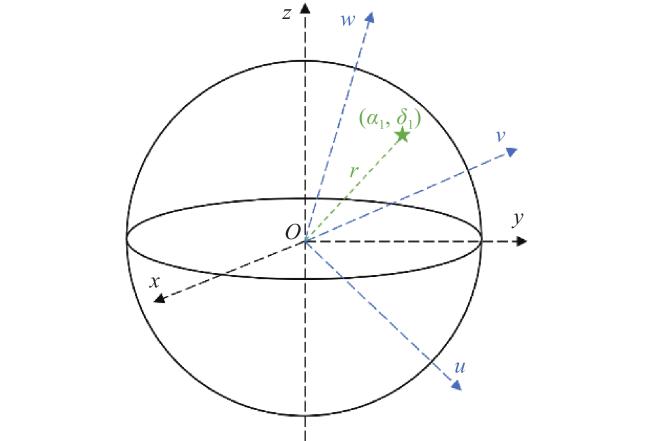
图 1 J2000 坐标系与相机坐标系转换关系

Fig.1 The transformation between J2000 and camera coordinate system

$ \varphi ={\alpha }_{0}-\dfrac{{\text π} }{2},\;\beta ={\delta }_{0}-\dfrac{{\text π} }{2},\;\gamma =0 $
式中,α0δ0分别为相机光轴的赤经和赤纬,γ与平台的姿态及传感器的安装角度有关,并假设为常量。对于距离地心为r的恒星,其在J2000坐标系中的坐标(Xw,Yw,Zw)为:
$ \left[\begin{array}{c}{X}_{w}\\{Y}_{w}\\{Z}_{w}\end{array}\right]=\left[\begin{array}{c}r\cos {\delta }_{1}\cos {\alpha }_{1}\\r\cos {\delta }_{1}\sin {\alpha }_{1}\\r\sin {\delta }_{1}\end{array}\right] $
式中,α1为恒星的赤经,δ1为恒星的赤纬。因此,恒星(Xc,Yc,Zc)在相机坐标系中的坐标为:
$ \left[\begin{array}{c}{X}_{c}\\{Y}_{c}\\{Z}_{c}\end{array}\right]=\left[\begin{array}{c}r\cos {\delta }_{1}\sin ({\alpha }_{0}-{\alpha }_{1})\\r(\cos {\delta }_{1}\sin {\delta }_{0}\cos ({\alpha }_{1}-{\alpha }_{0})-\sin {\delta }_{1}\cos {\delta }_{0}\\r(\cos {\delta }_{1}\cos {\delta }_{0}\cos ({\alpha }_{1}-{\alpha }_{0})+\sin {\delta }_{1}\sin {\delta }_{0}\end{array}\right] $
根据相机成像原理,恒星在像平面中的坐标计算如下:
$ \left[\begin{array}{c}x\\y\end{array}\right]=-\dfrac{f}{{Z}_{c}}\left[\begin{array}{c}{X}_{c}\\{Y}_{c}\end{array}\right] $
式中,f是相机的焦距。式(3)对时间进行求导,可得:
由于视场的限制,令α1α0=ηδ1δ0=ζ,通过泰勒展开,可得:
$ \tag{7}\begin{cases} \cos ({\delta }_{1}-{\delta }_{0})\approx 1-\dfrac{{\zeta }^{2}}{2},\;\sin ({\delta }_{1}-{\delta }_{0})\approx \zeta \\\cos ({\alpha }_{1}-{\alpha }_{0})\approx 1-\dfrac{{\eta }^{2}}{2},\;\sin ({\alpha }_{1}-{\alpha }_{0})\approx \eta \end{cases} $
联立式(5)~(7),可得:
$ \tag{8}\left\{\begin{aligned}\dot{x}&=f\cos {\delta }_{1}\dfrac{-{\dot{\alpha }}_{0}(1-\dfrac{{\zeta }^{2}}{2}+\dfrac{{\eta }^{2}}{2}(\cos {\delta }_{1}\cos {\delta }_{0}-1))-{\dot{\delta }}_{0}\eta \zeta }{1-{\zeta }^{2}-{\eta }^{2}\cos {\delta }_{1}\cos {\delta }_{0}}\\\dot{y}& = f\dfrac{ - {\dot{\alpha }}_{0}\cos {\delta }_{1}(\eta \zeta \cos {\delta }_{0} + \eta \sin {\delta }_{0}) - {\dot{\delta }}_{0}(1 - {\eta }^{2}\cos {\delta }_{1}\cos {\delta }_{0})}{1 - {\zeta }^{2}-{\eta }^{2}\cos {\delta }_{1}\cos {\delta }_{0}}\end{aligned} \right.$
式中, $ \dot{x} $$ \dot{y} $表示恒星在图像上的速度,$\dot{\alpha }_{0} $$\dot{\delta }_0 $是相机平台的角速度。对式(8)进行求导,忽略二阶及以上的高阶小量后,得到恒星在图像上的加速度表达式为:
$ \tag{9}\left\{\begin{aligned}\ddot{x}&=f\cos {\delta }_{1}{\dot{\delta }}_{0}({\dot{\alpha }}_{0}\zeta +{\dot{\delta }}_{0}\eta )\\\ddot{y}&=f\cos {\delta }_{1}\dot{\alpha }_{0}^{2}\sin ({\delta }_{0}+\vartheta ),\;\vartheta =\arctan \zeta \end{aligned}\right. $
式中,$ \ddot{x} $$ \ddot{y} $表示恒星在图像上的加速度。
$\tag{5} \begin{split} \dot{x}=&f\cos {\delta }_{1}\dfrac{\dfrac{{\mathrm{d}}{\alpha }_{0}}{{\mathrm{d}}t}\cos ({\alpha }_{1}-{\alpha }_{0})}{\cos {\delta }_{1}\mathrm{cos}{\delta }_{0}\mathrm{cos}({\alpha }_{1}-{\alpha }_{0})+\sin {\delta }_{1}\mathrm{sin}{\delta }_{0}}-\\&f\cos {\delta }_{1}\dfrac{\sin ({\alpha }_{1}-{\alpha }_{0})}{{(\cos {{\delta }_{1}}\cos {{\delta }_{0}}\cos ({{\alpha }_{1}}-{{\alpha }_{0}})+\sin {{\delta }_{1}}\sin {{\delta }_{0}})}^{2}}\cdot \\&\left\{\cos {\delta }_{1}\left[-\dfrac{{\mathrm{d}}{\delta }_{0}}{{\mathrm{d}}t}\sin {\delta }_{0}\cos ({\alpha }_{1}-{\alpha }_{0})+\dfrac{{\mathrm{d}}{\alpha }_{0}}{{\mathrm{d}}t}\cos {\delta }_{0} \sin ({\alpha }_{1}-{\alpha }_{0})\right]+\dfrac{{\mathrm{d}}{\delta }_{0}}{{\mathrm{d}}t}\sin {\delta }_{1}\mathrm{cos}\delta _{0}\right\}\end{split} $
$ \tag{6}\begin{split}\dot{y}=&f\dfrac{-\sin {\delta }_{1}\sin {\delta }_{0}\dfrac{{\mathrm{d}}{\delta }_{0}}{{\mathrm{d}}t}-\cos {\delta }_{1}\left[\cos {\delta }_{0}\cos ({\alpha }_{1}-{\alpha }_{0})\dfrac{{\mathrm{d}}{\delta }_{0}}{{\mathrm{d}}t}+\sin {\delta }_{0}\sin ({\alpha }_{1}-{\alpha }_{0})\dfrac{{\mathrm{d}}{\alpha }_{0}}{{\mathrm{d}}t}\right]}{\cos {\delta }_{1}\cos {\delta }_{0}\cos ({\alpha }_{1}-{\alpha }_{0})+\sin {\delta }_{1}\sin {\delta }_{0}}-\\&f\dfrac{\sin {\delta }_{1}\cos {\delta }_{0}-\cos {\delta }_{1}\sin {\delta }_{0}\cos ({\alpha }_{1}-{\alpha }_{0})}{{\left(\cos {\delta }_{1}\cos {\delta }_{0}\cos ({\alpha }_{1}-{\alpha }_{0})+\sin {\delta }_{1}\sin {\delta }_{0}\right)}^{2}}\cdot \\&\left\{\cos {\delta }_{1}\left[-\dfrac{{\mathrm{d}}{\delta }_{0}}{{\mathrm{d}}t}\sin {\delta }_{0}\cos ({\alpha }_{1}-{\alpha }_{0})+\dfrac{{\mathrm{d}}{\alpha }_{0}}{{\mathrm{d}}t}\cos {\delta }_{0}\sin ({\alpha }_{1}-{\alpha }_{0})\right]+\dfrac{{\mathrm{d}}{\delta }_{0}}{{\mathrm{d}}t}\sin {\delta }_{1}\cos {\delta }_{0}\right\}\end{split} $
根据上述推导可知,图像中不同位置恒星的速度各不相同,这表明图像的变换模型不能简单地用平移向量来描述。通过仿真在不同视场角和焦距下的加速度,图2显示,在短时间内恒星的速度变化很小。这同时也说明,短时间内图像的背景呈现出均匀变化的趋势。
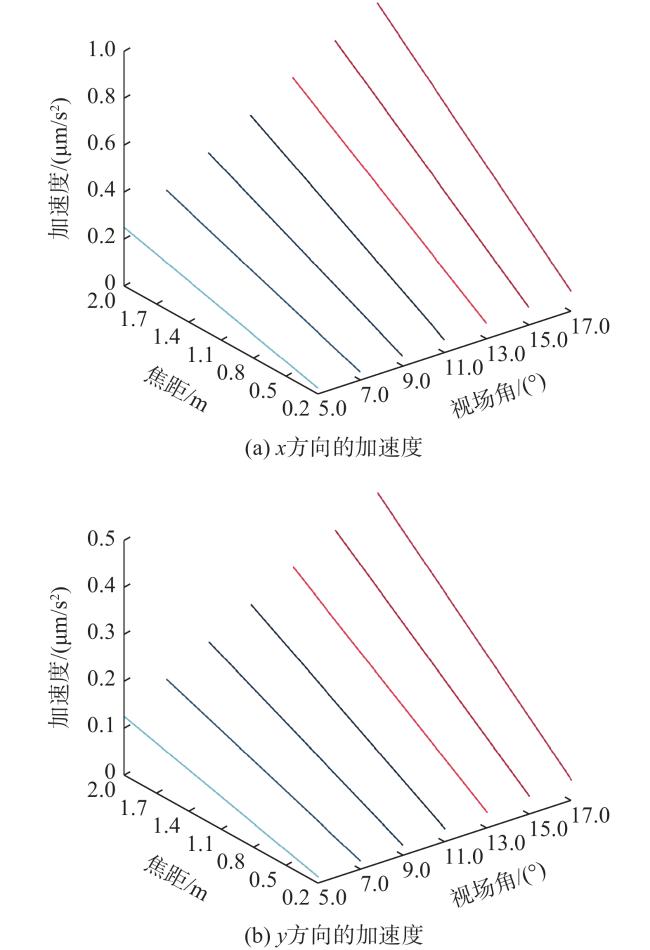
图 2 恒星在图像上的加速度范围

Fig.2 The acceleration range of stars in the images

2 基于速度场的星图配准方法

星图的帧间变换模型可以由线性和非线性分量组成,由于非线性分量的影响较小,仅需关注线性部分即可。在大部分探测场景中,旋转角度和平移向量的贡献尤为显著。且第1节对恒星运动特性的分析结果表明,短时间内图像背景的运动是均匀变化的。因此,可以从单帧图像中估计曝光时间内图像的旋转角速度和平移速度,从而为两帧之间的旋转角度和平移向量提供粗略的估计,进一步可以引导星点进行更准确、更快速的匹配。为了从单帧图像中估计出图像的旋转角速度和平移速度,引入了恒星速度场和图像速度场的概念。前者表示图像中恒星的速度,而后者则包括图像自身的平移速度和旋转速度。通过利用图像各个位置的SVF,可以估计出整个图像的IVF。

2.1 稳定星提取

由于图像配准算法无需用到所有的星点用于同名点配对,仅需提取图像中最显著的部分星点即可。参考文献[22-23]中的统计学分割方法,通过计算图像的全局均值μ和标准差(Standard Deviation,std),利用统计阈值th=μ+5×std可快速分割原图得到二值图像;随后,通过对前景连通域面积进行排序,获取面积最大即最显著的300个连通域作为待定的稳定星区域。为确保配准精度,通过加权灰度质心法对这些稳定星进行精准定位,来获取亚像素定位结果。该提取过程在待配准图像和目标图像上均实现一次后继续下述流程。

2.2 恒星速度场估计

为了根据恒星在曝光时间内的成像准确估计其速度,需要对恒星的分布进行建模。理想情况下,恒星的光斑强度近似为二维高斯分布;受曝光时间内运动模糊的影响,星点成像近似为不同纵横比的条带状[9]。通过计算不同星点的形态学分布参数,可以近似估计出曝光时间内星点在图像坐标系下的运动速度和方向。参考文献[22,24]中的形态学计算方法,采用图像二阶矩求解每个稳定星的主轴长度和方向、次轴长度[25],并基于该参数估计星点在图像坐标系下X、Y的速度:
$ \begin{cases} d=a-b\\{v}_{x}=d\mathrm{cos}\theta \\{v}_{y}=-d\sin \theta \end{cases} $
式中,abθ分别为星点的主轴长度、次轴长度和主轴方向与X轴夹角。
为了准确估计图像背景的平移速度和角速度,将原图划分为等宽等高的5×5个子图,并在每个子图中选择最显著的四颗样本星进行SVF估计,并获得可视化结果如图3所示。结果显示,恒星背景在平移中伴随着逆时针方向的旋转,而实际的稳定星位置变化图也印证了估计结果的正确性。
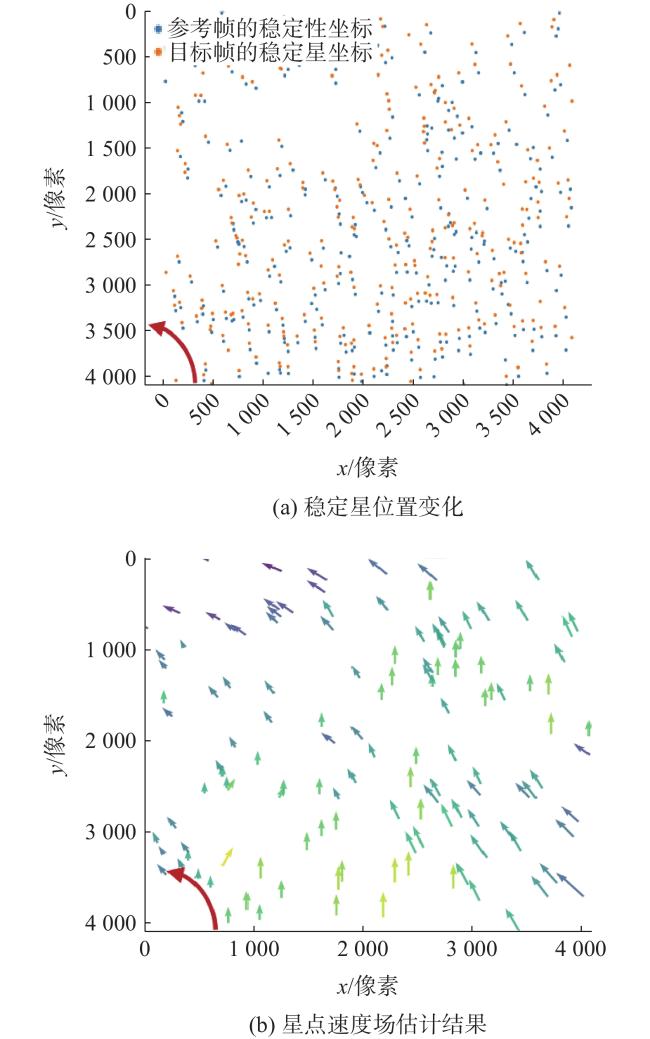
图 3 星点速度场估计可视化结果

Fig.3 Visualization of estimated velocity field for stars

2.3 图像速度场估计

由于图像背景的变换可以粗略近似为平面的刚性变换,可推导出SVF与IVF之间的关系为:
$ \begin{cases} {v}_{x}={v}_{ox}+\omega y\\{v}_{y}={v}_{oy}-\omega x\end{cases} $
式中,voxvoy为图像原点的速度,(11)为图像的角速度。为了减小样本星SVF异常值的影响,采用四分位距方法来过滤SVF中的异常值,只保留25%~75%内的计算结果。整个计算过程步骤如下:
(1)对N个样本星的速度构建残差项:
$ \begin{cases} r_{x}^{(i)}=v_{x}^{(i)}-({v}_{ox}+\omega {y}^{(i)}),\\r_{y}^{(i)}=v_{y}^{(i)}-({v}_{oy}+\omega {x}^{(i)}) ,\end{cases} i=1,\cdot \cdot \cdot ,N $
(2)最小化残差平方和:
$ \underset{\theta }{\min }\sum \limits_{i=1}^{N}[{({r_{x}^{(i)}})}^{2}+{({r_{y}^{(i)}})}^{2}],\;\theta =\left[\begin{array}{l}{v}_{ox}\\{v}_{oy}\end{array}\right] $
(3)计算雅可比矩阵,残差对参数的偏导矩阵为:
$ \boldsymbol{J}=\left[\begin{array}{c}\dfrac{\partial {r}^{(1)}}{\partial {\theta }^{{\mathrm{T}}}}\\\vdots \\\dfrac{\partial {r}^{(N)}}{\partial {\theta }^{{\mathrm{T}}}}\end{array}\right]={\left[\begin{matrix}1 & 0 & {y}^{(1)}\\0 & 1 & -{x}^{(1)}\\\vdots & \vdots & \vdots \\1 & 0 & {y}^{(N)}\\0 & 1 & -{x}^{(N)}\end{matrix}\right]}_{2N\times 3} $
(4)采用高斯-牛顿法迭代求解:
$ \begin{cases} \Delta \theta ={({{\boldsymbol{J}}^{\text{T}}}\boldsymbol{J})}^{-1}{\boldsymbol{J}}^{\text{T}}\boldsymbol{r}\\{\theta }_{k+1}={\theta }_{k}+\alpha \Delta \theta ,\;\alpha \in (0,1]\end{cases} $

2.4 恒星匹配

在求解出IVF后,假定λ表示帧间时间与曝光时间的比值,则可以对图像在帧间间隔的平移量tx=λvoxty=λvoy和图像绕原点的旋转角度β=λ$ \omega $进行粗略估计。鉴于图像变换近似为刚性变换,主要表现为平移和旋转,则可以通过使用变换矩阵T预测稳定星在参考图像中的大概位置:
$ \left[\begin{array}{c}{x}_{p}\\{y}_{p}\\1\end{array}\right]=\left[\begin{matrix}\cos \beta & -\sin \beta & {t}_{x}\\\sin \beta & \cos \beta & {t}_{y}\\0 & 0 & 1\end{matrix}\right]\left[\begin{array}{c}{x}_{c}\\{y}_{c}\\1\end{array}\right] $
式中,(xc,yc)、(xp,yp)分别为稳定星及其在参考图中的预测位置。随后,所有稳定星都会被精确引导到其在参考图像中的预测位置,以便进行邻近的同名点匹配。图4展示了稳定星预测位置与真实位置对比的可视化结果,在背景发生平移和旋转的情况下,本文方法使稳定星的预测位置与真实位置较为接近,解决了后续同名点的盲匹配问题。
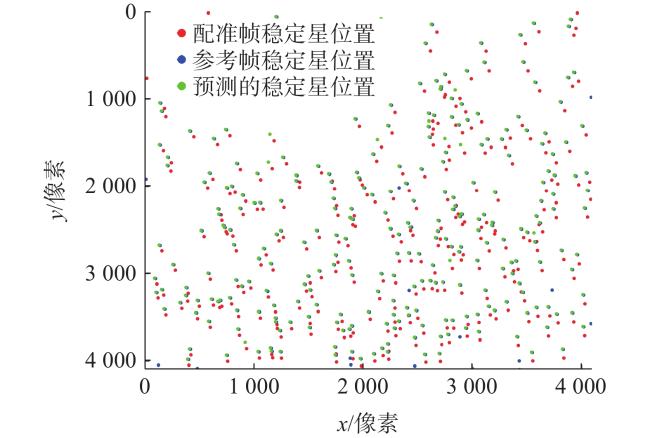
图 4 稳定星预测位置与真实位置对比的可视化结果

Fig.4 Visualization comparing predicted positions of stable stars with their true positions

为了对预测位置的精度进行量化评估,对不同位移的恒星在不同时间比λ下的预测误差进行分析,结果如图5所示。本文通过仿真对预测位置的精度进行量化评估。结果表明,当λ越低或d越小时,预测精度越高;当预测位置误差在可控水平内,都能为后续点对的匹配提供有效的引导。
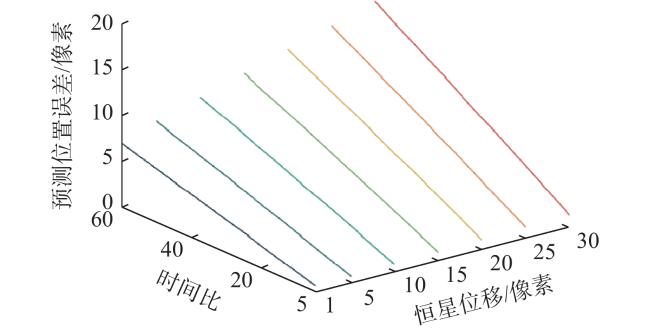
图 5 稳定星位置预测误差范围

Fig.5 The errors of position predictions of stable stars

综上所述,通过计算每对相邻稳定星的匹配置信度来找到匹配点对。该指标的计算过程如下:
$ {\sigma }_{i,j}=1-\left| 1-\dfrac{{v}_{i}}{{v}_{j}}\right| \cdot \text{NCC}({D}_{i},{D}_{j}) $
式中,v表示对应星点的强度和,NCC表示归一化互相关系数,D表示对应星点对应的连通域。Tσ的默认值为0.7,选择匹配置信度高于Tσ的点对作为同名点对P,最后采用投票机制来确定图像正确的运动方向。

2.5 基于迭代优化的单应矩阵求解

由于P中可能存在错误匹配的点对,会导致对应矩阵H的计算误差较大。为减小这些错误匹配带来的误差,采用两阶段的迭代方法来进一步优化单应矩阵。迭代优化流程如下:
(1)使用初始点对P,通过最小二乘法计算初始旋转矩阵R0、平移向量T0
(2)基于R0T0进行投影计算,对每个点计算投影误差εi
(3)如果平均误差高于误差阈值,则去除投影误差最大的5%的点对并重新计算;反之则终止迭代,输出优化后的单应矩阵。

3 试验及结果

3.1 试验数据及指标

对于图像配准任务,天基和地基观测数据的最显著差异在于帧间的运动偏移量,即观测平台的旋转角速度,以及相邻帧之间背景的平均平移量txty和旋转角度β。因此,为进一步验证本文方法的有效性,分别选取了六组天基和地基模拟观测图像进行验证,每个序列的详细信息如表1所示,示例图像如图6所示。为尽可能模拟出天基观测数据,可以通过地基观测平台控制转台以不同运动模式模拟天基观测场景。序列1~3中的第一帧作为参考帧,将后续帧与其进行配准,测试算法在不同程度的平移和旋转情况下的性能;序列4~6因偏移量较大,仅使用相邻帧进行配准。序列1和序列2中的星点呈点状,其他序列中的星点呈条状,以此测试本文方法在不同星点形状场景下的鲁棒性。
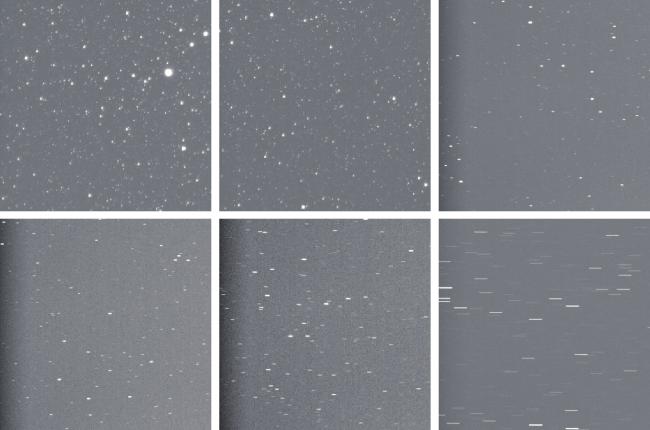
表 1 测试图像信息

Table 1 Information of test images

序列 模式 帧数 $ \omega $[(')/s] tx/ty β/( °)
1 天基 30 −4/−6 0.06
2 天基 10 −4/−6 0.06
3 模拟天基 16 1.0 −40/0 0
4 模拟天基 22 2.8 −90/1 0.03
5 模拟天基 19 3.6 −120/−2 −0.04
6 模拟天基 30 6.0 −170/−1 0.01
图 6 测试数据集演示

Fig.6 Demonstration of the test dataset

此外,选择了五种图像配准的代表性算法用于对比试验:基于星点通量的配准方法Flux[26];基于三角形的配准算法Astroalign[13]、Delaunay[14]和Lin[16];基于特征描述子的配准方法SURF[7];以及基于深度学习的配准方法LoFTR[19]。其中,深度学习算法在NVIDIAA100的服务器上运行,其他算法在一台配备Intel i7-13650HX处理器和16 GB内存的笔记本电脑上运行,所有算法均通过Python语言实现。
验证指标则从三个方面进行评估:匹配准确率(Accuracy,Accm)、配准精度(Position Error,PE)和算法效率,部分指标的表达式如下:
$ \begin{cases} {\text{Acc}}_{m}=\dfrac{{N}_{cp}}{{N}_{p}}\\\text{PE}=\dfrac{1}{{N}_{cp}}\displaystyle\sum \limits_{i=1}^{{N}_{cp}}\sqrt{\Delta d}\end{cases} $
式中,NcpNp、Δd分别表示正确匹配的同名点对数量、点对总数、理想和实际配准点对之间投影的欧氏距离。

3.2 试验结果

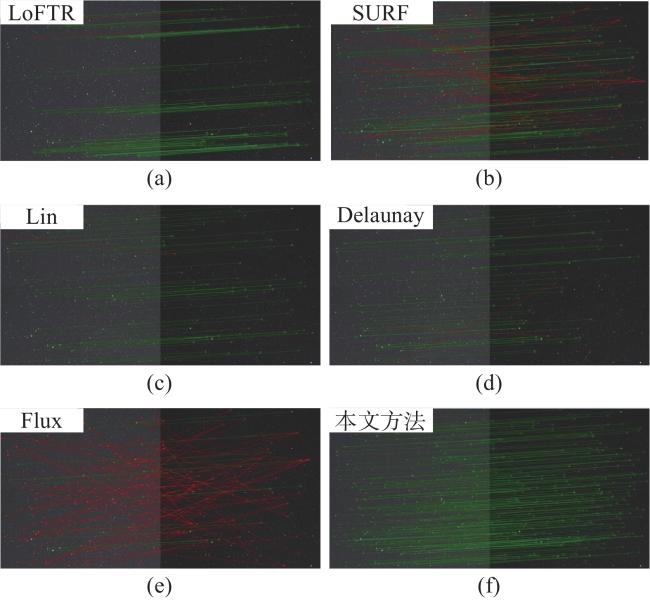
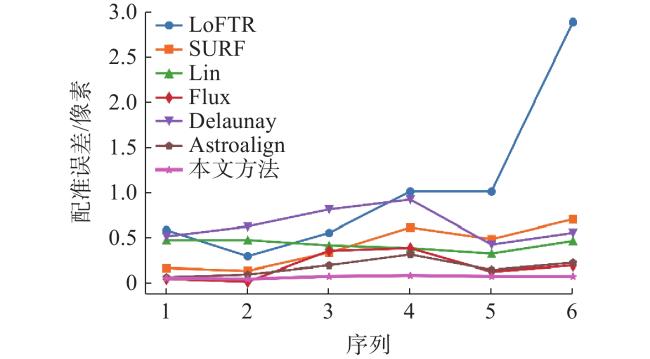
基于上述方法和对比方法测试所有数据,表2展示了不同方法特征点匹配的准确率。值得注意的是,Astroalign表现出最低的匹配准确度,主要归因于其构建了数量最多的三角形。图7展示了在序列1的第一帧与最后一帧配准过程中,六种不同算法的恒星匹配结果。图7中,正确的匹配用绿色线条表示,错误的匹配用红色线条表示。表2展示了不同算法的配准准确率的对比,而表3则提供了配准效率的比较,图8展示了不同算法的配准精度对比。总体而言,尽管LoFTR和SURF等盲配准算法可以表现出一定的匹配效果,但由于星图存在弱语义信息、弱纹理信息等特征,这些算法的综合性能较差。虽然LoFTR达到了较高的匹配准确度,但在配准精度和配准效率上表现较差。另一方面,SURF取得了较高的配准精度和效率,但其匹配准确度较低。
表 2 匹配准确率对比

Table 2 Comparisons of matching accuracy

序列 LoFTR/% SURF/% Lin/% Flux/% Delaunay/% Astroalign/% 本文方法/%
1 99.25 79.55 96.04 19.72 93.08 2.74 99.81
2 99.87 77.79 95.72 21.00 95.38 2.46 100
3 96.30 49.05 93.89 21.42 52.77 2.23 98.70
4 92.30 25.65 97.76 12.06 56.71 2.65 99.19
5 88.97 22.26 98.40 23.96 59.56 2.48 99.12
6 89.47 46.83 90.52 20.06 76.78 2.50 99.42
图 7 序列 1 首、尾帧配准结果(β=180°, λ=150)

Fig.7 Registration results of the first and last frames of sequence 1 (β=180°, λ=150)

表 3 配准效率对比

Table 3 Comparisons of registration efficient

组别LoFTR/sSURF/sLin/sFlux/sDelaunay/sAstroalign/s本文方法/s
15661.052.201.251.271.330.62
25761.056.320.881.070.690.55
34721.952.580.631.040.730.47
44751.268.270.590.990.720.54
54741.3111.370.581.010.660.63
65161.348.990.621.030.841.01
图 8 不同方法在不同序列的配准精度对比 (β=180°, λ=150)

Fig.8 Registration results of the first and last frames of sequence (β=180°, λ=150)

Lin、Delaunay和Moffat都是通过构建三角形来进行恒星匹配的方法。与Delaunay相比,Lin采用区域化三角形的构建与匹配,因此在匹配准确率上表现更好;而Delaunay由于其高效的三角形构建方法,大幅减少了三角形的数量,在效率上更具优势。与其他对比方法相比,Flux和Astroalign在配准精度和效率方面表现更为稳定,两者都使用SExtractor[27-28]进行恒星提取,借助高精度的恒星定位能力提高了配准精度。其中,Flux通过直接匹配通量最接近的恒星,避免了构建三角形带来的额外计算成本,因此计算效率较高;但这种逐点匹配的方式容易导致大量的误匹配,尤其是在许多恒星具有相近通量的场景中问题更为突出。Astroalign由于使用了K-D(K-Dimensional)树[29]的数据结构,减少了处理时间;然而,其构建大量三角形并依赖于点对点的盲匹配,导致了相对较低的匹配精度。
与对比方法相比,本文提出的基于速度场的配准方法在匹配准确率、配准精度和效率方面表现出最佳的综合性能。通过利用速度场引导恒星点群进行最优匹配,避免了传统配准方法中存在的冗余盲匹配操作,从而显著提高了匹配精度;同时降低了计算复杂度。在传统的逐点匹配模式中,计算复杂度与恒星数量的平方成正比;而本文方法的复杂度仅与恒星数量成正比。此外,由于本文方法可以在相同时间内匹配更多的恒星,所以它能够获得更精确的变换参数,实现稳定且较高的配准精度。

4 结 语

通过建立星点成像模型,从单帧图像估计星点速度场,进而利用全局星点速度场推导图像速度场,本文提出了一种高效的星图配准算法。该图像速度场可引导星点群实现高效精准的最优匹配,最终通过大量匹配点对优化得到精确的变换参数。该方法将传统天文配准中“点对点”的盲目匹配模式,转变为基于全局估计的“点群最优匹配”模式,显著提升了匹配精度与效率。本文方法已在多类数据集上完成验证,并与代表性基线方法进行了对比,结果表明该方法在星图匹配的精度上具有显著优势,预期可为空间碎片图像在轨实时处理提供技术支撑。
1
王兆魁, 刘纯武, 蔡映凯. 空间目标天基协同感知技术与展望[J]. 上海航天(中英文), 2024, 41 (6): 1- 13.

DOI

WANG Z K, LIU C W, CAI Y K. Technologies and perspectives for space-based cooperative perception of space targets[J]. Aerospace Shanghai(Chinese & English), 2024, 41 (6): 1- 13.

DOI

2
郑珍珍, 朱振才, 康一舟. 天基空间碎片可见光观测系统与关键技术发展概述[J]. 光学学报, 2022, 42 (17): 1712002.

DOI

ZHENG Z Z, ZHU Z C, KANG Y Z. Overview of space-based optical observation systems for space debris and development of key technologies[J]. Acta Optica Sinica, 2022, 42 (17): 1712002.

DOI

3
陶江, 曹云峰, 丁萌. 空间碎片检测技术研究进展[J]. 激光与光电子学进展, 2022, 59 (14): 1415010.

DOI

TAO J, CAO Y F, DING M. Progress of space debris detection technology[J]. Laser & Optoelectronics Progress, 2022, 59 (14): 1415010.

DOI

4
王锋, 张哲, 叶昊, 等. 国外空间态势感知能力分析与发展趋势: 特邀[J]. 激光与光电子学进展, 2024, 61 (20): 2011006.

DOI

WANG F, ZHANG Z, YE H, et al. Analysis and development trend of foreign space situational awareness capabilities: Invited[J]. Laser & Optoelectronics Progress, 2024, 61 (20): 2011006.

DOI

5
覃军友, 沈智华, 林彬, 等. 天基序列星图高精度在轨实时配准方法[J]. 光学技术, 2023, 49 (4): 476- 486.

QIN J Y, SHEN Z H, LIN B, et al. High-precision on-orbit real-time registration method for space-based sequential star images[J]. Optical Technique, 2023, 49 (4): 476- 486.

6
王华超, 刘静, 程昊文, 等. 自适应指向误差的快速星图识别方法[J]. 激光与光电子学进展, 2023, 60 (6): 0610003.

DOI

WANG H C, LIU J, CHENG H W, et al. Fast star map recognition method adaptive to pointing error[J]. Laser & Optoelectronics Progress, 2023, 60 (6): 0610003.

DOI

7
BAY H, ESS A, TUYTELAARS T, et al. Speeded-up robust features(SURF)[J]. Computer Vision and Image Understanding, 2008, 110 (3): 346- 359.

8
郑雨韵, 黄翔宇, 毛晓艳. 基于图像配准的暗弱目标小行星识别方法[J]. 深空探测学报(中英文), 2023, 10 (4): 397- 404.

DOI

ZHENG Y Y, HUANG X Y, MAO X Y. Faint target asteroid recognition method based on image registration[J]. Journal of Deep Space Exploration, 2023, 10 (4): 397- 404.

DOI

9
SUN Q, LIU L, NIU Z, et al. A practical star image registration algorithm using radial module and rotation angle features[J]. Remote Sensing, 2023, 15 (21): 5146.

DOI

10
周海洋, 朱鑫炎, 余飞鸿. 改进型高效三角形相似法及其在深空图像配准中的应用[J]. 光学学报, 2017, 37 (4): 0410003.

DOI

ZHOU H Y, ZHU X Y, YU F H. Improved efficient triangle similarity method and its application in deep space image registration[J]. Acta Optica Sinica, 2017, 37 (4): 0410003.

DOI

11
CHEN G, JIANG L, ZHANG Y, et al. A semi-analytical Fourier-Mellin method for real-time dynamic star image registration[J]. IEEE Transactions on Aerospace and Electronic Systems, 2025.

12
HAN Y, WEN D, LI J. Fast registration method for sequential star images[J]. Applied Optics, 2023, 62 (27): 7316- 7329.

DOI

13
BEROIZ M, CABRAL J B, SANCHEZ B. Astroalign: A Python module for astronomical image registration[J]. Astronomy and Computing, 2020, 32, 100384.

DOI

14
YANG L, LI M, DENG X. Fast matching algorithm for sparse star points based on improved Delaunay subdivision[C]. 2021 2nd International Symposium on Computer Engineering and Intelligent Communications, Nanjing, China, August 6—8, 2021: 117-121.

15
SCHUCKMAN M, PROUTY R, CHAPMAN D, et al. Using Moffat profiles to register astronomical images[C]. European Conference on Computer Vision, Cham, Switzerland, October 23—27, 2022: 80-95.

16
LIN B, XU X, SHEN Z, et al. A registration algorithm for astronomical images based on geometric constraints and homography[J]. Remote Sensing, 2023, 15 (7): 1921.

DOI

17
WANG H, SHEN Z, CHEN S, et al. A smeared astronomical image registration method based on imaging mechanism constraints[J]. IEEE Geoscience and Remote Sensing Letters, 2024, 21, 1- 5.

DOI

18
SARLIN P E, DETONE D, MALISIEWICZ T, et al. SuperGlue: learning feature matching with graph neural networks[C]. Proceedings of the IEEE/CVF Conference on Computer Vision and Pattern Recognition, Seattle, USA, June 13—19, 2020: 4938-4947.

19
SUN J, SHEN Z, WANG Y, et al. LoFTR: detector-free local feature matching with transformers[C]. Proceedings of the IEEE/CVF Conference on Computer Vision and Pattern Recognition, Nashville, USA, June 20—25, 2021: 8922-8931.

20
TANG L, DENG Y, MA Y, et al. SuperFusion: a versatile image registration and fusion network with semantic awareness[J]. IEEE/CAA Journal of Automatica Sinica, 2022, 9 (12): 2121- 2137.

DOI

21
KANG M, HU X, HUANG W, et al. Dual-stream pyramid registration network[J]. Medical Image Analysis, 2022, 78, 102379.

DOI

22
ZHAO G, LI J, LUO L, et al. A deep neural network-based distortion registration technique for astronomical images[C]. Fourteenth International Conference on Information Optics and Photonics, Xi’an, China, August 7—10, 2023: 1293509.

23
李振伟, 张涛, 孙明国. 星空背景下空间目标的快速识别与精密定位[J]. 光学精密工程, 2015, 23 (2): 589- 599.

DOI

LI Z W, ZHANG T, SUN M G. Fast recognition and precise positioning of space targets against starry background[J]. Optics and Precision Engineering, 2015, 23 (2): 589- 599.

DOI

24
孙荣煜, 赵长印. GEO空间碎片的光学观测与精密定位[J]. 天文学进展, 2012, 30 (3): 394- 410.

DOI

SUN R Y, ZHAO C Y. Optical survey technique for space debris in GEO[J]. Progress in Astronomy, 2012, 30 (3): 394- 410.

DOI

25
WANG H, ZHANG G, WANG L, et al. Anomalous individuals searching framework for space debris detection in single optical astronomical image[J]. Advances in Space Research, 2025, 75 (4): 3820- 3837.

DOI

26
MASCI F J, MAKOVOZ D, MOSHIR M. A robust algorithm for the pointing refinement and registration of astronomical images[J]. Publications of the Astronomical Society of the Pacific, 2004, 116 (823): 842- 858.

DOI

27
HAACK R F, SMITH CASTELLI A V, MENDES DE OLIVEIRA C, et al. The S-PLUS Fornax Project(S+FP): SExtractor detection and measurement of nearby galaxies in large photometric surveys[J]. Monthly Notices of the Royal Astronomical Society, 2024, 530 (3): 3195- 3207.

DOI

28
BERTIN E, ARNOUTS S. SExtractor: software for source extraction[J]. Astronomy and Astrophysics Supplement Series, 1996, 117 (2): 393- 404.

29
TIWARI V R. Developments in KD tree and KNN searches[J]. International Journal of Computer Applications, 2023, 185 (17): 17- 23.

DOI

Outlines

/