Special Issue: Tianwen-2

Study on Asteroid Exposure Ages Based on the Double Asteroid Redirection Test Impact Experiment

  • Ruoyu ZHAI , 1, 2 ,
  • Yunzhao WU , 1, 3, * ,
  • Haibo ZHANG 4, 5 ,
  • Wenyue GUO 4 ,
  • Zhijun LIU 4 ,
  • Yan JIN 6
Expand
  • 1. Purple Mountain Observatory, Chinese Academy of Sciences, Nanjing 210023, China
  • 2. School of Astronomy and Space Sciences, University of Science and Technology of China, Hefei 230026, China
  • 3. Space Science Institute, Macau University of Science and Technology, Macau 999078, China
  • 4. Department of Space Engineering, China Aerospace Science and Industry Corporation Limited, Beijing 100854, China
  • 5. School of Mechatronicol Engineering, Beijing Institute of Technology, Beijing 100081, China
  • 6. Earth Observation and Data Center, China National Space Administration, Beijing 100101, China

Online published: 2025-11-04

Abstract

Studying the exposure age of asteroids is crucial for understanding their formation and evolution. The implementation of the Double Asteroid Redirection Test (DART) mission demonstrated the feasibility of using kinetic impact to deflect the trajectory of a near-Earth asteroid and also provided a valuable opportunity to investigate the exposure age and evolutionary processes of Didymos. This study investigates the exposure age of the surface of the primary asteroid Didymos and the ejecta of the secondary asteroid Dimorphos, based on visible and near-infrared spectral data obtained by ground-based telescopes before and after the DART impact. It shows that the exposure age of Didymos surface is approximately 457 thousand years, implying that the primary asteroid experienced a significant rotational fission event about 457 thousand years ago. This event had almost no effect on the surface age of the primary asteroid but reset the surface age of the secondary asteroid and the exposure age of the primary asteroid. The ejecta of Dimorphos share the same composition as the surface of Didymos but exhibit a lower degree of space weathering, suggesting that after the formation of the secondary, the surfaces of both the primary and the secondary underwent intense space weathering, while the material from the interior of the secondary was relatively less affected.

Cite this article

Ruoyu ZHAI , Yunzhao WU , Haibo ZHANG , Wenyue GUO , Zhijun LIU , Yan JIN . Study on Asteroid Exposure Ages Based on the Double Asteroid Redirection Test Impact Experiment[J]. Journal of Space Science and Experiment, 2025 , 2(4) : 64 -72 . DOI: 10.19963/j.cnki.2097-4302.2025.04.008

0 引 言

长期暴露在太空环境中的小行星受到宇宙线、太阳风离子辐照及微陨石撞击等多种作用的影响,表现出红化和暗化的成熟表面。这些引起天体表面变化的过程被统称为太空风化。暴露年龄指天体表面新鲜物质在太空风化中暴露的时间。行星交会[1-2]、YORP(Yarkovsky–O'Keefe–Radzievskii–Paddack effect)自旋加速[3]、撞击[4]、热降解[5]等机制可更新小行星的表面[6]。因此,获得小行星的暴露年龄,可以认识其演化历史并有助于限制其表面演化过程的发生时间。
2022年9月27日,美国国家航空航天局(National Aeronautics and Space Administration,NASA)的双小行星重定向测试(Double Asteroid Redirection Test,DART)航天器以6.1 km/s的速度撞击65803Didymos双小行星系统的次星Dimorphos,成功将其公转周期缩短33.0±1.0 min[7],首次验证了动能撞击技术偏转近地小行星轨道的可行性。Didymos属于“阿波罗”型近地小行星,是一颗潜在威胁小行星,其轨道半长轴为1.643 AU,偏心率为0.383,轨道倾角为3.414º,近日点距太阳1.013 AU[8]。Didymos双小行星系统由主星Didymos和次星Dimorphos组成,主星和次星的等效直径分别为761±26 m和151±5 m[9],主星的自转周期为2.259 3±0.000 1 h[10],撞击前次星绕主星公转周期和轨道半长轴分别为11.921 48±0.000 13 h[7]和1 190±30 m[11]
直径在0.2~10.0 km之间的小行星通常是由母体灾难性破裂产生的碎片重新聚集形成的碎石堆[12],其中约15%拥有卫星[1013]。一些模拟研究[14-15]表明YORP效应引发的自转分裂是形成双小行星系统的有效机制。碎石堆小行星可能因YORP效应引发自旋加速而发生解体,产生的抛射物在引力作用下重新聚集,最终形成双小行星系统中的卫星。DART任务获得的高分辨率图像支持了Didymos双小行星系统形成的自转分裂机制[16-17]。Didymos和Dimorphos砾石的尺寸频率分布(Size Frequency Distribution,SFD)表明,次星的表面直接继承了主星部分砾石的SFD,这种继承关系可能是由主星物质脱落事件导致的[16]。撞击坑累计尺寸频率分布(Crater Cumulative Size Frequency Distributions,CSFD)表明,Didymos表面年龄约为1 250万年,而Dimorphos的表面年龄约为9万~30万年,两者表面年龄的巨大差异支持了这一机制[17]
Didymos的自转分裂作为一种有效的表面更新机制[3],暴露出其风化层下的新鲜物质,使暴露年龄小于表面年龄。因此,研究Didymos表面的暴露年龄,可以认识其演化历史并有助于限制其自转分裂事件的发生时间。此外,观测和模拟结果显示,DART撞击可使次星内部数米深的物质溅射出[18-20],在Didymos系统周围形成一个持久存在的溅射物云[21-22]。这些溅射物的亮度在撞击后的数十小时内显著超过主星[23],为研究次星内部物质的太空风化程度提供了宝贵机会。小行星25143“糸川”(Itokawa)样品表明,太空风化主要作用于硅酸盐颗粒表面厚度在数十至数百纳米范围内的极薄一层[24-27]。因此,源自次星内部数米深的溅射物可能表现出相对较低的风化程度。
Didymos属于S型小行星,其表面主要由橄榄石、辉石等硅酸盐矿物组成,在反射光谱的近红外波段表现出1 $ \text{μm} $和2 $ \text{μm} $处的吸收特征[28]。对S型小行星,至少需要获得0.55~2.40 $ \text{μm} $频段的观测才能获得较为完整的太空风化特征。DART航天器[29]和LICIACube立方星[30]上配备了三台成像仪:DRACO(Didymos Reconnaissance and Asteroid Camera for OpNav,400~1 000 nm宽谱段全色成像)、LEIA(Liciacube Explorer Imaging for Asteroid,650±250 nm 单色成像)和LUKE(Liciacube Unit Key Explorer,RGB彩色成像)。由于观测波段的限制,上述三台成像仪都不利于Didymos的风化分析。因此,分析DART撞击前后地基天基望远镜的观测数据尤为重要。
De León等[28]使用北欧光学望远镜(Nordic Optical Telescope,NOT)和意大利伽利略国家望远镜(Telescopio Nazionale Galileo,TNG)分别获得了Didymos双星系统的可见(0.491~0.800 $ \text{μm} $)和近红外(0.800~2.493 $ \text{μm} $)光谱,认为其陨石类似物为普通球粒陨石。Dunn等[31]分析该光谱后认为Didymos的陨石类似物为LL或L型普通球粒陨石。Ieva等[32]在2022年8月至11月期间的六个晚上,使用TNG望远镜对Didymos系统进行了近红外(0.75~2.25 μm)观测。由于DART撞击后的第一次观测实施于撞击后的第四天,Didymos系统的细微光谱变化未能被及时捕获。Ieva等[32]获得的六条光谱数据高度相似,且与De León等[28]2004年的观测结果一致。为了进一步研究次星溅射物,他们将狭缝对准Didymos撞击溅射物尾部进行单独观测。结果表明,尽管无法完全排除Didymos和Dimorphos的影响,撞击溅射物的光谱与主星Didymos十分相似。由于缺乏2.25 μm之后的观测,他们基于1 μm吸收带中心推测Didymos系统的陨石类似物可能为L型普通球粒陨石。Polishook等[33]用NASA的近红外望远镜设施(Infrared Telescope Facility,IRTF)[34],从DART撞击前一天开始对Didymos系统进行了连续七天的近红外(0.80~2.45 μm)观测,发现撞击后14 h和38 h的光谱斜率明显降低,并在后续几夜逐渐回升,这与Ieva等[32]在撞击后第四天的观测一致。
过去对Didymos双星系统的成分开展了详细分析,本文对DART撞击前后地基望远镜获得的可见近红外数据进行研究,获得主星Didymos表面及次星Dimorphos溅射物的暴露年龄,揭示主星Didymos自转分裂的发生时间。

1 数据与方法

1.1 可见近红外光谱数据
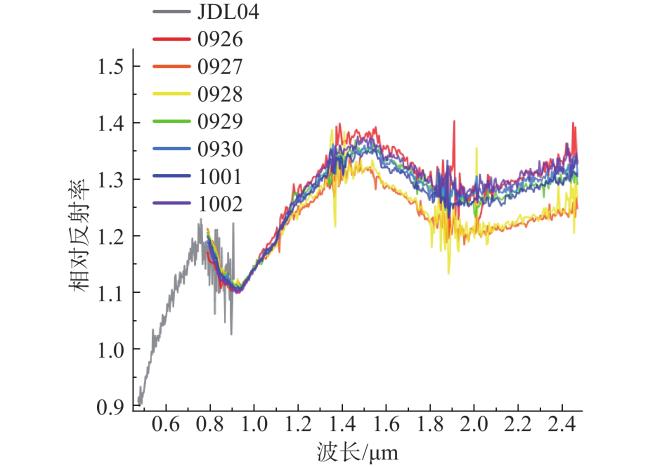
图1展示了本研究使用的可见近红外光谱。其中,近红外数据(0.80~2.45 μm)来自IRTF望远镜在DART撞击前后七日(撞击前:2022年9月26日;撞击后:2022年9月27日至10月2日)对Didymos系统进行的连续观测[33],按观测日期依次编号为0926、0927、0928、0929、0930、1001和1002。可见光数据(0.491~0.800 μm)来自DART撞击前(2004年1月16日)NOT望远镜对Didymos系统的观测,记为JDL04[28]
图 1 DART撞击前后Didymos系统的可见近红外光谱

Fig.1 Visible and near-infrared spectra of the Didymos system before and after the DART impact

为了获得DART撞击前Didymos表面的可见近红外光谱,对2004年NOT望远镜获得的可见光数据与0926近红外数据进行拼接,拼接后的光谱在0.55 μm处进行归一化处理。为保证重叠波段(0.80~0.92 μm)的斜率统一,采用1.15的调整系数对近红外数据进行处理。
DART撞击后的近红外光谱由Didymos、Dimorphos以及撞击溅射物共同构成。根据主星和次星截面积计算,DART撞击前,Dimorphos对总反射光的贡献仅为4%[32],其对整体近红外光谱的影响可以忽略不计。DART航天器撞击次星后,次星溅射物显著提高了系统的亮度。随着溅射物逐渐散去,系统的亮度逐步恢复至原有水平。根据亮度变化分析,在撞击后六日内IRTF望远镜的观测时段,溅射物对系统反射光的贡献比例依次为64%、58%、51%、43%、34%和23%[33]

1.2 风化模型

太空风化会影响月球和S类小行星表面的光谱特征,导致近红外范围内的反射光谱逐渐变暗、光谱斜率变红[35]、可见光谱段变蓝[36]。根据离子辐照前后的光谱变化,Brunetto等[37]对太阳风离子辐照对硅酸盐天体表面产生的红化作用进行了定量描述:
$ \begin{array}{c}W\left(\lambda \right)=K\;\mathrm{exp}\left(\dfrac{{C}_{S}}{\lambda }\right)\end{array} $
式中,$ W\left(\lambda \right) $为风化函数,即风化光谱与未风化光谱之间的比值;$ \lambda $为波长;$ K $为随光谱标准化变化的尺度因子。参数$ {C}_{S} $是一个负值,表示指数曲线的弯曲程度,是衡量风化程度的指标。$ {C}_{S} $的绝对值越大,风化函数越弯曲,风化程度越高。风化后硅酸盐的光谱为:
$ \begin{array}{c}{R}_{\mathrm{w}\mathrm{e}\mathrm{a}\mathrm{t}\mathrm{h}\mathrm{e}\mathrm{r}\mathrm{e}\mathrm{d}}\left(\lambda \right)=W\left(\lambda \right){R}_{\mathrm{f}\mathrm{r}\mathrm{e}\mathrm{s}\mathrm{h}}\left(\lambda \right)\end{array} $
硅酸盐的离子辐照实验显示,当离子通量低于1017离子/cm2时,光谱红化主要归因于硅酸盐中原子位移的产生[38-40]。损伤参数$ d $指的是单位面积内的位移数量,$ {C}_{S} $值与损伤参数$ d $之间的关系(损伤曲线)为:
$ \begin{array}{c}{C}_{S}=\alpha {\mathrm{ln}}(\beta d+1)\end{array} $
式中,$ \alpha =-0.33\pm 0.06\text{ μm} $$ \beta =(1.1\pm 0.5)\times {10}^{-19}{\text{cm}}^{2} $
太阳风离子辐照并非唯一的太空风化过程,但却是在近地及主带区域最有效的过程。根据太阳风离子通量,给出了轨道半长轴$ D $、损伤参数$ d $与暴露年龄$ t $之间的关系为:
$ \begin{array}{c}t=2.53\times {10}^{-13}\times {\left(\dfrac{D}{2.9\text{AU}}\right)}^{2}d\end{array} $
由于太空风化具有红化作用,小行星的光谱斜率高于其陨石类似物的平均值。由式(1)可以看出,红化作用对光谱的影响主要体现在$ 1\text{.6}\text{}\text{ μm} $前的波段范围,因此0.55~1.6 μm波段的线性拟合斜率可以作为风化程度的标准[41],使用风化模型对小行星光谱去风化,使小行星光谱斜率达到其陨石类似物的平均值,得到小行星光谱的$ {C}_{S} $值。
假设近红外观测的目标中存在两个成分相同、风化程度不同的硅酸盐ab,其光谱分别为:
$ \begin{array}{c}{R}_{a}\left(\lambda \right)={W}_{a}\left(\lambda \right){R}_{\mathrm{f}\mathrm{r}\mathrm{e}\mathrm{s}\mathrm{h}a}\left(\lambda \right)={K}_{a}\mathrm{exp}\left(\dfrac{{C}_{Sa}}{\lambda }\right){R}_{\mathrm{f}\mathrm{r}\mathrm{e}\mathrm{s}\mathrm{h}a}\left(\lambda \right)\end{array} $
$ \begin{array}{c}{R}_{b}\left(\lambda \right)={W}_{b}\left(\lambda \right){R}_{\mathrm{f}\mathrm{r}\mathrm{e}\mathrm{s}\mathrm{h}b}\left(\lambda \right)={K}_{b}\mathrm{exp}\left(\dfrac{{C}_{Sb}}{\lambda }\right){R}_{\mathrm{f}\mathrm{r}\mathrm{e}\mathrm{s}\mathrm{h}b}\left(\lambda \right)\end{array} $
式中,$ {R}_{\mathrm{f}\mathrm{r}\mathrm{e}\mathrm{s}\mathrm{h}a}\left(\lambda \right) $$ {R}_{\mathrm{f}\mathrm{r}\mathrm{e}\mathrm{s}\mathrm{h}b}\left(\lambda \right) $表示风化前硅酸盐ab的新鲜反射光谱;$ {W}_{a}\left(\lambda \right) $$ {W}_{b}\left(\lambda \right) $为对应硅酸盐ab风化程度的风化函数;$ {C}_{Sa} $$ {C}_{Sb} $分别为硅酸盐ab$ {C}_{S} $值。本文定义硅酸盐ba的相对光谱为:
$ \begin{array}{c}\dfrac{{R}_{b}\left(\lambda \right)}{{R}_{a}\left(\lambda \right)}\end{array} $
由于它们物质成分相同:
$ \begin{array}{c}{R}_{\mathrm{f}\mathrm{r}\mathrm{e}\mathrm{s}\mathrm{h}a}\left(\lambda \right)={R}_{\mathrm{f}\mathrm{r}\mathrm{e}\mathrm{s}\mathrm{h}b}\left(\lambda \right)\end{array} $
因此
$ \begin{array}{c}\dfrac{{R}_{b}\left(\lambda \right)}{{R}_{a}\left(\lambda \right)}=\dfrac{{W}_{b}\left(\lambda \right)}{{W}_{a}\left(\lambda \right)}=\dfrac{{K}_{b}}{{K}_{a}}\mathrm{exp}\left(\dfrac{{{C}_{Sb}-C}_{Sa}}{\lambda }\right)\end{array} $
式中,$ {{C}_{Sb}-C}_{Sa} $被定义为相对$ {C}_{S} $值。
若两个硅酸盐的相对光谱符合式(9),且在$ 1\text{ μm} $$ 2\text{ μm} $处无明显的吸收峰,则说明这两个硅酸盐物质成分相同,仅在风化程度上存在差异。

2 结果分析

2.1 Didymos表面的暴露年龄

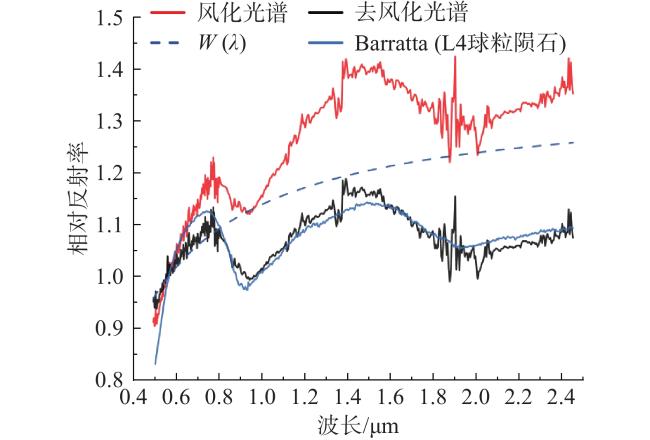
基于太空风化模型,对Didymos表面的可见近红外光谱进行了去风化处理。图2展示了Didymos原始光谱、去风化光谱和风化函数,并将其与L4型普通球粒陨石Barratta的光谱进行了对比。去风化前,Didymos表面光谱的0.55~1.6 μm线性拟合斜率为0.341。以普通球粒陨石的平均斜率0.117(由RELAB数据库的48条普通球粒陨石光谱计算得出)作为参考斜率,可得Didymos表面光谱的$ {C}_{S} $值为−0.159 1。
图 2 Didymos风化函数及其原始与去风化光谱

Fig.2 The weathering function of Didymos and its original and de-weathered spectra

激光脉冲模拟实验表明,在近地空间微陨石撞击引起红化的时标约为108[42-44]。离子辐照模拟实验显示,在1 AU处,太阳风重离子辐照导致红化的时标为104~106[38],而太阳风轻离子的太空风化时标为103~104[45]。由此可见,在近地区域,对于暴露年龄小于107年的天体,可以忽略微陨石撞击引起的光谱红化,只需考虑太阳风离子辐照的作用。图3(a)展示了Didymos的$ {C}_{S} $值与暴露年龄之间的关系。可以看出,$ {C}_{S} $值大于−0.883 0时,暴露年龄小于107年。Didymos表面光谱的$ {C}_{S} $值为−0.159 1,远大于−0.883 0,因此Didymos表面的光谱红化主要由太阳风离子辐照引起,使用该风化模型计算暴露年龄是可靠的。图3(b)展示了Didymos表面的损伤参数和暴露年龄,分别为5.63×1018 cm−2和45.7万年。
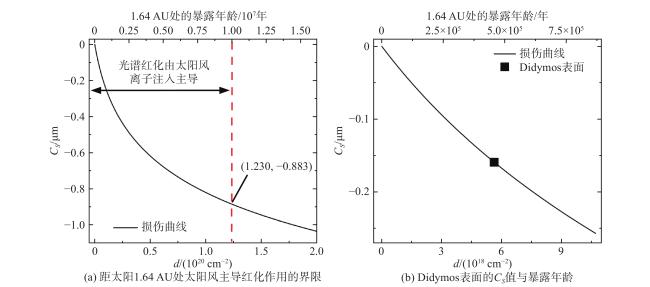
图 3 损伤曲线

Fig.3 Damage curve

2.2 Dimorphos溅射物的风化程度

由于撞击后第六天的观测缺乏相应的可见光数据,本文通过近红外波段的相对光谱分析Dimorphos溅射物的暴露年龄。图4展示了其他六组近红外数据相对于0927的光谱,以及通过式(9)进行最小二乘拟合的结果。从图4可以看出,相对光谱由式(9)的拟合效果良好,且未显示出明显的1 μm和2 μm吸收特征,这表明Dimorphos溅射物与Didymos表面物质的成分相同,但在风化程度上存在差异。这一发现支持了Didymos双小行星系统起源于主星的自转分裂事件,即Dimorphos是由主星Didymos的抛射出的物质形成的。
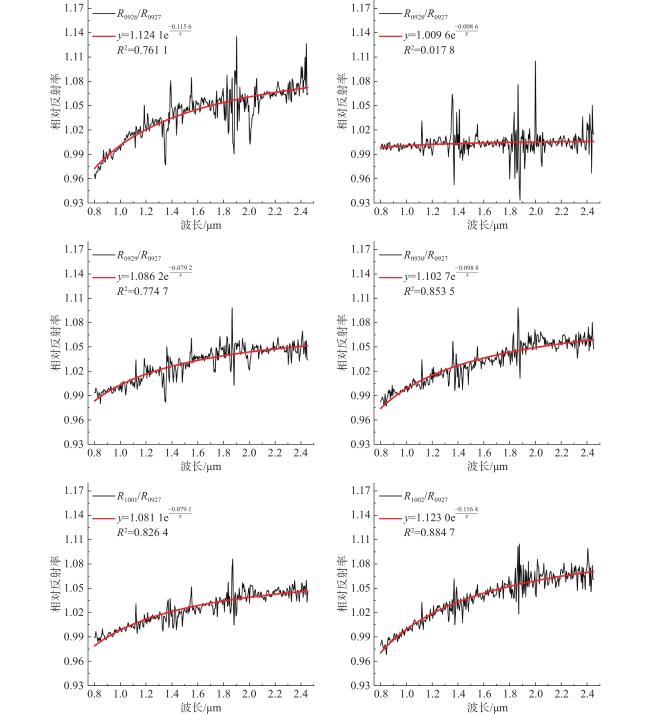
图 4 六组近红外数据相对于0927的光谱

Fig.4 Spectra of six near-infrared data relative to 0927

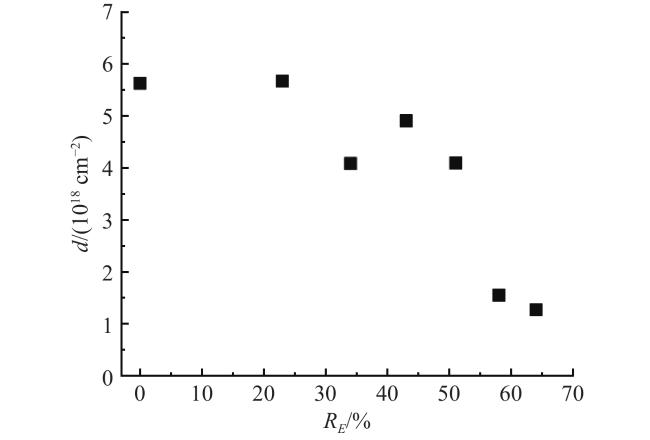
通过最小二乘拟合得到的相对$ {C}_{S} $值,计算出了撞击后六日Didymos系统光谱的绝对$ {C}_{S} $值,并依据式(3)和式(4)计算出损伤参数(见表1)。由于撞击后六日的光谱由Didymos与Dimorphos溅射物共同贡献,因此计算暴露年龄无实际意义,表1中的暴露年龄仅供对比参考。图5绘制出了损伤参数随溅射物占比(RE)变化的趋势。从图5可以看出,损伤参数随着溅射物占比的增大呈现下降趋势。这一趋势表明,与Didymos表面相比,Dimorphos溅射物的风化程度相对较低。
表 1 七条光谱的$ {C}_{S} $值、溅射物占比、损伤参数及暴露年龄

Table 1 $ {C}_{S} $values, proportions of ejecta, damage parameters, and exposure age of seven spectra

观测日期编号 $ {C}_{S}\text{/μm} $ RE / % d/1018 cm−2 暴露年龄/年
0926 −0.159 1 0 5.63 4.57×10⁵
0927 −0.043 6 64 1.28 1.04×10⁵
0928 −0.052 2 58 1.56 1.27×10⁵
0929 −0.122 8 51 4.10 3.33×10⁵
0930 −0.142 4 43 4.91 3.98×10⁵
1001 −0.122 7 34 4.09 3.32×10⁵
1002 −0.160 0 23 5.67 4.60×10⁵
图 5 损伤参数随溅射物占比变化趋势

Fig.5 Variation trend of damage parameter with proportion of ejecta

3 分析讨论

CSFD分析结果表明,Didymos的表面年龄约为1 250万年,而Dimorphos的表面年龄相当于Didymos年龄为0.7%~2.4%,约为9万~30万年[17]。Dimorphos的形成年龄可能与其表面年龄基本一致,即Didymos的大规模物质脱落事件发生于约30万年前。这一事件为Dimorphos的形成提供了可能,导致Didymos变得扁平,却保留了其表面最大的一些陨石坑,因此并未重置其表面年龄。
暴露年龄数据显示,主星经历较大规模自旋加速引发的物质脱落事件发生在约45.7万年前。这一事件对主星的表面年龄几乎没有影响,却重置了次星的表面年龄及主星的暴露年龄。Didymos的暴露年龄比其表面年龄小两个数量级,与Dimorphos的表面年龄在同一数量级,这表明自转分裂是更新小行星表面的有效机制。主星暴露年龄和次星表面年龄之间的差异可能是由于光谱观测或陨石坑尺寸频率统计的误差,也可能是物质脱落过程中主星表面保留了一部分风化物质所致。Dimorphos的溅射物与Didymos表面物质成分相同,但风化程度较低,这印证了Didymos双小行星系统起源于主星的自转分裂事件。虽然自转分裂事件更新了主星的表面,但在次星形成后,主星和次星的表面持续受到强烈的太空风化作用,次星内部物质受到的太空风化作用相对较弱,因此表现出较低的风化程度。
主星Didymos表面的新鲜物质在经历了45.7万年的太空风化后,表现出S型小行星的光谱特征,这与太阳风离子辐照导致红化的时标(104~106年)一致[38]。这表明太阳风是导致小行星表面快速变红的主要原因,在106年左右使小行星表现出成熟的光谱特征,这与先前的研究结论一致[46]

4 结 语

获得Didymos双小行星系统的暴露年龄,有助于了解其演化历史并有助于限制其自转分裂的发生时间。DART任务的实施为研究小行星暴露年龄及其成因演化提供了宝贵机会。本文基于对DART撞击前后地基望远镜获得的可见近红外数据,对主星Didymos表面及次星Dimorphos溅射物开展暴露年龄研究。结果表明:
(1)Didymos表面的暴露年龄约为45.7万年,这表明Didymos在约45.7万年前发生了一起较大规模的物质脱落事件。该事件为次星的形成提供了可能,对主星的表面年龄几乎没有影响,却重置了次星的表面年龄及主星的暴露年龄。
(2)Dimorphos溅射物与Didymos表面物质成分相同但风化程度较低,这支持了Didymos双小行星系统起源于主星的自转分裂事件,即Dimorphos源于主星Didymos的抛射物。虽然自转分裂事件更新了主星的表面,但在次星形成后,主星和次星的表面持续受到强烈的太空风化作用,次星内部物质受到的太空风化作用相对较弱,因此次星内部物质表现出较低的风化程度。

致谢

感谢魏茨曼科学研究所的David Polishook研究员提供的Didymos七日近红外光谱数据。
1
BINZEL R P, MORBIDELLI A, MEROUANE S, et al. Earth encounters as the origin of fresh surfaces on near-Earth asteroids[J]. Nature, 2010, 463 (7279): 331- 334.

DOI

2
NESVORNÝ D, BOTTKE W F, VOKROUHLICKÝ D, et al. Do planetary encounters reset surfaces of near Earth asteroids?[J]. Icarus, 2010, 209 (2): 510- 519.

DOI

3
WALSH K J, RICHARDSON D C, MICHEL P. Rotational breakup as the origin of small binary asteroids[J]. Nature, 2008, 454 (7201): 188- 191.

DOI

4
SHESTOPALOV D I, GOLUBEVA L F, CLOUTIS E A. Optical maturation of asteroid surfaces[J]. Icarus, 2013, 225 (1): 781- 793.

DOI

5
GRANVIK M, MORBIDELLI A, JEDICKE R, et al. Super-catastrophic disruption of asteroids at small perihelion distances[J]. Nature, 2016, 530 (7590): 303- 306.

DOI

6
DEMEO F E, MARSSET M, POLISHOOK D, et al. Isolating the mechanisms for asteroid surface refreshing[J]. Icarus, 2023, 389, 115264.

DOI

7
THOMAS C A, NAIDU S P, SCHEIRICH P, et al. Orbital period change of Dimorphos due to the DART kinetic impact[J]. Nature, 2023, 616 (7957): 448- 451.

DOI

8
JPL Small-Body Database[DB/OL]. (2024-09-22) [2025-04-07]. https: //ssd.jpl.nasa.gov/tools/sbdb_lookup.html#/?sstr=Didymos.

9
DALY R T, ERNST C M, BARNOUIN O S, et al. Successful kinetic impact into an asteroid for planetary defence[J]. Nature, 2023, 616 (7957): 443- 447.

DOI

10
PRAVEC P, SCHEIRICH P, KUŠNIRÁK P, et al. Photometric survey of binary near-Earth asteroids[J]. Icarus, 2006, 181 (1): 63- 93.

DOI

11
NAIDU S P, BENNER L A M, BROZOVIC M, et al. Radar observations and a physical model of binary near-Earth asteroid 65803 Didymos, target of the DART mission[J]. Icarus, 2020, 348, 113777.

DOI

12
BAGATIN A C, PETIT J M, FARINELLA P. How many rubble piles are in the asteroid belt?[J]. Icarus, 2001, 149 (1): 198- 209.

DOI

13
PRAVEC P, HARRIS A W. Binary asteroid population: 1. Angular momentum content[J]. Icarus, 2007, 190 (1): 250- 259.

DOI

14
SCHEERES D J. Rotational fission of contact binary asteroids[J]. Icarus, 2007, 189 (2): 370- 385.

DOI

15
SÁNCHEZ P, SCHEERES D J. Simulating asteroid rubble piles with a self-gravitating soft-sphere distinct element method model[J]. The Astrophysical Journal, 2011, 727 (2): 120.

DOI

16
PAJOLA M, TUSBERTI F, LUCCHETTI A, et al. Evidence for multi-fragmentation and mass shedding of boulders on rubble-pile binary asteroid system (65803) Didymos[J]. Nature Communications, 2024, 15 (1): 6205.

DOI

17
BARNOUIN O, BALLOUZ R L, MARCHI S, et al. The geology and evolution of the near-Earth binary asteroid system (65803) Didymos[J]. Nature Communications, 2024, 15 (1): 6202.

DOI

18
HIRABAYASHI M, FERRARI F, JUTZI M, et al. Double asteroid redirection test (dart): Structural and dynamic interactions between asteroidal elements of binary asteroid (65803) didymos[J]. The Planetary Science Journal, 2022, 3 (6): 140.

DOI

19
RADUCAN S D, JUTZI M. Global-scale reshaping and resurfacing of asteroids by small-scale impacts, with applications to the DART and Hera missions[J]. The Planetary Science Journal, 2022, 3 (6): 128.

DOI

20
STICKLE A M, DECOSTER M E, BURGER C, et al. Effects of impact and target parameters on the results of a kinetic impactor: predictions for the double asteroid redirection test (DART) mission[J]. The Planetary Science Journal, 2022, 3 (11): 248.

DOI

21
LI J Y, HIRABAYASHI M, FARNHAM T L, et al. Ejecta from the DART-produced active asteroid Dimorphos[J]. Nature, 2023, 616 (7957): 452- 456.

DOI

22
MORENO F, BAGATIN A C, TANCREDI G, et al. Characterization of the ejecta from the NASA/DART impact on dimorphos: Observations and Monte Carlo models[J]. The Planetary Science Journal, 2023, 4 (8): 138.

DOI

23
GRAYKOWSKI A, LAMBERT R A, MARCHIS F, et al. Light curves and colours of the ejecta from Dimorphos after the DART impact[J]. Nature, 2023, 616 (7957): 461- 464.

DOI

24
NOGUCHI T, NAKAMURA T, KIMURA M, et al. Incipient space weathering observed on the surface of Itokawa dust particles[J]. Science, 2011, 333 (6046): 1121- 1125.

DOI

25
KELLER L P, BERGER E L. A transmission electron microscope study of Itokawa regolith grains[J]. Earth, Planets and Space, 2014, 66, 1- 7.

26
NOGUCHI T, KIMURA M, HASHIMOTO T, et al. Space weathered rims found on the surfaces of the Itokawa dust particles[J]. Meteoritics & Planetary Science, 2014, 49 (2): 188- 214.

27
MATSUMOTO T, TSUCHIYAMA A, MIYAKE A, et al. Surface and internal structures of a space-weathered rim of an Itokawa regolith particle[J]. Icarus, 2015, 257, 230- 238.

DOI

28
DE LEÓN J, LICANDRO J, SERRA-RICART M, et al. Observations, compositional, and physical characterization of near-Earth and Mars-crosser asteroids from a spectroscopic survey[J]. Astronomy & Astrophysics, 2010, 517, A23.

29
FLETCHER Z J, RYAN K J, MAAS B J, et al. Design of the didymos reconnaissance and asteroid Camera for OpNav (DRACO) on the double asteroid redirection test (DART)[C]. Space Telescopes and Instrumentation 2018: Optical, Infrared, and Millimeter Wave. SPIE, 2018, 10698: 602-612.

30
DOTTO E, DELLA CORTE V, AMOROSO M, et al. LICIACube-the light italian Cubesat for imaging of asteroids in support of the NASA DART mission towards asteroid (65803) Didymos[J]. Planetary and Space Science, 2021, 199, 105185.

DOI

31
DUNN T L, BURBINE T H, BOTTKE JR W F, et al. Mineralogies and source regions of near-Earth asteroids[J]. Icarus, 2013, 222 (1): 273- 282.

DOI

32
IEVA S, EPIFANI E M, DOTTO E, et al. Near-infrared spectral homogeneity of the didymos system before and after the DART Impact[J]. The Planetary Science Journal, 2024, 5 (10): 225.

DOI

33
POLISHOOK D, DEMEO F E, BURT B J, et al. Near-IR spectral observations of the Didymos system: Daily evolution before and after the DART impact indicates that Dimorphos originated from Didymos[J]. The Planetary Science Journal, 2023, 4 (12): 229.

DOI

34
RAYNER J T, TOOMEY D W, ONAKA P M, et al. SpeX: A medium-resolution 0.8~5.5 micron spectrograph and imager for the NASA infrared telescope facility[J]. Publications of the Astronomical Society of the Pacific, 2003, 115 (805): 362.

DOI

35
HAPKE B. Space weathering from Mercury to the asteroid belt[J]. Journal of Geophysical Research: Planets, 2001, 106 (E5): 10039- 10073.

DOI

36
WU Y Z, WANG Z C, LU Y. Space weathering of the Moon from in situ detection[J]. Research in Astronomy and Astrophysics, 2019, 19 (4): 051.

DOI

37
BRUNETTO R, VERNAZZA P, MARCHI S, et al. Modeling asteroid surfaces from observations and irradiation experiments: The case of 832 Karin[J]. Icarus, 2006, 184 (2): 327- 337.

DOI

38
STRAZZULLA G, DOTTO E, BINZEL R, et al. Spectral alteration of the Meteorite Epinal (H5) induced by heavy ion irradiation: A simulation of space weathering effects on near-Earth asteroids[J]. Icarus, 2005, 174 (1): 31- 35.

DOI

39
BRUNETTO R, STRAZZULLA G. Elastic collisions in ion irradiation experiments: A mechanism for space weathering of silicates[J]. Icarus, 2005, 179 (1): 265- 273.

DOI

40
MARCHI S, BRUNETTO R, MAGRIN S, et al. Space weathering of near-Earth and main belt silicate-rich asteroids: Observations and ion irradiation experiments[J]. Astronomy & Astrophysics, 2005, 443 (3): 769- 775.

41
POLISHOOK D, MOSKOVITZ N, BINZEL R P, et al. Observations of “fresh” and weathered surfaces on asteroid pairs and their implications on the rotational-fission mechanism[J]. Icarus, 2014, 233, 9- 26.

DOI

42
YAMADA M, SASAKI S, NAGAHARA H, et al. Simulation of space weathering of planet-forming materials: Nanosecond pulse laser irradiation and proton implantation on olivine and pyroxene samples[J]. Earth, Planets and Space, 1999, 51, 1255- 1265.

43
SASAKI S, NAKAMURA K, HAMABE Y, et al. Production of iron nanoparticles by laser irradiation in a simulation of lunar-like space weathering[J]. Nature, 2001, 410 (6828): 555- 557.

DOI

44
BRUNETTO R, ROMANO F, BLANCO A, et al. Space weathering of silicates simulated by nanosecond pulse UV excimer laser[J]. Icarus, 2006, 180 (2): 546- 554.

DOI

45
LOEFFLER M J, DUKES C A, BARAGIOLA R A. Irradiation of olivine by 4 keV He+: Simulation of space weathering by the solar wind[J]. Journal of Geophysical Research: Planets, 2009, 114(E3).

46
VERNAZZA P, BINZEL R P, ROSSI A, et al. Solar wind as the origin of rapid reddening of asteroid surfaces[J]. Nature, 2009, 458 (7241): 993- 995.

DOI

Outlines

/