

0 引 言
太阳系小天体是指太阳系中直径通常在数百米到数十公里之间的天体,主要包括小行星和彗星。其中,公转轨道接近地球轨道的一类小行星被称为近地小行星(Near-Earth Asteroids,NEAs)。近地小行星的直径范围从几米到数十公里不等,形状可以是球形、椭球形、不规则形状或薄片状,具有不同的表面特征和组成成分。由于近地小行星靠近地球,与人类安全密切相关,因此成为太空探索的重要研究对象。
截至2025年6月8日,已发现小行星约145万颗,其中包含38 505颗近地小行星。但是只有约100个近地小行星具有非常可信的自转轴指向和形状参数。这些挑战导致了一些科学上的限制,对于小天体的形成过程及其在演化中的角色仍存在许多未知,内部构造、物质组成以及可能存在的活动过程也不完全清楚。解决这些问题需要更多连续的时域观测。
原位探测是最直接地获取小行星信息的方式,也最具有挑战性。目前,只有18颗小行星被人类探测器飞跃或原位探测过。按照尺寸从小到大的顺序分别是“迪莫弗斯”(Dimorphos)[12]、“糸川”(Itokawa)[13]、“贝努”(Bennu)[14]、“丁基內什”(Dinkinesh)、“龙宫”(Ryugu)[15]、“布拉叶”(Braille)、“图塔蒂斯”(Toutatis)、“安妮弗兰克”(Annefrank)、“施泰因斯”(Steins)[16]、“唐纳德约翰森”(Donaldjohanson)、“马瑟斯基”(Masursky)、“加斯普拉”(Gaspra)[17-18]、“爱神星”(Eros)[19]、“艾达”(Ida)[18]、“阿罗科斯”(Arrokoth)、“梅西尔德星”(Mathilde)[20]、“司琴星”(Lutetia)[16]、“灶神星”(Vesta)[21]、“谷神星”(Ceres)[22]。地面探测小行星仍是最主要的手段。随着国际需求的增加,以及中国综合国力的提升,越来越多的高校和科研机构也开始建造自己的巡天望远镜。例如,“南京大学时域天文台”[23]、上海交通大学李政道研究所的“天语计划”[24],以及中国科学技术大学等单位联合研制的墨子巡天望远镜[25]等。这些巡天望远镜有望为近地小天体的观测提供重要的基础设施,在完成主观测目标的同时,能对一些近地小行星进行更细致的刻画,获得其自转轴方向和形状信息,服务国家深空探测战略需求。
本文将通过近地小行星自转和形状的反演过程的仿真模拟,为地基望远镜以及近地空间望远镜制定观测策略,限制能实现反演的参数空间,以指导观测。本文结构如下:第1节介绍日-地-小行星的物理模型,第2节介绍生成光变曲线的过程和方法,第3节探讨参数反演过程,第4节展示具体的反演结果,第5节讨论和总结相关拟合参数和反演结果的应用,并进行了展望。
1 日-地-小行星物理模型
为了仿真地基和近地卫星反演近地小行星自转和形状的过程,建立了一个包含太阳-地球-近地小行星的物理模型。下面分别从轨道和形状两方面分别描述小天体参数的设置。
1.1 近地小行星的轨道
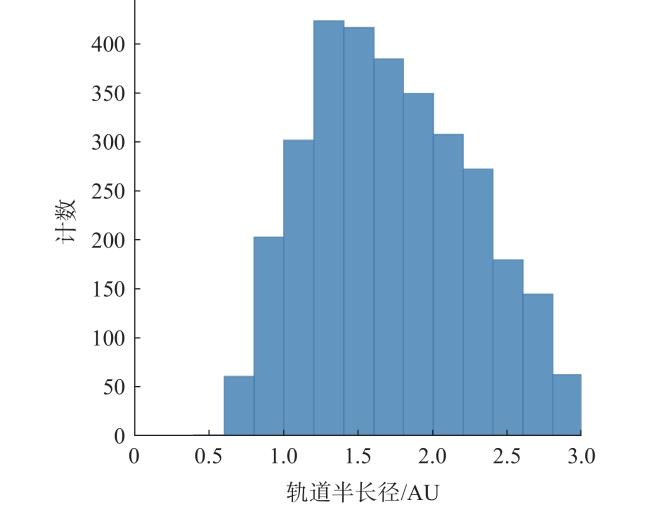
对于近地小行星,为了确定其轨道根数的典型值,参考已知近地小天体这些参数的统计分布。利用喷气推进实验室(Jet Propulsion Laboratory,JPL)的小天体数据库,按照近地天体、小行星和已编号天体三个条件筛选出所有近地小行星,其中32 344个目标有轨道半长径a、偏心率e和轨道倾角i的测量值,2 127个目标有自转周期的测量值。如图1 所示,根据近地小行星轨道半长径的分布情况,选择该分布的峰值作为轨道半长径的典型值,即1.3 AU。鉴于绝大多数太阳系小行星都在黄道附近,因此认为轨道倾角的典型值是0°。为了简化问题,轨道偏心率也设为0。
1.2 近地小行星的形状
小行星的形状受到旋转速度、组成材料和碰撞历史等多种因素的共同影响,因此形状多样且具有不规则性,其长短轴比有一定的分布范围。为了合理简化并模拟小行星的主要形状特征,本文采用了三轴椭球模型,三轴从大到小分别用a、b和c表示。模型设置如下:
(1)模型1。三轴设置为a∶b∶c=3∶2∶1。该模型参考了如Itokawa(2.6∶1.4∶1.0)和Ida(3.2∶1.4∶1.0)等小行星的形状特征,适用于一般不等轴椭球的情况。
(2)模型2。b和c相等的一般三轴椭球,三轴设置为a∶b∶c=2∶1∶1。该模型参考了如小行星9969 (9969 Braille)(2.1∶1.0∶1.0)和Gaspra(2.0∶1.2∶1.0)等小行星,适用于模拟两短轴相等的小行星。
(3)模型3。b和c相等的极高偏心率的椭球,三轴设置为a∶b∶c=6∶1∶1。该模型参考了小行星“奥陌陌”(Oumuamua),它是已知的第一颗经过太阳系的星际天体,于2017年10月在距地球约0.2 AU处被全景巡天望远镜和快速反应系统(Panoramic Survey Telescope and Rapid Response System,Pan-STARRS)望远镜发现,其尺寸为180 m×30 m×30 m,适用于研究极端细长形状的小行星。
模型1~3的设置既涵盖了两短轴相近和不相近的小行星形状特征,又基于已知小行星的典型参数合理选取,如原位探测过的Ida(3.2∶1.4∶1.0)、Eros(3∶1∶1)、Itokawa(2.6∶1.4∶1.0)、Braille(2.4∶1.0∶1.0)、Gaspra(2.0∶1.2∶1.0)和星际天体Oumuamua(6∶1∶1)等。尽管实际小行星的形状可能更加复杂且不规则,但三轴椭球模型是一种合理的简化方法,能够有效模拟大多数小行星的主要形状特征,降低计算复杂度,同时保证分析的科学性,适用于光变曲线参数反演研究。当然,接近球形的小行星,如Ryugu(1.2∶1.2∶1.0)和Bennu(1.10∶1.05∶1.00),本文的分析可能不适用。
1.3 近地小行星的自转参数
近地小行星的自转参数主要包括自转周期、自转轴指向λ和β。自转轴指向反映了自转轴在空间中的倾斜程度。其中λ为小行星自转轴在黄道坐标系下的黄经角,取值范围为0°~360°;β为自转轴的黄纬角,取值范围为−90°~90°。
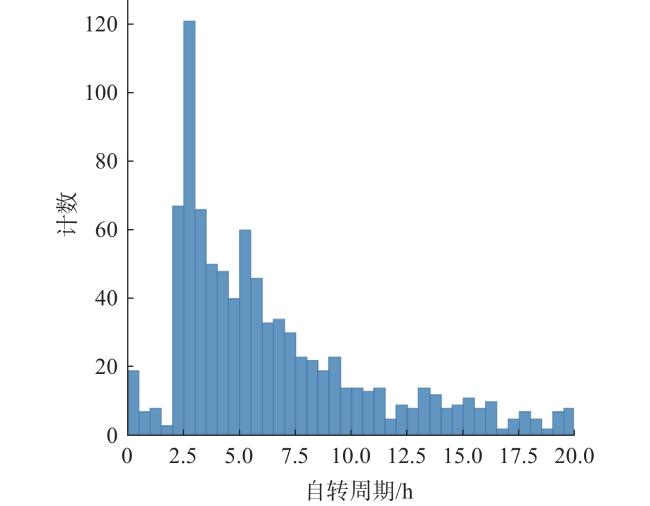
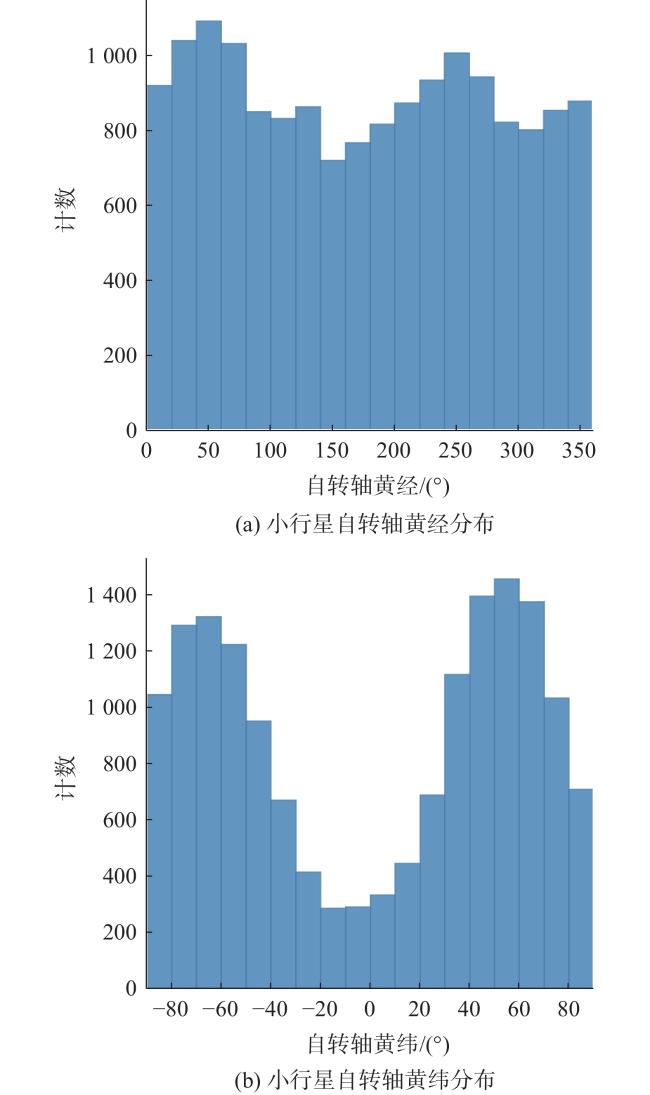
根据近地小行星的自转分布观测数据,自转周期的峰值为2.67 h,如图2 所示。而自转轴指向λ在0°~360°之间均匀分布,β峰值是±60°左右,黄经方向近似均匀分布,黄纬方向峰值约±60°。如图3 所示。因此置小行星的自转周期为3 h,自转轴指向λ=60°,β=60°。这种基于统计数据的设定能够有效避免个体系统误差和随机误差的影响,兼具稳定性和代表性。λ和β设为相同的值便于结果的分析和比较。下面仿真时相邻两张图片的观测时间间隔和每条光变曲线的观测时长将以3 h的自转周期为参考进行设定。
需要说明的是,自转周期相比自转轴指向更容易测量,因此拥有自转周期参数的近地小行星样本较为丰富,可以为参数统计分析提供充分支持。然而,自转轴指向的观测数据相对较少,为了保证统计的样本量和结果的可靠性,本文对自转轴指向的统计分析选择使用所有已知该值的小行星。这种处理方式是科学的,因为自转轴指向的分布主要受到天体动力学过程和随机碰撞历史的影响,与小行星的具体种类或轨道分类关系不大。
为了准确确定自旋轴在空间中的方向,通常需要广泛的太阳相位角和视角范围。视角是指自旋轴与观测者方向之间的夹角。由于本文模型综合考虑了地球的真实轨道、小行星的模拟轨道,以及小行星自转参数的统计分布,因此该模型内在地包含了近地小行星在天空运动中所覆盖的弧长、太阳相位角的变化以及视角的变化,使其在统计上具有合理性。在该模型下,通过设置不同的光度参数(详见第4节),可以生成多种不同的视角和光照几何条件,从而研究反演的可行性。
2 生成光变曲线
2.1 对三轴椭球的建模方法
为了生成小行星光变曲线,需要选择合适的建模方式。本文采用三角网格模型作为描述天体表面形状的数学模型,实现对三轴椭球的建模。该模型基于三角形构成的网格结构来表示天体表面,通过将天体表面划分为众多小三角形,并记录每个三角形的顶点坐标和连接关系来描述整体形状。三角网格模型适用于描述天体表面的复杂结构,如撞击坑、山脊和裂隙等。
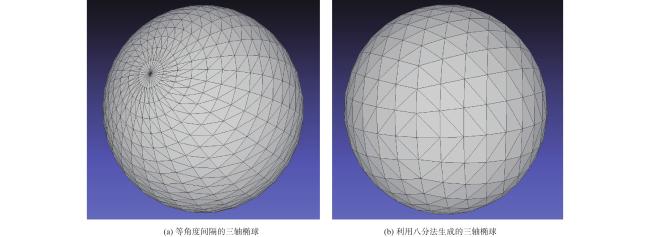
实现三角网格模型有两种方法:一种是等角度间隔的三轴椭球,即经纬度间隔固定;另一种是利用八分法生成三轴椭球。如图4 所示,前者在极区和赤道的三角形面积差异显著,而八分法生成的模型在这两个区域的面积差别较小。需要说明的是,图4 中使用球体示意,旨在更直观地展示两种方法的原理和在面片均匀性上的差异。通过对比两种方法生成的光变曲线发现,虽然二者的光变曲线误差均达到了十万分之一的量级,但八分法生成的三轴椭球模型在光变曲线的精度和稳定性上表现出更明显的优势。因此,本文选择八分法模型下的三轴椭球,来生成模拟的光变曲线。
2.2 测光参数
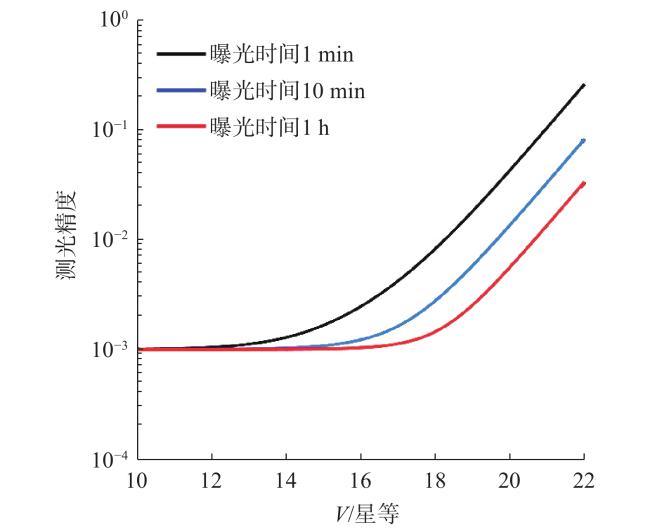
近年来,国内高校和研究机构纷纷建造米级望远镜。米级望远镜具备较大的光收集能力和空间分辨能力,且造价相对较低,因此特别适用于时域天文学研究。时域天文学关注天体的时间变化和暂时性事件,其中小行星光变曲线反演也是时域天文研究内容之一。地基望远镜的测光精度受到多种因素的影响,包括天气条件、台址、观测设备性能、观测对象的亮度等,一般米级望远镜测光精度能到千分之一,对于19等以内天体曝光10 min的精度可达1%,如图5 所示。而天基望远镜由于避免了大气干扰,可以实现更高的测光精度,例如亚米级的“开普勒”空间望远镜可达到几十万分之一,10厘米级的凌星系外行星普查卫星(Transiting Exoplanet Survey Satellite,TESS)空间望远镜可以达到万分之一[26]。本文模拟测光精度分别设为0、0.001、0.010和0.100。其中测光精度为0的情形是为了提供一个无误差(或测光误差极小)的理想基准参考。
在第1.3节中,本文将小行星的自转周期设定为3 h。为了确保反演自转轴和形状的准确性,需要观测完整的周期,同时考虑到地球上观测夜的长度,假设每次持续监测6 h,相当于覆盖2个完整的小行星自转周期。随着系外行星等研究领域的发展,越来越多的巡天望远镜已将凝视模式作为主要观测模式,以探测相关天文现象。这种观测模式同样适用于刻画太阳系小天体。
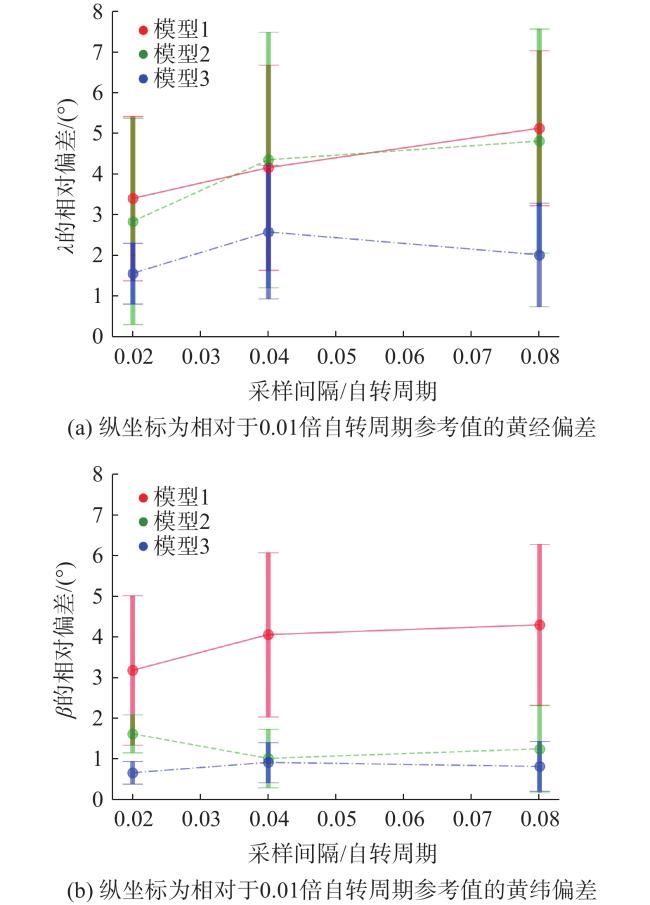
为了分析相邻两张图片时间间隔的影响,本文考虑了四个时间间隔,分别是自转周期的0.01、0.02、0.04和0.08倍。分别模拟了10、15和20条光变曲线,且相邻两条光变曲线的时间间隔分别设为5、10、15和20天。在上述条件下,太阳相位角至少变化6°(观测时间跨度50天),最大变化约50°(观测时间跨度400天)。需要注意的是,黄经有可能被拟合到镜像解(与理论值相差180°),但本文不考虑镜像解的影响。
结果表明,以0.01 倍自转周期的反演结果作为参考值,随着采样频率从0.02降至0.08倍自转周期,λ和β的总体偏差呈大致增加的趋势。该趋势如图6 所示。图6 展示了观测时间跨度为50天(10次观测,光变曲线间隔为5天)的反演结果。综合考虑反演结果的准确性和程序的运行时间,在仿真过程中,时间间隔选为0.04倍自转周期,相当于每个自转周期内进行25次采样。根据仿真结果,建议在实测时,将时间间隔控制在0.02~0.04倍自转周期范围内。此外,还令初始时刻小天体的太阳相位角是0°,以便更准确地考察反演结果与太阳相位角之间的依赖关系。
3 反演自转和形状参数
在光变曲线的生成和反演过程中,借助小行星反演技术模型数据库(Database of Asteroid Models from Inversion Techniques,DAMIT)软件[27]。因为仅使用相对光变曲线,所以不需要拟合光散射参数。针对不同三轴椭球模型,模拟参数设置如下:测光误差为0.001、0.010、0.100;光变曲线数为4、6、8、10、15、20条;相邻光变曲线时间间隔为1、5、10、15天;采样间隔为0.04倍自转周期;每条光变曲线的观测时长为6 h。在此条件下,几乎能够涵盖太阳相位角的全部可变区间。根据前文的计算和讨论,光变曲线之间的时间间隔设为0.04倍理论自转周期,每次观测覆盖2个自转周期,自转轴指向参数的拟合步长均为2°。小行星的空间位置由地球位置和太阳相位角决定,因此小行星的亮度会随太阳和地球的距离及角度变化而变化。其他拟合参量还包括自转周期和小行星形状。自转周期的拟合初值通过对光变曲线的周期分析获得,具体方法如下。
3.1 光变周期拟合
LS方法是一种基于频域分析的周期提取算法,具有以下两个优势:一是,某些在时间域中难以检测的信号特征,在频域中却易于识别;二是,对于具有多周期分量的时间序列,频域分析方法在周期提取方面具有明显优势。然而,该方法也存在不足之处。由于涉及傅里叶变换等复杂计算,因此计算复杂度较高。此外,对于非周期性信号或周期性不明显的信号,该方法可能无法有效提取周期信息。
PDM方法是基于时域分析的周期提取算法,其优点是可以避免传统傅里叶分析方法中存在的某些问题,如窗口和频谱混叠,且需要预先定义的参数也较少。然而,该方法也存在一些缺点:一是,检测仅限于时间域,缺乏在频域中发现隐藏信息的能力;二是,周期混叠会干扰其他周期成分的检测。
3.2 参数反演
自旋反演的拟合参数包括黄经(λ)、黄纬(β)、自转周期以及小行星的形状。为实现自动化拟合,构建了一套基于DAMIT代码的反演流程,同时对DAMIT代码的部分细节进行了优化,使其能够处理具有高光度精度的光变曲线反演。此外,通过引入并行处理技术,提高了流程的计算效率。
首先,通过LS和PDM方法获得初步的自转周期估计。然后,在选定的初始周期附近进行详细的扫描,扫描范围由拟合周期的不确定性决定。为避免局部极小值,每个周期格点的拟合都设置了84组不同的初始自转轴指向方向,并设置黄经拟合范围为0°~360°、黄纬拟合范围为−90°~90°。为提高拟合精度,黄经和黄纬的拟合步长均设置为2°。在反演阶段,对每组(λ, β)的拟合结果进行保存,并按卡方值进行排序。
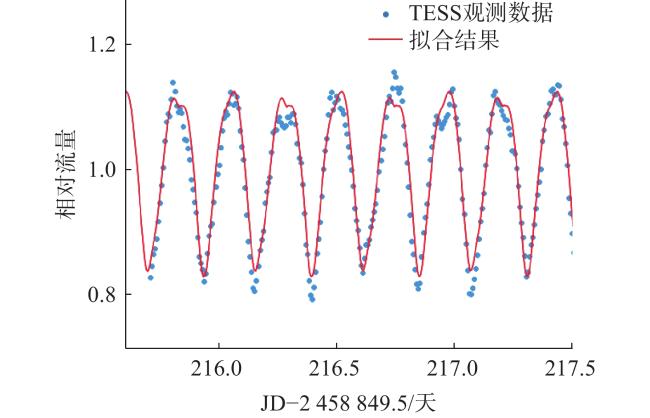
为了验证程序的有效性,选用了空间卫星TESS对主带小行星328(328 Gudrun)的观测数据。DAMIT数据库基于地面望远镜的充分观测,已提供了该小行星较为精确的自转参数。而TESS卫星也恰好对这颗小行星进行了不间断的持续观测。TESS的有效口径为10.5 cm,采用凝视模式对同一片天区进行连续观测,曝光时间为10~30 min。仅使用TESS的观测数据,结合本文改进的程序进行反演。结果表明,反演得到的参数与DAMIT数据库基于地面望远镜数据的反演结果完全一致。图7 展示了TESS一段持续两天的观测数据及拟合结果。其中,蓝点表示TESS观测数据,红线为拟合结果。横坐标为儒略日(以2020年1月1日0点为参考时刻,JD=2 458 849.5)。拟合结果与TESS的观测数据吻合,验证了本文改进程序的有效性。
4 反演结果
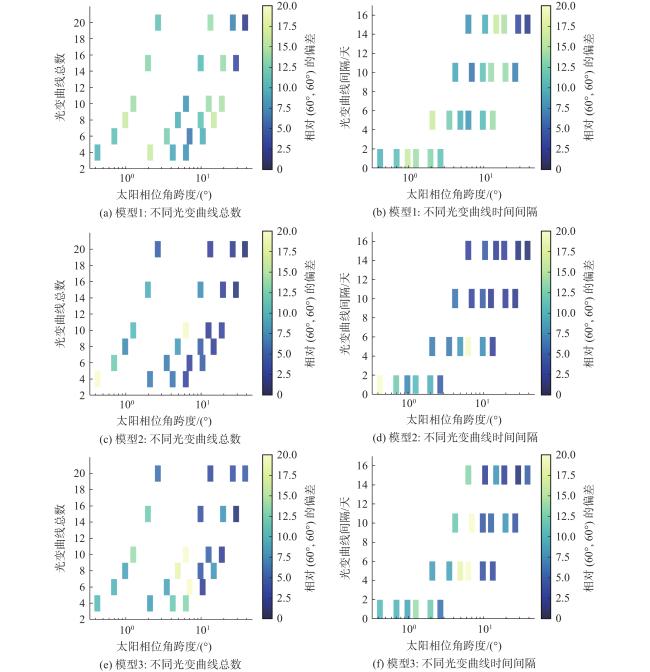
影响反演结果的因素包括数据质量、数据总量、太阳相位角的跨度、相邻两条光变曲线的时间间隔等。本文研究了不同观测策略对三种模型(a∶b∶c=3∶2∶1、2∶1∶1和6∶1∶1)的自转轴方向和形状反演结果的影响。如果自转轴拟合准确,能同时获得较好的形状和自转周期的拟合。图8 ~图11 展示了不同观测误差下,反演结果和理论值的偏差。偏离程度d的表达式为:
式中,lmean和bmean分别是反演(λ,β)的平均值。因为拟合格点密集,对于每组参数,都会得到一系列(λ,β)的拟合值。本文取前50组拟合值的平均值作为(λ,β)的拟合结果。通常这50组(λ,β)的卡方值非常相近。然而,由于简并现象的存在,可能会存在拟合至镜像解的情况。
4.1 无观测误差情形
由图8 还可以看出,在相同观测条件下,反演精度会因小行星形状的不同而有所变化。对于不等轴三轴椭球模型(模型1),反演误差通常较大;而对于两个短轴相等的椭球模型(模型2和模型3),误差相对较小,这在颜色分布上体现为更深的蓝色。
4.2 存在观测误差情形
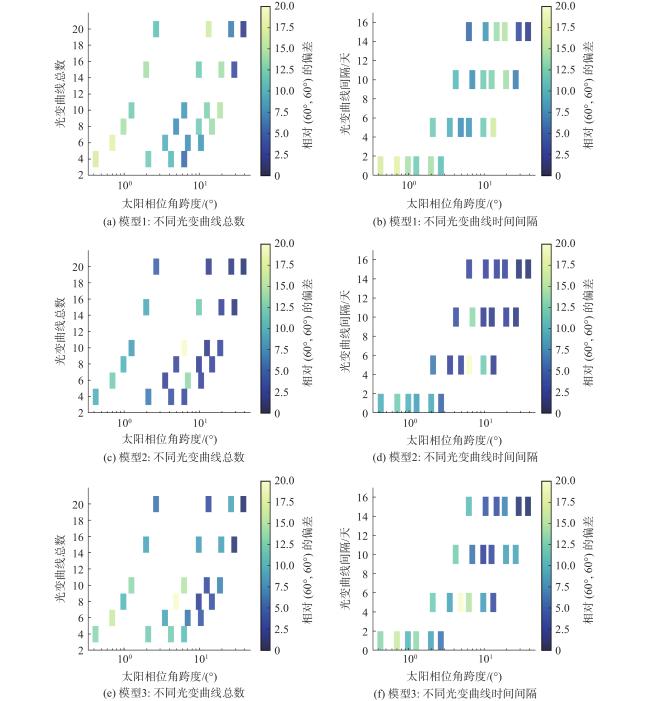
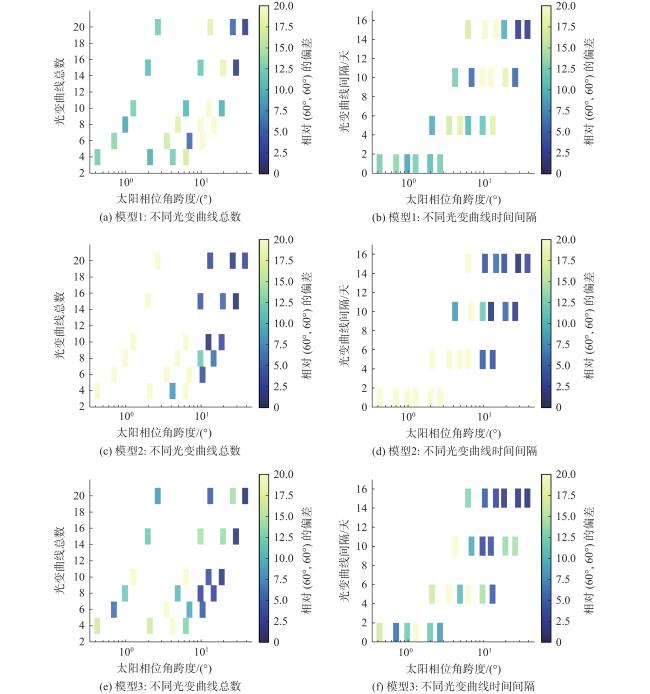
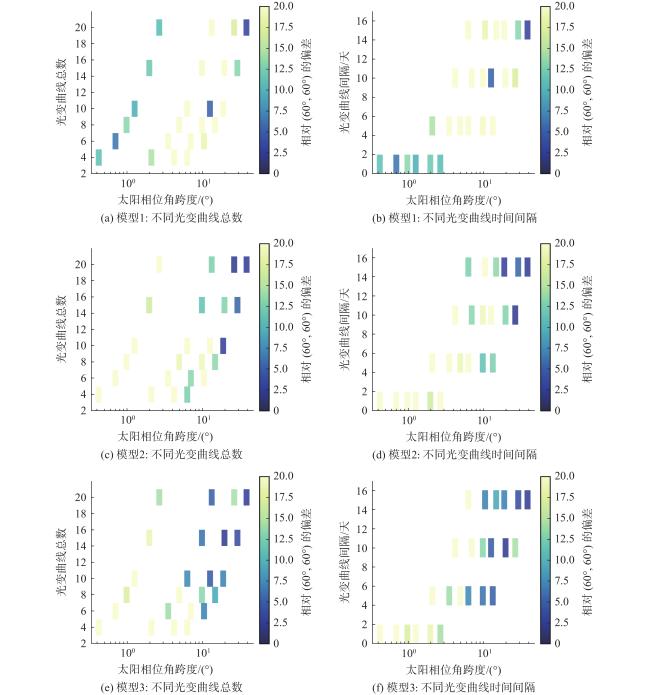
当观测误差从0.001增大到0.100时,反演难度会相应增大。但是,当太阳相位角跨度足够大,拟合精度趋于稳定。如图9 ~图11 所示,对于模型1,误差分别为0.001、0.010和0.100时,所需的太阳相位角跨度分别为10°、20°、30°;对于模型2,三个误差所需的相位角跨度分别约为5°、10°、20°;对于模型3,三个误差所需的相位角跨度均为10°。
由图11 (a)可以看出,在观测误差较大的情况下,对于三轴不等的小行星,采用持续监测的方法仍能获得正确的反演结果。这可能是因为持续监测有助于获得更准确的自转周期,进而提高反演精度。由图11 (c)和图11 (e)可以看出,如果小行星两轴相等,可以采用8~10次的稀疏观测尽可能增加太阳相位角,以实现反演。综合以上分析,如果小行星的形状未知,可以采用“连续观测+稀疏观测”的策略。在该模式下,如果小行星的形状为三轴不等,根据图11 (a),通过光变曲线间隔为一天的密集观测,前期的连续观测即可确定其自转轴指向。如果小行星的两短轴近似相等(见图11 (c)),后期通过稀疏观测逐步扩展太阳相位角,最终获得小行星的自转轴指向。
综上所述,在小行星形状未知的情况下,若测光精度为0.001时,太阳相位角跨度需超过10°;若测光精度为0.010,相位角要增至20°;若测光精度仅为0.100,则需先进行连续观测,再通过稀疏观测将太阳相位角扩展至30°以确认反演结果。如果已知小行星两短轴相等,则可以放宽太阳相位角跨度要求:光度精度为0.001和0.010时,需10°跨度;光度精度为0.100时,需20°跨度。
此外,还可以得到以下结论:无论小行星的形状和测光精度如何(但需小于0.100),确保正确反演自转轴和形状的充分条件是太阳相位角跨度大于30°。尽管光变曲线相隔时间过长和数据量不足会增加反演难度,但只要太阳相位角跨度足够大,即使光变曲线间隔长达20~30天,进行8~10次观测也足以准确反演小行星的自转轴指向(和形状)。


5 结 语
本文通过模拟分析不同观测条件下的光变曲线数据,研究了近地小行星自旋状态和形状的反演过程,得出以下结论和建议:
(1)测光精度和观测策略。在地面观测中,望远镜的口径和测光精度对观测需求和反演结果有直接影响。对于米级地面望远镜,当测光精度为0.001时,最少仅需4条光变曲线即可完成反演,每条光变曲线需覆盖2个完整的自转周期,建议太阳相位角跨度大于10°;对于几十厘米口径的望远镜,测光精度降至0.010时,太阳相位角跨度需扩展至20°,光变曲线需增至8~10条;对于十几厘米口径的望远镜,或者相对暗弱的小行星,测光精度为0.100时,建议采用“连续观测+稀疏观测”策略,并将太阳相位角跨度扩展至30°以确保结果的准确性。此外,仿真结果还表明,实际观测时的采样间隔最好控制在0.02~0.04倍自转周期(即每个自转周期采样25~50次),以兼顾反演精度与观测效率。
(2)小行星形状的影响。小行星的形状对反演精度有明显影响。对于短轴较接近的规则形状小行星(模型2和模型3),反演精度可小于5°;而对于不等轴的三轴椭球(模型1),反演精度偏差通常较大,约为10°。在相同的数据量条件下,规则形状的小行星的反演性能优于不规则形状的小行星。因此,观测小行星光变曲线时,应结合小行星已知的大致形状优化观测时间分配,对规则形状的小行星可适当减少观测需求,而对不规则形状的小行星需增加光变曲线数量以确保反演精度。
本文为利用光变曲线数据反演近地小行星的自旋状态和形状提供了重要参考,同时能够为我国现有及在建地面和空间观测设施提供方法指导。未来研究需进一步针对已知自转轴和形状的小行星进行统计分析,覆盖完整的自转周期、自转轴指向及形状空间,以获得更精确的统计结果。本文方法具有较强的通用性,有助于探索多平台联合观测可行性,例如,利用地面和空间望远镜开展“天地联测”。此外,还可以结合更复杂光散射模型下的观测过程模拟,以获得更加真实的小行星观测仿真和光变曲线。