Planetary Defense Column

Quantitative Inversion of Siliceous Asteroid Minerals

  • Xiaotong HUANG , 1 ,
  • Haitao HUANG 2, 3 ,
  • Kaiyu LEI 4 ,
  • Baocheng HUA 4 ,
  • Li WANG 4 ,
  • Yunzhao WU , 1, 2, * ,
  • Yanzhao Li 1 ,
  • Tianyi XU 2 ,
  • Yu LU 2
Expand
  • 1 State Key Laboratory of Lunar and Planetary Sciences, Macau University of Science and Technology, Macau 999078, China
  • 2 Purple Mountain Observatory, Chinese Academy of Sciences, Nanjing 210023, China
  • 3 School of Astronomy and Space Sciences, University of Science and Technology of China, Hefei 230026, China
  • 4 Beijing Institute of Control Engineering, China Academy of Space Technology, Beijing 100190, China

Online published: 2025-03-17

Copyright

Copyright © 2024 Journal of Space Science and Experiment. All rights reserved.

Abstract

Understanding the components of asteroids plays an important role in guiding research on the origin and evolution of asteroids, utilization of space resources, and asteroid defense. Siliceous asteroids are the main type of near-Earth and inner main belt asteroids and are also the most common parent bodies of ordinary chondrite. In order to improve our understanding of the mineral composition of siliceous asteroids, the mineral compositions of eight siliceous asteroids with high spectral signal-to-noise ratios were investigated. By deconvolving the mixed spectrum of asteroids, we have obtained the absorption characteristics of ferromagnesian minerals, including their magnesium olivine index (Fo#) and the proportion of high-calcium pyroxene and then we identified the corresponding meteorite analogues for these asteroids. The results indicate that Sr-type asteroids (3) Juno, (808) Merxia and S-type asteroid (4197) Morpheus have higher Fo# and lower high-calcium pyroxene content, with surface compositions similar to H chondrites. The Sq-type asteroid (433) Eros has a relatively low Fo# and a high proportion of high-calcium pyroxene, with surface compositions resembling L chondrites. Sv-type asteroid (5) Astraea and S-type asteroid (17) Thetis have surfaces almost devoid of olivine, while V-type asteroids (3908) Nyx and (4055) Magellan lack olivine altogether, with surface mineral compositions similar to basaltic achondrites. The results show that even if they are all siliceous asteroids, their types have mineral diversity, and their correspondence with meteorite types is also complex and diverse. This is related to the origin and evolution of the asteroid itself and its later transformations such as space weathering and impact metamorphism. It also shows that the existing asteroid spectral classification system needs to be improved, and caution is needed when interpreting the mineral composition and evolution of asteroids based on spectra.

Cite this article

Xiaotong HUANG , Haitao HUANG , Kaiyu LEI , Baocheng HUA , Li WANG , Yunzhao WU , Yanzhao Li , Tianyi XU , Yu LU . Quantitative Inversion of Siliceous Asteroid Minerals[J]. Journal of Space Science and Experiment, 2024 , 1(4) : 1 -9 . DOI: 10.19963/j.cnki.2097-4302.2024.04.001

0 引言

小行星是太阳系形成早期的遗留物,记录了太阳系早期的信息。了解小行星的物质组成以及在太阳系的空间分布规律,有助于了解太阳星云的初始物质组成及其后期演化过程。小行星还可能含有金属、有机化合物等资源,对于未来太空资源开发具有潜在的经济价值。此外,对含水与有机物小行星的探测也有助于寻找地外生命。从物质组成的角度出发,小行星主要分为3类:硅质小行星、碳质小行星和金属小行星。硅质小行星主要由硅酸盐矿物和一些金属组成,它们是近地小行星和主带内侧小行星的主要类型。
小行星的光谱特征是探测小行星物质成分的重要手段,也是小行星分类的主要依据。Bus等[1]基于1341颗主带小行星的可见光近红外波段(0.435~0.925 µm)光谱提出的Bus分类法将小行星分为26类,在此基础上Demeo等[2]结合了短波红外光谱(0.80~2.50 µm)发展了Bus-Demeo分类法,将小行星分为24类。由于Bus-Demeo分类系统使用的光谱波段范围涵盖了可见光-短波红外,分类精度更高,已成为当前的主流小行星分类方法。小行星表面是复杂的成分混合,其可见光近红外光谱展示的复合吸收特征是由多个矿物吸收带组成,为获得各矿物单独吸收需要对光谱进行去卷积。Sunshine等[3]开发的修正高斯模型(Modified Gaussian Model,MGM)是小行星以及其他天体矿物成分定量反演常用方法之一。
小行星防御关乎人类安危和地球可持续发展。小行星经过地球时可能被地球引力所吸引从而改变轨道撞向地球[4],或在穿过大气层时产生空爆[5],或撞击地球表面引发地震、火山喷发、海啸等灾害[6]。因此,包括我国在内的世界多个国家都已在考虑小行星防御[7]。行星防御需要小行星的物质组成、物理性质等多方面研究作为支撑[8],根据其大小、轨道、物质成分、密度等信息为高威胁小行星提供防御方案。由于近地小行星多为硅质,因此硅质小行星是小行星防御的重要目标。本文对8颗近地与主带具有高质量可见光-近红外光谱的硅质小行星进行矿物反演研究,了解硅质小行星的矿物组成特征,有助于深化对小行星表面矿物组成多样性的认识,增进对小行星形成历史与演化的理解,为小行星防御以及未来的太空资源开发提供科学依据。

1 数据与方法

1.1 可见光-近红外光谱数据

本文所研究的8颗小行星分别为(3) Juno、(5) Astraea、(17) Thetis、(433) Eros、(808) Merxia、(3908) Nyx、(4055) Magellan和(4197) Morpheus。研究使用的可见光谱段光谱数据来自小型主带小行星光谱研究(Small Main-belt Asteroid Spectroscopic Survey,SMASS)项目,数据来源于美国亚利桑那州密歇根达特茅斯麻省理工学院(Michigan Dartmouth MIT,MDM)天文台的希尔特纳望远镜(Hiltner telescope),光谱以2.5 nm分辨率覆盖0.45~0.92 μm[9-10]。近红外光谱由美国航空航天局(National Aeronautics and Space Administration,NASA)红外望远镜(Infrared Telescope Facility,IRTF)获得,这些光谱以5 nm分辨率覆盖0.80~2.50 μm[11]。本研究选取的8颗小行星光谱数据反射率值1σ不确定度小于0.01,平均相对误差小于0.4%[12]。该谱段范围内的光谱包含了多种矿物特征吸收带,能够有效识别小行星表面的物质成分。
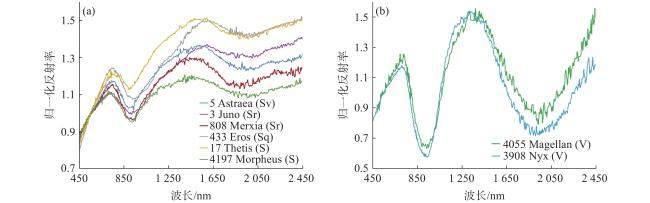
图1展示了本文所用小行星的可见光近红外光谱曲线,它们均归一化至0.55 μm。由于橄榄石和辉石等铁镁质矿物的存在,这些光谱在1μm和2μm附近呈现明显吸收特征。基于我们开发的小行星光谱分类算法,它们的类型如下:(17) Thetis和(4197) Morpheus是S型,(433) Eros是Sq型,(3) Juno和(808) Merxia是Sr型,(5) Astraea是Sv型,(3908) Nyx和(4055) Magellan是V型。在轨道分布上,(3) Juno、(5) Astraea、(17) Thetis和(808) Merxia属于主带小行星,(4197) Morpheus属于阿波罗型近地小行星,(433) Eros、(3908) Nyx和(4055) Magellan属于阿莫尔型近地小行星。
图 1 可见光-近红外反射光谱

(a) (5) Astraea、(3) Juno、(808) Merxia、(433) Eros、(17) Thetis和(4197) Morpheus;(b)(3908) Nyx与(4055) Magellan

Fig.1 VIS-NIR spectra of 8 asteroids

1.2 光谱分析方法

小天体的光谱参数是识别其物质成分的关键。本文计算的小行星光谱参数包括1 μm附近的吸收波段中心Ⅰ(Band I Center,BIC)、2 μm附近的吸收波段中心Ⅱ(Band Ⅱ Center,BIIC)以及由波段Ⅱ面积与波段I面积之比得到的波段面积比(Band Area Ratio,BAR)。为获得这些参数,需要对反射光谱进行连续统去除。过去的研究发现光谱连续统去除算法及相应的光谱参数结果受矿物吸收波段端元的影响,并据此提出了连续统去除方法[13]。本文基于该研究获得的连续统去除及光谱参数获取方法进行连续统去除并获得这8颗小行星的光谱参数。
本文进一步利用修正高斯模型(MGM)对混合物光谱进行去卷积[14]。MGM通过调整矿物吸收带的数量以及光谱连续统,能够将光谱反卷积为单高斯吸收峰从而识别存在的矿物含量,已被广泛应用于硅质小行星矿物反演[15] 。MGM模型认为小行星原始光谱由对数空间的连续统和数个高斯峰的和组成[16],如式(1)所示。
$ \mathrm{l}\mathrm{n}\left[R\left(\lambda \right)\right]=F\left(\mathrm{c}\mathrm{o}\mathrm{n}\mathrm{t}\right)+\sum _{i=1}^{N}{S}_{i} {\mathrm{exp}}\left[-\frac{{\left({\lambda }^{-1}-{{\mu }_{i}}^{-1}\right)}^{2}}{2{\sigma }_{i}^{2}}\right] $
式中,λ是波长;$ R\left(\lambda \right) $是波长λ的反射率;$ {S}_{i} $是高斯峰吸收强度;$ {\mu }_{i} $是高斯峰吸收中心;$ {\mathrm{\sigma }}_{i} $是高斯峰吸收宽度;N是高斯峰数量;$ F\left({\mathrm{cont}}\right) $是连续统的函数。
本文使用了波长空间的二阶多项式连续统,它能最大程度地拟合光谱形状[17],如式(2)所示。
$ {F}\left({\mathrm{cont}}\right)=C\left(\lambda \right)={\mathrm{ln}}\left({a}_{0}+{a}_{1}\lambda +{a}_{2}{\lambda }^{2}\right) $
式中,λ是波长;$ {a}_{0} $$ {a}_{1} $$ {a}_{2} $是连续统参数。
去除连续统后,每个高斯峰由3个模型参数描述,分别是吸收带的中心、宽度和强度。

2 结果与讨论

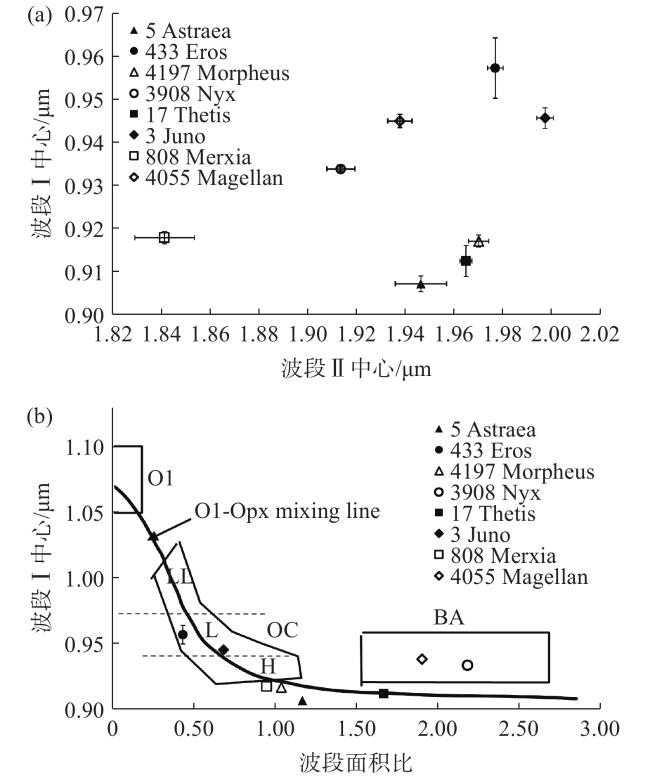
表1列出了本文计算的8颗小行星的波段I中心(BIC)、波段Ⅱ中心(BIIC) 、BAR等光谱参数。将表1的光谱参数绘制图2以确定所含的矿物类型和近似相对含量。虚线表示LL、L、H球粒陨石区域划分线[18],图中粗实线表示橄榄石-辉石矿物混合线[19],闭合多边形分别对应橄榄石(OL)区域、普通球粒陨石(OC)区域和玄武质无球粒陨石(BA)区域[20]。由图2(a)可见,除(808) Merxia外,其他小行星BIIC都超过1.90 μm,而(808) Merxia在2 μm处具有两个独立吸收峰,分别位于1.85 μm和2.35 μm附近,表明这些小行星都含有低钙辉石和高钙辉石。图2(b)对比了小行星和陨石的光谱参数。(433) Eros位于L型普通球粒陨石区域;(3) Juno位于H型普通球粒陨石区域;(4055) Magellan和(3908) Nyx位于玄武质无球粒陨石区域;(808) Merxia、(4197) Merpheus和(5) Astraea位于H型普通球粒陨石区域与橄榄石-辉石混合矿物线下方,(17) Thetis位于玄武质无球粒陨石区域下方的矿物混合线上。
表 1 8颗小行星的光谱参数

Table 1 Spectral band parameters of the eight asteroids

小行星 波段Ⅰ中心/μm 波段Ⅱ中心/μm 波段面积比
(5) Astraea 0.9071±0.0018 1.9464±0.0105 1.1666±0.0009
(17) Thetis 0.9124±0.0036 1.9649±0.0024 1.6669±0.0018
(433) Eros 0.9572±0.0070 1.9769±0.0032 0.4314±0.0003
(3) Juno 0.9456±0.0024 1.9973±0.0034 0.6814±0.0015
(4197)
Morpheus
0.9170±0.0014 1.9701±0.0041 1.0370±0.0026
(808) Merxia 0.9178±0.0014 1.8412±0.0122 0.9471±0.0013
(3908) Nyx 0.9338±0.0005 1.9135±0.0058 2.1818±0.0075
(4055) Magellan 0.9385±0.0013 1.9378±0.0050 1.9006±0.0108
图 2 小行星以及陨石光谱参数图

Fig.2 Plot of spectral parameter for asteroids and meteorites

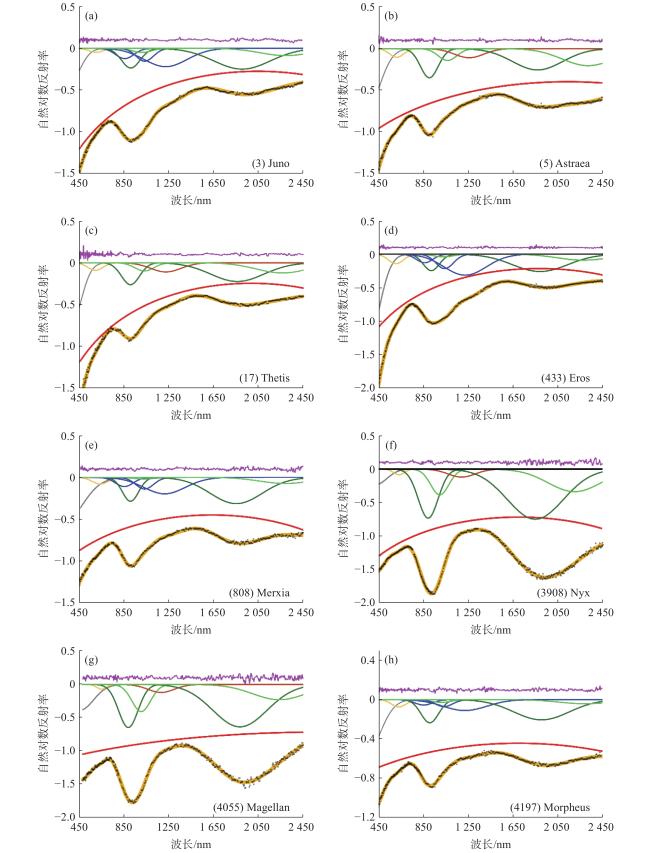
图3为8颗小行星MGM光谱去卷积结果。黑点是对数反射率;红线表示连续统;灰色、黄色、深绿色、浅绿色、蓝色、棕色高斯曲线分别代表紫外短波、稀有金属、低钙辉石、高钙辉石、橄榄石和辉石弱吸收曲线;橙色曲线是拟合结果;紫色线表示残差。根据残差结果采用7个或9个高斯峰解混,包括0.45 μm和0.65 μm附近的两个高斯峰,1 μm区域的3个或5个高斯峰以及2 μm区域的2个高斯峰。表2~表5分别展示了MGM的连续统和高斯拟合结果。通过MGM去卷积得到的橄榄石高斯峰中心以及辉石高斯峰深度比值确定这些小行星的镁橄榄石指数Fo#以及高钙辉石占比。
图 3 8颗小行星MGM光谱去卷积结果

Fig.3 Deconvolution results of MGM spectra of eight asteroids

表 2 修正高斯模型连续统参数和拟合误差

Table 2 Continuum and error in fit for MGM

小行星 连续统 拟合误差
a0 a1 a2
(5) Astraea 3.16E-01 6.42E-04 −1.50E-07 1.16%
(17) Thetis −2.65E-02 1.09E-03 −2.74E-07 1.68%
(433) Eros −8.15E-04 1.16E-03 −3.09E-07 0.88%
(3) Juno 9.27E-03 9.00E-04 −2.26E-07 1.68%
(4197) Morpheus 5.21E-01 4.08E-04 −1.20E-07 0.98%
(808) Merxia 3.59E-01 8.45E-04 −2.59E-07 1.19%
(3908) Nyx 1.19E-01 6.34E-04 −1.87E-07 1.68%
(4055) Magellan 3.80E-01 2.14E-04 −4.06E-08 2.24%
表 3 修正高斯模型高斯峰吸收带参数

Table 3 Gaussian peak absorption band parameters in MGM

小行星 波段Ⅰ 波段Ⅱ 波段Ⅲ
中心/
nm
半高宽/
nm
深度
(对数反射率)
中心/
nm
半高宽/
nm
深度
(对数反射率)
中心/
nm
半高宽/
nm
深度
(对数反射率)
(5) Astraea 332.44 283.58 0.7622 610.39 151.13 0.1032 902.29 188.01 0.3494
(17) Thetis 372.44 217.68 0.7624 594.36 159.62 0.0897 907.52 189.56 0.2632
(433) Eros 345.11 249.11 1.3099 600.13 158.63 0.1424 855.06 173.17 0.1285
(3) Juno 354.48 233.30 0.4295 600.53 142.46 0.0503 851.17 190.46 0.1231
(4197) Morpheus 331.17 301.02 0.5583 626.22 153.01 0.0733 849.21 187.52 0.0541
(808) Merxia 284.68 415.61 0.5877 634.06 166.33 0.0799 850.05 185.96 0.1102
(3908) Nyx 424.64 232.60 0.2304 630.05 113.87 0.0854 890.06 209.35 0.7362
(4055) Magellan 456.38 282.96 0.3884 649.85 99.82 0.0716 888.41 203.87 −0.63
表 4 修正高斯模型高斯峰吸收带参数

Table 4 Gaussian peak absorption band parameters in MGM

小行星 波段Ⅳ 波段Ⅴ 波段Ⅵ
中心/
nm
半高宽/
nm
深度
(对数反射率)
中心/
nm
半高宽/
nm
深度
(对数反射率)
中心/
nm
半高宽/
nm
深度
(对数反射率)
(5) Astraea 1065.67 196.25 0.1418 1258.97 311.94 0.1082 1871.90 528.51 0.2551
(17) Thetis 1030.81 200.93 0.0987 1222.91 318.80 0.1096 1860.54 558.85 0.2251
(433) Eros 915.53 169.60 0.2449 1024.56 202.92 0.0392 1034.49 185.98 0.2142
(3) Juno 913.89 195.42 0.2507 1027.66 200.02 0.0100 1032.03 182.12 0.1743
(4197) Morpheus 903.08 184.95 0.2345 1003.94 200.11 0.0273 1030.20 182.39 0.0698
(808) Merxia 905.39 171.20 0.2863 1023.82 202.52 0.0196 1031.57 186.47 0.1406
(3908) Nyx 993.72 190.49 0.3869 1188.94 284.19 0.1190 1846.29 588.20 0.7524
(4055) Magellan 1004.02 195.75 0.4082 1181.31 275.84 0.1196 1885.41 571.77 0.6366
表 5 修正高斯模型高斯峰吸收带参数

Table 5 Gaussian peak absorption band parameters in MGM

小行星 波段Ⅶ 波段Ⅷ 波段Ⅸ
中心/
nm
半高宽/
nm
深度
(对数反射率)
中心/
nm
半高宽/
nm
深度
(对数反射率)
中心/
nm
半高宽/
nm
深度
(对数反射率)
(5) Astraea 2324.91 549.60 0.2041
(17) Thetis 2263.98 553.20 0.1216
(433) Eros 1218.82 443.18 0.3128 1889.08 581.14 0.2583 2276.56 542.69 0.0897
(3) Juno 1213.89 456.53 0.2187 1924.19 602.72 0.2438 2292.27 542.18 0.0445
(4197) Morpheus 1211.58 456.50 0.1100 1902.41 580.79 0.2050 2292.90 547.60 0.0410
(808) Merxia 1210.36 440.05 0.1973 1852.15 547.47 0.3146 2293.04 543.48 0.0725
(3908) Nyx 2196.30 557.20 0.3379
(4055) Magellan 2237.70 560.30 0.2292
表 6 基于橄榄石高斯峰中心的镁橄榄石指数

Table 6 Fo# based on Gaussian peak center of olivine

小行星镁橄榄石指数
M1-10.766
(433) ErosM20.769
M1-20.759
M1-10.820
(3) JunoM20.825
M1-20.504
M1-10.847
(4197) MorpheusM20.866
M1-20.825
M1-10.835
(808) MerxiaM20.832
M1-20.837
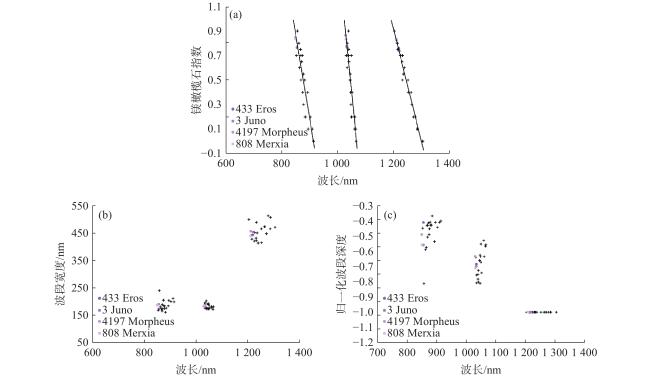
在反射光谱中,吸收中心的连续变化是由稍大的Fe2+(离子半径为0.077 nm)取代Mg2+(离子半径为0.072 nm)引起的,这增加了每个吸收位点的大小。由于吸收能量与位点大小成反比[21],随着铁含量的增加,吸收向较低的能量移动,光谱中橄榄石高斯峰吸收中心向长波方向移动[22],这种变化反映了Fo#的降低。即橄榄石高斯峰波段中心波长越长,橄榄石中镁橄榄石含量越少。图4为4颗小行星橄榄石高斯峰参数,其中黑十字表示Pinet等[23]反演的纯橄榄石样品,黑线表述趋势线图4(a)展示了基于橄榄石高斯峰波段中心反演Fo#的结果,其中(3) Juno、(4197) Morpheus和(808) Merxia的Fo#非常相近,在0.804~0.866;(433) Eros的Fo#值稍小,为0.76,具体数值见表6图4(b)和4(c)展示了橄榄石高斯峰的吸收宽度和吸收强度比,与Pinet等[23]实验样品的结果相吻合,表2展示的拟合残差均小于3%,证明本文反演结果具有物理意义和可靠性。
图 4 4颗小行星橄榄石高斯峰参数

Fig.4 Parameters of olivine Gaussian peak of four asteroids with olivine

表 7 基于辉石高斯峰吸收深度的高钙辉石占比

Table 7 Proportion of HCP based on absorption depth of pyroxene Gaussian peak

小行星 低钙与高钙辉石
吸收深度之比
高钙辉石丰度
(3) Juno 1 μm 25.00 0.09
2 μm 5.48 0.21
(5) Astraea 1 μm 2.47 0.37
2 μm 1.25 0.63
(17) Thetis 1 μm 2.67 0.37
2 μm 1.85 0.50
(433) Eros 1 μm 6.24 0.18
2 μm 2.88 0.35
(808) Merxia 1 μm 14.63 0.11
2 μm 4.34 0.24
(3908) Nyx 1 μm 1.90 0.47
2 μm 2.23 0.42
(4055) Magellan 1 μm 1.58 0.55
2 μm 2.78 0.36
(4197) Morpheus 1 μm 8.58 0.15
2 μm 5.00 0.22
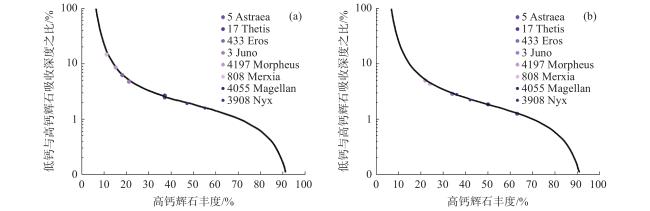
图5是基于相对能带强度(Component Band Strength Ratios,CBSR)和辉石丰度之间的相关性[24]得到的高钙辉石占比,即低钙辉石与高钙辉石高斯峰深度比值越小,辉石中高钙辉石占比越大。8颗小行星的高钙辉石占比差异较大,0.09~0.63不等,具体数值见表7。(3) Juno、(808) Merxia和 (4197) Morpheus光谱的MGM高斯峰反演结果相近,表明它们的成分类似。由表6表7可见,这3颗小行星具有较高的镁橄榄石含量(Fo#为0.82~0.85)和较低的高钙辉石占比(HCP/(HCP+LCP)为0.10到0.25),表明它们的成分与H球粒陨石相似; (433) Eros的Fo#为0.76,HCP/(HCP+LCP)为0.18~0.35,表明该小行星的表面成分与L球粒陨石相似,与Korda等[25]利用NEAR探测器抵近探测的研究结果一致,证明本文基于地基望远镜观测光谱的MGM反演具有可靠性。
图 5 低钙辉石和高钙辉石吸收强度比与小行星高钙辉石丰度之间的对数关系(a)1 μm区域的吸收;(b)2 μm区域的吸收[24]

Fig.5 The logarithmic relationships between the component band strength ratios (CBSR) for the primary LCP and HCP absorption bands and the modal abundance of HCP[24]

图3(b)和图3(c)显示小行星(5) Astraea和(17) Thetis表面主要由低钙辉石和高钙辉石组成。对拟合残差的分析表明,(5) Astraea和(17) Thetis不需要加入额外的橄榄石矿物。这两颗小行星的高钙辉石占比HCP/(HCP+LCP)均在 0.4~0.6,与玄武质无球粒陨石相似。
表7可见,V型小行星(3908) Nyx和(4055) Magellan的高钙辉石占比为0.36~0.55。这两颗小行星的矿物类型与富含高钙辉石的Sv型小行星(5) Astraea和S型小行星(17) Thetis类似,陨石类似物为玄武质无球粒陨石[26]
实验室测得的H球粒陨石、L球粒陨石、玄武质无球粒陨石的体密度分别为3.39 g/cm2、3.31 g/cm2以及 2.90 g/cm2,它们的孔隙度分别为和8.3%、3.7%和8.0%[27-28],而NEAR探测器飞越测得 (433) Eros的体密度和孔隙度分别为2.5 g/cm2和50%[29],Farnocchia等[30]预测的(3908) Nyx体密度为1 g/cm2。由此可见,小行星与陨石在密度与孔隙度等物理性质上差异很大,反映了太空风化等过程对小天体的显著影响。今后需要更多的探测手段和方法(如光度学)来反演小行星的矿物组成、颗粒度、孔隙度等目标特性,以更好地为防御任务方案制定提供详细支撑。

3 结论

硅质小行星是近地以及内主带小行星的主要类型,也是小行星防御任务和太空资源开采的重要对象。研究硅质小行星的物质成分有助于增进对太阳系天体多样性的理解,为小行星防御计划、太空资源开采等提供支撑。本文定量反演了8颗不同轨道位置具有高质量光谱的硅质小行星的矿物组成和含量,得到如下结论:
(1) (3) Juno、(433) Eros、(808) Merxia和(4197) Morpheus表面矿物成分与普通球粒陨石类似,其中Sr型小行星(3) Juno、(808) Merxia和S型小行星(4197) Morpheus具有较高的Fo#和较低的高钙辉石占比,表面成分类似于H型普通球粒陨石。Sq型小行星(433) Eros具有相对较低的Fo#和较高的高钙辉石占比,表面成分类似于L型普通球粒陨石。
(2)Sv型小行星(5) Astraea,S型小行星(17) Thetis与V型小行星(3908) Nyx和(4055)Magellan表面几乎不含橄榄石,这4颗小行星表面矿物成分与玄武质无球粒陨石类似。
(3)即便具有明显光谱吸收特征的硅质小行星,它们的矿物组成与密度具有多样性,与陨石类型并不一一对应。这既反映了小行星自身起源演化以及后期太空风化、冲击变质的影响,也说明了现有小行星光谱分类体系有待改进,在基于光谱解译小行星矿物组成及演化时需要谨慎。
1
BUS S J, BINZEL R P. Phase II of the small main-belt asteroid spectroscopic survey: A feature-based taxonomy[J]. Icarus, 2002, 158: 146- 177.

DOI

2
DEMEO F E,BINZEL R P,SLIVAN S M,et al,An extension of the Bus Asteroid taxonomy into the near-infrared[J]. Icarus,2009,202:160-180.

3
SUNSHINE J M, PIETERS C M, PRATT S F. Deconvolution of mineral absorption bands: An improved approach[J]. Journal of Geophysical Research: Solid Earth, 1990, 95 (B5): 6955- 6966.

DOI

4
龚自正, 李明, 陈川, 等. 小行星监测预警、安全防御和资源利用的前沿科学问题及关键技术[J]. 科学通报, 2020, 65 (5): 346- 372.

5
MILLER S D, STRAK III W C, BACHMEIER A S, et al. Earth-viewing satellite perspectives on the Chelyabinsk meteor event[J]. Proceedings of the National Academy of Sciences, 2013, 110 (45): 18092- 18097.

DOI

6
National Research Council,Division on Engineering,Physical Sciences,et al. Defending planet earth:Near-Earth-Object surveys and hazard mitigation strategies[M]. Washington DC:National Academies Press,2010.

7
吴伟仁, 唐玉华, 李明涛. 小行星防御在轨处置技术研究进展[J]. 深空探测学报(中英文), 2023, 10 (4): 345- 356.

8
RIVKIN A S, CHENG A F. Planetary defense with the Double Asteroid Redirection Test (DART) mission and prospects[J]. Nature Communications, 2023, 14 (1): 1003.

DOI

9
党雷宁, 白智勇, 石义雷, 等. 小行星撞击地球危害评估研究进展[J]. 力学进展, 2024, 54: 1- 43.

DOI

10
XU S, BINZEL R P, BURBINE T H, et al. Small main-belt asteroid spectroscopic survey: Initial results[J]. Icarus, 1995, 115 (1): 1- 35.

DOI

11
RAYNER J T, TOOMEY D W, ONAKA P M, et al. SpeX: A medium‐resolution 0.8-5.5 micron spectrograph and imager for the NASA infrared telescope facility[J]. Publications of the Astronomical Society of the Pacific, 2003, 115 (805): 362.

DOI

12
BINZEL R P, MORBIDELLI A, MEROUANE S, et al. Earth encounters as the origin of fresh surfaces on near-Earth asteroids[J]. Nature, 2010, 463 (7279): 331- 334.

DOI

13
WU Y, LI L, LUO X, et al. Geology, tectonism and composition of the northwest Imbrium region[J]. Icarus, 2018, 303: 67- 90.

DOI

14
RIVKIN A S, BINZEL R P, SUNSHINE J, et al. Infrared spectroscopic observations of 69230 Hermes (1937 UB): Possible unweathered endmember among ordinary chondrite analogs[J]. Icarus, 2004, 172 (2): 408- 414.

DOI

15
SUNSHINE J M, BUS S J, MCCOY T J, et al. High‐calcium pyroxene as an indicator of igneous differentiation in asteroids and meteorites[J]. Meteoritics & Planetary Science, 2004, 39 (8): 1343- 1357.

16
HAN H J, LU X P, YANG Y Z, et al. Study of the Modified Gaussian Model on olivine diagnostic spectral features and its applications in space weathering experiments[J]. Research in Astronomy and Astrophysics, 2020, 20 (8): 129.

DOI

17
CLOUTISl E A, GAFFEY M J, JACKOWSKI T L, et al. Calibrations of phase abundance, composition, and particle size distribution for olivine‐orthopyroxene mixtures from reflectance spectra[J]. Journal of Geophysical Research: Solid Earth, 1986, 91 (B11): 11641- 11653.

DOI

18
DUNN T L, MCCOY T J, SUNSHINE J M, et al. A coordinated spectral, mineralogical, and compositional study of ordinary chondrites[J]. Icarus, 2010, 208 (2): 789- 797.

DOI

19
CLENET H, PINET P, DAYDOU Y, et al. A new systematic approach using the Modified Gaussian Model: Insight for the characterization of chemical composition of olivines, pyroxenes and olivine-pyroxene mixtures[J]. Icarus, 2011, 213 (1): 404- 422.

DOI

20
GAFFEY M J, BELL J F, BROWN R H, et al. Mineralogical variations within the S-type asteroid class[J]. Icarus, 1993, 106 (2): 573- 602.

DOI

21
BURNS R G. Mineralogical applications of crystal field theory[M]. Cambridge:Cambridge University Press,1993.

22
SUNSHINE J M, PIETERS C M. Determining the composition of olivine from reflectance spectroscopy[J]. Journal of Geophysical Research: Planets, 1998, 103 (E6): 13675- 13688.

DOI

23
PINET P C, DAYDOU Y H, CHEVREL S D. Olivine composition and reflectance spectroscopy relationship revisited from advanced MGM deconvolution based on synthetic and natural samples[J]. Icarus, 2022, 373: 114765.

DOI

24
SUNSHINE J M, PIETERS C M. Estimating modal abundances from the spectra of natural and laboratory pyroxene mixtures using the modified Gaussian model[J]. Journal of Geophysical Research: Planets, 1993, 98 (E5): 9075- 9087.

DOI

25
KORDA D, KOHOUT T, FLANDEROVA K, et al. (433) Eros and (25143) Itokawa surface properties from reflectance spectra[J]. Astronomy & Astrophysics, 2023, 675: A50.

26
MAYNE R G, SUNSHINE J M, MCSWEEN Jr H Y, et al. The origin of Vesta’s crust: Insights from spectroscopy of the Vestoids[J]. Icarus, 2011, 214 (1): 147- 160.

DOI

27
WILKISON S L, MCCOY T J, MCAMANT J E, et al. Porosity and density of ordinary chondrites: Clues to the formation of friable and porous ordinary chondrites[J]. Meteoritics & Planetary Science, 2003, 38 (10): 1533- 1546.

28
MACKE R J, BRITT D T, CONSOLMAGNO G J. Density, porosity, and magnetic susceptibility of achondritic meteorites[J]. Meteoritics & Planetary Science, 2011, 46 (2): 311- 326.

29
YEOMANS D K, ANTREASIAN P G, CHENG A, et al. Estimating the mass of asteroid 433 Eros during the NEAR spacecraft flyby[J]. Science, 1999, 285 (5427): 560- 561.

DOI

30
FARNOCCHIA D, CHESLEY S R, THOLEN D J, et al. High precision predictions for near-Earth asteroids: The strange case of (3908) Nyx[J]. Celestial Mechanics and Dynamical Astronomy, 2014, 119: 301- 312.

DOI

Outlines

/