
0 引 言
月球表面的复杂带电等离子体环境主要由太阳光照、二次电子发射、高能带电粒子撞击及高能宇宙线传输等因素共同组成。Shi等[7]梳理了宇宙线、太阳能量粒子事件、太阳风、地球风及月源粒子等不同辐射源的传输机制,分析了近月带电粒子辐射环境对月表物质的作用机理。Stubbs等[8]发现,在太阳风作用下,月面电位主要受等离子体密度、电子温度、离子温度、流速、光电子发射电流及光电子温度等六个参数影响,其中电子温度起主要作用。Halekas等[9]观测表明,月面向阳侧电位约为10.00~20.00 V,而背阳侧电位约为0~−100.00 V。在数值模拟方面,劳传祺等[10]基于欧空局开发的航天器等离子体相互作用系统(Spacecraft Plasma Interaction System,SPIS),揭示了不同等离子体环境下的月面充电效应及电位变化规律。李梦谣等[11]分析了月球南极0~200 m高度范围内的月面充电效应和带电月尘分布,总结出了月球南极附近尘埃等离子体环境的主要特征。王馨悦等[12]基于嫦娥一号、二号绕月卫星穿越地球磁尾边界层的观测数据,采用电流平衡法建立了月表与绕月卫星的充电模型,研究了高能电子爆发对绕月卫星及月球表面电位变化产生的影响。Griseri等[13]通过分析多起与静电放电相关的航天器故障案例,揭示了月面充电效应对航天器安全运行的潜在影响。由此可见,月面电位的形成与变化不仅受到等离子体环境的物理影响,也会反过来作用于月尘颗粒的带电状态和空间分布规律。
月面充电效应与空间等离子体环境直接决定了月球近表空间的电势结构与带电月尘分布特性。针对月面充电效应与带电月尘的相互作用机理,国内外学者已开展了大量研究。Popel等[14-17]和Kassem等[18]系统研究了月球表面尘埃等离子体的形成过程、动力学行为及数学模型。Zelenyi等[19]聚焦月球风化层中等离子体与带电尘埃层的形成机制,分析了月尘、月壤形成的外部因素,尤其是极区月尘在近地等离子体中的动力学机制。Gan等[20]模拟了不同半径带电月尘颗粒在静电力作用下的运动轨迹,推断月球尘埃实验装置(Lunar Dust Experiment,LDEX)探测到的月球背阳侧沙尘事件可能与月尘颗粒的静电迁移相关。在月尘输运与沉积机制方面,董泰郎等[21]发现月球明暗交界区存在显著的月尘输运异常,认为交界线上方月尘积聚可能是探测器表面沉积的主要来源。Yang等[22]探究了月尘脱离月球表面的动力学方程和影响因素,并通过长期模拟计算了地月系统中的粒子数密度分布,其研究侧重点偏向于带电月尘在等离子体环境中运动存在的各类影响因素,包括太阳辐射压力,月球、地球及太阳的重力、运行轨道影响,尘埃粒子的轨迹、最终状态、组成成分及平均寿命,得到了综合考虑下能够逸出月面的月尘颗粒的特征参数。现有研究在月尘输运、充电效应机理等方面取得了重要进展,但多数工作仍集中于太阳风区等典型磁层条件。月球在绕地运行过程中会周期性地穿越地球磁层,在此过程中,磁层会屏蔽太阳风,导致地球磁尾区的等离子体参数与典型磁层环境存在显著差异。然而,针对月球处于磁尾不同区域(尤其是磁尾瓣区)时,月表的充电过程以及月表空间中的电子、离子与带电月尘的空间分布特征,相关研究仍存在不足。
因此,本文采用欧空局开发的SPIS,对磁尾瓣区等离子体环境中的月面充电效应及带电月尘空间分布进行仿真研究。首先,分析了月面充电和带电月尘运动的物理过程;其次,根据磁尾瓣区等离子体环境特征设定仿真参数,建立了月面等离子体充电模型;最后,通过该模型分析了磁尾瓣区月面充电效应与带电月尘的空间分布特征。研究结果有助于揭示月面附近月尘等离子体的空间环境特性,为我国后续月球探测任务中设备防护与环境适应设计提供理论支撑。
1 月面充电效应原理与带电月尘动力学分析
1.1 月面充电效应原理
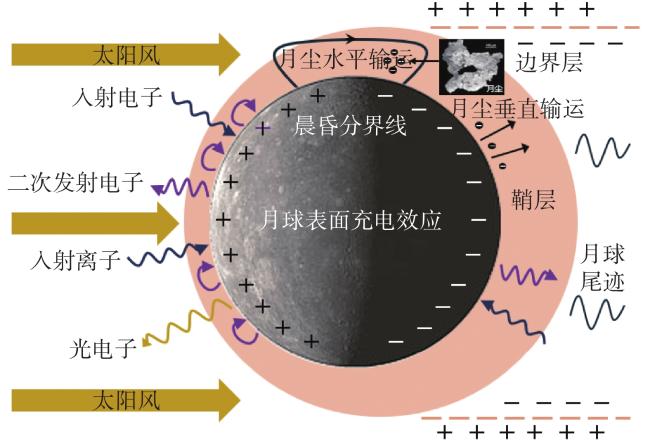
受潮汐锁定效应作用,月球的自转周期与绕地公转周期相同,这使得月球一面始终朝向地球,导致月球表面形成了长期且显著的日照不对称性。在向阳面,太阳光照诱发光电效应,促使电子从月球表面逸出;同时,太阳风和极紫外辐射带来的高能粒子不断轰击月球表面。在电子入射电流与光电子发射电流共同作用下,月球向阳面上方会形成一个非均匀电势区域,即光电鞘层。该区域具有明显的德拜屏蔽效应,能够削弱周围等离子体对带电表面的直接影响,使光电子发射成为月面电位变化的主导过程,从而导致月球向阳面呈正电位。相对而言,背阳面缺乏太阳辐照,月球表面电荷主要由等离子体环境产生的入射电流主导。由于等离子体中电子与离子的密度和温度相近,而电子质量远小于离子,其热速度更高,向月面输运的电流密度更大,导致月球背阳面带负电[23-24]。月面充电效应原理如图1 所示。
月面的充电方程为:
式中,$ {I}_{P} $ 为光电子发射电流,$ {I}_{e} $ 为电子入射电流,$ {I}_{i} $ 为离子入射电流,$ {I}_{s} $ 为电子二次发射电流。在月球向阳面,月面充电由光电子发射电流主导,在月球背阳面,月面充电由电子入射电流主导。
1.2 带电月尘在月球表面电场中的迁移特性
在月面电位随入射电流变化的过程中,飘散在月球表面的月尘会因黏附、摩擦、光电效应及二次电子发射等原因带上电荷,并在月面电场的作用下向面外迁移,带电月尘颗粒在月球表面的迁移运动过程如图2 所示。月尘所受静电力$ {F}_{q} $ 与自身重力$ {F}_{g} $ 、分子间作用力$ {F}_{c} $ 达到动态平衡,使得带电月尘悬浮于月表之上。
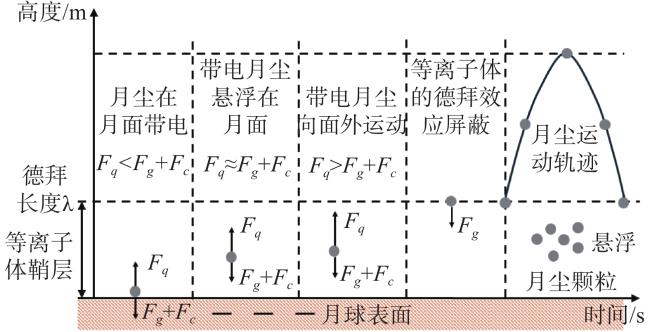
在研究月尘的迁移特性时,一般忽略分子间的作用力,其表达式为:
式中,$ m $ 为月尘颗粒的质量,$ {r}_{{\mathrm{d}}} $ 为月尘颗粒的半径,$ {\rho }_{{\mathrm{d}}} $ 为月尘颗粒的密度,$ g $ 为月球的重力加速度。
月尘颗粒所受静电力由自身所带电荷和所处月面的电场强度决定。月面场强会对到达月尘表面的电子和离子的数量与速度产生影响,而带电月尘形成的尘埃云也会影响月面电势分布。因此,月尘颗粒所受到的静电力是与时间相关的变函数。磁尾瓣区充斥的主要为低温等离子体,月尘颗粒通过与电子的碰撞带电。依据轨道限制理论,可以得到只考虑碰撞效应下电子轰击尘埃颗粒的充电方程如下[25]。
式中,$ q $ 为月尘颗粒的带电量,$ {n}_{\text{e}} $ 为电子密度,$ \text{e} $ 为单位电荷量,$ {\overline{v}}_{\text{e}} $ 为电子的平均热速度,$ {\phi }_{\text{d}} $ 为月尘颗粒的表面电势,$ \text{erf(}\cdot \text{)=(2/}\sqrt{\text{π}}\text{)}\int\exp (-{t}^{2})\text{d}t $ 为误差函数。$ \varsigma $ 为一个无量纲的数,表达式为:
式中,$ {v}_{\text{e}} $ 表示电子的热速度,$ {T}_{\text{e}} $ 表示局域的平衡温度,$ {m}_{\text{e}} $ 表示电子的质量。
2 地球磁尾瓣区月面充电效应仿真分析
2.1 磁尾环境参数设置
在绕地球公转的轨道周期中,月球约有四分之三的时间处于太阳风环境中,其余约四分之一的时间处于地球磁层内。地球磁层由磁层顶、等离子体幔、磁尾瓣、中性片、等离子体层、等离子体片等区域组成。磁层的存在有效屏蔽了太阳风高能粒子的传播,使磁尾区域内的带电粒子流在密度、温度和能谱结构等方面与太阳风环境存在显著差异。在确定磁尾环境参数时,由于太阳风环境会爆发太阳高能粒子事件,使能量电子注入量瞬时增强,形成高能等离子体电流,并使月表电位出现急剧跃变,幅值可达数千伏级。此外,磁尾等离子片环境中的热等离子体可能会引起月球尘暴和静电释放,而磁鞘层环境下的等离子体温度过低,无法引起月面电位显著变化。综上所述,磁尾瓣区因为缺乏太阳光照,其月面充电效应及带电月尘的迁移运动仅由入射电子和离子主导,其月面充电及带电月尘的迁移过程如图3 所示。
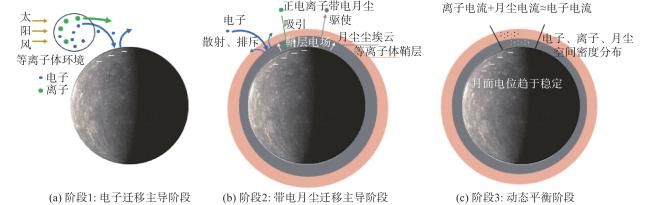
因此,为研究稳态条件下的月面充电效应,本文针对无光照(即月球背阳面)条件下的地球磁尾瓣区等离子体环境,通过仿真分析月面充电效应及带电尘埃空间分布特征。月球表面的等离子体环境典型参数参照表1 。
等离子体环境参数设置如下:电子和离子密度均为5.00×10⁴ m−3,电子速度为400 km/s,电子温度为50 eV,离子温度为500 eV,月球土壤的电导率设定为10−14 S/m。模拟采用71501-1号月壤材料,月尘颗粒的半径设置为2~100 μm,初始月尘密度为1 000 kg/m3,其中月尘颗粒密度为3 000 kg/m3,月面初始电位设置为0,模拟时间设置为230 s。
2.2 磁尾瓣区月面电流变化分析
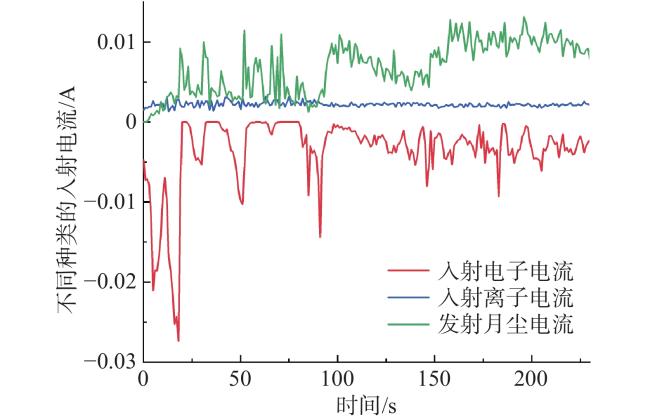
仿真结果如图4 所示。在初始状态下,月面电位为0 V,此时电子入射电流约为−0.004 0 A,离子电流约为0.001 8 A。仿真开始后,由于电子质量远小于离子,磁尾中的高速电子流率先抵达月面并被吸收,导致电子入射电流迅速增加。同时,处于等离子体环境中的月尘颗粒逐渐带负电,并向面外迁移,月尘电流由零缓慢上升。在充电初期,月面电位的变化主要由电子迁移过程主导。随着月面负电位增强,静电排斥力驱动大量带负电的月尘颗粒向外迁移运动,并在月表上方形成带电尘埃层。约19 s时,月面电位达到幅值−39.00 V,月尘电流增加至幅值0.009 0 A。这一幅值的出现标志着月面电流开始从“电子主导阶段”向“尘埃主导阶段”过渡。此时,带负电的尘埃云通过吸收和排斥作用削弱电子通量,使电子入射电流骤降至接近零的水平。随后,部分高速电子流突破尘埃层的遮挡,电子入射电流开始回升。但外层等离子体与月面的电荷交换速率已显著降低,使电子电流维持在极低水平。而环境中的离子流受惯性影响较小,且不受月面电位影响,基本保持在0.002 0 A左右。当充放电过程趋于稳定后(t>160 s),电子入射电流、月尘电流与离子入射电流形成新的动态平衡并保持稳定:电子入射电流约为−0.030 0 A,月尘电流约0.010 0 A,离子电流约0.002 0A。
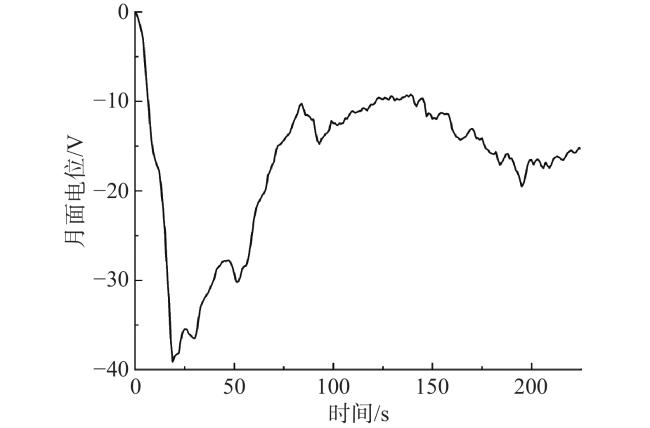
磁尾瓣区月面电位随时间的变化如图5 所示。在仿真开始时,月面电位因高速电子流入射而逐渐降低,并在19 s达到最大幅值。随后,大量带电月尘在静电力和分子间作用力下向面外迁移,并形成带电尘埃层,近月面负电荷逐渐减少。随着磁尾区的高速电子流突破尘埃云,月面电位缓慢回升并在−10.00~−20.00 V内波动。综上所述,月面电位随时间的演化可分为两个阶段:早期由电子迁移驱动的月面电位负化和带电尘埃云形成过程;后期是高速电子流突破尘埃层而形成的电位回升过程,这两个阶段共同构成了磁尾瓣区等离子体条件下的月面稳态充放电平衡。
3 磁尾瓣区粒子空间分布特征分析
3.1 磁尾瓣区月尘空间密度分布
仿真达到平衡状态后,月尘空间密度随月面高度的分布如图6 所示。根据图2 所示的带电月尘运动原理,带电月尘首先会在月面电场的作用下向月面上方运动。由于磁尾瓣区所充斥的低温稀薄等离子体,导致月面电位变化幅值较低,大部分带电月尘所受静电力约等于自身重力和分子间作用力之和,该部分月尘会在近月面区域悬浮。由仿真结果可知,在0~100 m高度范围内,大部分月尘集中于此,使该范围内的近月面月尘空间密度达到最大值,约为1.00×10⁶~1.10×10⁶ m−3;在月面100~5 000 m高度范围内,存在部分平均粒径较大的月尘颗粒。该部分月尘颗粒因体积较大,在空间等离子体的作用下会携带更多电荷,从而在月面电场的作用下产生更强的静电力,使其可迁移至离月面较远的区域。但随着高度的不断上升,等离子体鞘层会受到德拜屏蔽效应的影响,使离开该鞘层的月尘仅受自身重力作用,并再次返回近月面,月尘空间密度随离月面高度而不断下降,其范围约为6.10×10⁴~1.00×10⁶ m−3间。综上所述,在磁尾瓣环境下,带电月尘会在0~100 m高度范围内形成密度在106 m−3量级的尘埃层,这严重危害航天设备的安全性。
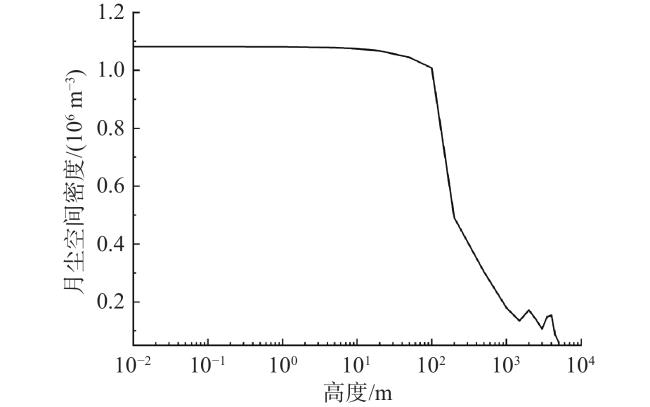
磁尾瓣区等离子体环境可概括为:无光照,温度低,离子流动缓慢。因此,在该区域内,月球表面电位较低;且由于缺乏光电效应,月尘颗粒仅通过碰撞和二次电子发射带电,单位密度的月尘颗粒所带电荷量不大。这两个因素相互叠加,导致带电月尘所受静电力较小,使得月尘主要集中于近月面。正如仿真结果所示,近月面的月尘密度达106 m−3量级,而在100~5 000 m内,月尘密度在104~106 m−3量级,接近“阿波罗”探测数据的量级。为了探究本文数据的合理性,保持仿真模型不变,参照磁尾等离子片环境参数重新进行了仿真实验。结果表明,在等离子体片环境下,月面充电电位较高,平衡后约为−748.00 V,使得对应的月表带电月尘的空间密度也出现了降低,在0~10 000 m高度范围内为0~3.5×10⁴ m−3,符合“阿波罗”探测数据的量级[26-29]。
近月面高密度尘埃层的量级差异和形成原因同样是因为磁尾瓣环境的参数差异所致。例如,李梦谣等[11]同样是通过SPIS,研究了月球南极0~200 m高度范围的等离子体和月尘的空间分布情况及月面充电特性。该地区的等离子体环境在空间电子、离子密度和太阳入射角等方面与磁尾瓣区存在显著差异,其所得的月尘空间密度就与本文存在量级差异。
3.2 磁尾瓣区电子空间密度分布
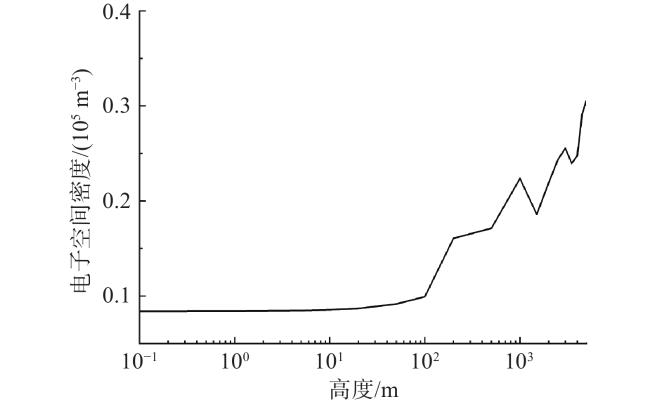
电子的空间分布主要受近月面空间电场的影响。由于电子质量轻,速度快,在热运动下,高速电子流会沿地球磁尾运动至月面,使月面电位快速下降。随着月面电位的升高,电子所受静电力排斥及带电尘埃云的散射作用增强,大部分电子会被带电尘埃云阻挡并聚集在云外,仅有部分电子能够再次突破尘埃云,被月表吸收。如图7 所示,在0~100 m高度范围内,电子的空间密度约为8.39×10³~9.92×10³ m−3;而在100~10 000 m高度范围内,大部分电子富集在此,电子空间密度随距月面高度的升高而逐渐上升,密度范围为9.92×10³~3.06×10⁴ m−3。
3.3 磁尾瓣区离子空间密度分布
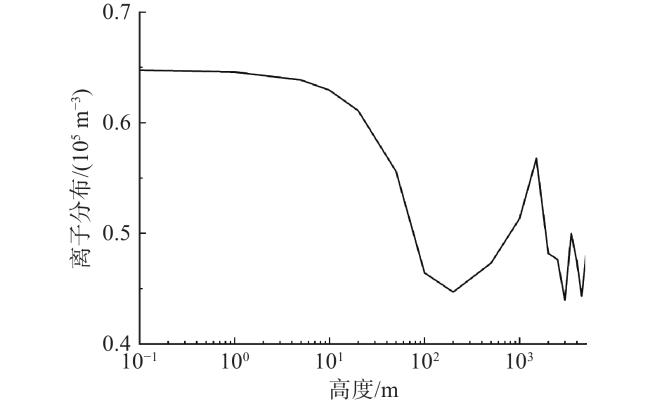
离子因质量较大且热运动较弱,主要集中在离月表较远空间的等离子体环境中。因此,该远月区域的离子密度趋于稳定。但由于带负电月面和月尘颗粒对近月面区域离子的吸引作用,使得中间区域的离子朝月面运动,离子的空间密度随距月表距离的降低而不断增加,最终在月球表面形成电子和离子入射电流的动态平衡。如图8 所示,在月表上方0~100 m高度区间内,近月面区域的离子受电场的吸引,朝着月球表面运动,使得近月表区域内的离子空间密度达到峰值,约为6.47×10⁴ ~4.64×10⁴ m−3;在100~1 000 m高度范围内,离子密度则稳定维持在约5.00×10⁴ m−3的水平。
3.4 磁尾瓣区空间电势分布
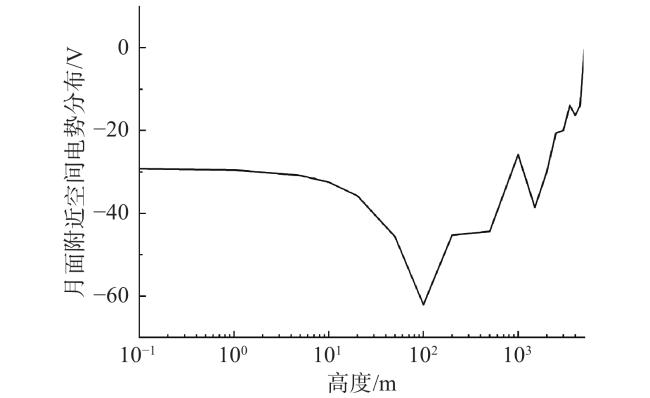
在磁尾瓣区等离子体环境下,月面附近空间电势分布如图9 所示。在0~100 m高度区间,电势随高度降低,形成竖直向上的电场。这使得带负电的月尘颗粒受到方向向下的静电力,促使月尘聚集于近月表区域。而在100~5 000 m高度区间内,电场方向转变为竖直向下,带电月尘受到竖直向上的静电力,驱使月尘颗粒远离月面。该仿真结果同时也解释了图6 所得的月尘空间密度分布曲线的原因,即在0~100 m高度处,月尘空间密度较高;而在大于100 m高度处,月尘空间密度急剧下降。假设不考虑带电月尘间的分子作用力,带电月尘在月面主要受静电力和重力影响,以典型月尘颗粒(密度为3 000 kg/m3,粒径为1.6 nm,带电量为1.6×10⁻¹⁹ C)为例,在100~5 000 m的高度区间内,月表电场强度约为0.013 V/m,该月尘所受电场力约为2×10−21 N,显著大于其自身所受到的重力(约5×10⁻²² N)。因此,在此高度区间内,带电月尘在垂直于月面的电场力作用下持续向上迁移。


4 结 语
本文首先分析了月面电位变化和带电月尘迁移过程的物理原理,然后通过SPIS,分析磁尾瓣区等离子体环境下的月面充电特性和带电月尘的空间迁移过程,揭示磁尾瓣区月球表面电位、电流的变化趋势,以及带电月尘、电子和离子的空间密度分布规律,得出了如下结论:
(1)月面电位波动规律。磁尾瓣区月面电位变化具有显著的波动性。仿真结果显示,月面最低电位约为−39.11 V,最高约为−10.00 V。当月面电位降至最低点时,离子入射电流、电子入射电流和带电月尘电流达到动态平衡,随后月面电位趋于稳定。该结果与月球勘探者(Lunar Prospector,LP)探测结果(月球充电电位等离子体片环境为−500.00~−2 000.00 V;磁尾瓣环境为0~−100.00 V)及Halekas等[9]的仿真一致(月球表面向阳侧电位约为10.00~20.00 V,背阳侧电位约为−100.00 V),验证了模型的合理性。
(2)带电尘埃空间分布规律。磁尾瓣区下的月尘空间密度随月面高度的升高而降低。在0~100 m高度范围内,带电月尘的空间密度约为1.00×10⁶~1.10×10⁶ m−3;在100~5 000 m高度范围内,空间密度约为6.10×10⁴~1.00×10⁶ m−3。研究表面,磁尾瓣区独特的等离子体环境会在月面近地层(0~100 m)形成密度达106 m−3量级的高浓度尘埃层,远超“阿波罗”、月球大气与尘埃环境探测器(Lunar Atmosphere and Dust Environment Explorer,LADEE)的探测数据量级,可能对航天器表面及电子设备的安全运行构成潜在威胁。
(3)电子与离子密度与月面空间电势分布特征。在0~100 m高度范围内,受月面负电势影响,电子密度较低(8.39×10³~9.92×10³ m−3),离子密度相对较高(6.47×10⁴~4.64×10⁴ m−3)。随着月面电位上升,电子受静电力排斥及带电尘埃云的散射作用增强,其空间密度逐渐上升至9.92×10³~3.06×10⁴ m−3,而离子密度受自身质量与惯性影响,基本维持在5.00×10⁴ m−3。