氧化锆纤维的稳定策略、制备方法与应用

  • 绪哲 , 1 ,
  • 李佳欣 1 ,
  • 路振燕 1 ,
  • 刘红梅 , 1, * ,
  • 汪俊亮 2 ,
  • 贾超 , 1, * ,
  • 朱美芳 1
展开
  • 1. 东华大学先进纤维材料全国重点实验室, 上海 201620
  • 2. 东华大学人工智能研究院, 上海 201620
(1991-),女,博士后。主要研究方向为气流辅助微纳米纤维纱线、功能纤维纱线、陶瓷纤维纱线。(本文通信作者)通信地址:上海市松江区人民北路 2999 号(201620)电子邮箱:
(1986-),男,副研究员。主要研究方向为陶瓷纤维、功能纤维。(本文通信作者)通信地址:上海市松江区人民北路 2999 号(201620)电子邮箱:

(1999-),女,博士研究生。主要研究方向为陶瓷纤维制备及性能研究。通信地址:上海市松江区人民北路 2999 号(201620)电子邮箱:

网络出版日期: 2026-01-20

基金资助

国家自然科学基金(52422312,52102090,U23B2079);中央高校基本科研业务费专项资金(2232022D-04)

Stabilization Strategies, Preparation Methods and Applications of Zirconia Fibers

  • Zhe XU , 1 ,
  • Jiaxin LI 1 ,
  • Zhenyan LU 1 ,
  • Hongmei LIU , 1, * ,
  • Junliang WANG 2 ,
  • Chao JIA , 1, * ,
  • Meifang ZHU 1
Expand
  • 1. State Key Laboratory of Advanced Fiber Materials, Donghua University, Shanghai 201620, China
  • 2. Institute of Artificial Intelligence, Donghua University, Shanghai 201620, China

Online published: 2026-01-20

摘要

氧化锆(Zirconia,ZrO2)陶瓷纤维因其具有耐高温、低热导率及良好的化学稳定性等优势,已在多个领域得到广泛应用。综述了近年来ZrO2纤维的研究进展,包括稳定化策略、制备方法及应用。首先,简要介绍了ZrO2纤维的稳定剂及稳定化机理。其次,探讨了ZrO2纤维的多种制备方法,如静电纺丝、溶液喷射纺丝、离心纺丝、模板法及干法纺丝等。随后,详细介绍了ZrO2纤维在隔热保温、空气过滤及水处理等领域的应用。最后,对ZrO2纤维的制备及应用前景进行了展望。

本文引用格式

绪哲 , 李佳欣 , 路振燕 , 刘红梅 , 汪俊亮 , 贾超 , 朱美芳 . 氧化锆纤维的稳定策略、制备方法与应用[J]. 空间科学与试验学报, 2025 , 2(5) : 20 -36 . DOI: 10.19963/j.cnki.2097-4302.2025.05.003

Abstract

Zirconia (ZrO2) ceramic fibers have been widely used in various fields due to their advantages of high-temperature resistance, low thermal conductivity, and good chemical stability. This paper reviews the research progress of ZrO2 fibers in recent years, including stabilization strategies, preparation methods, and applications. First, the stabilizers and stabilization mechanism of ZrO2 fibers are introduced briefly. Then, various preparation methods for ZrO2 fibers are discussed, including electrospinning, solution blow spinning, centrifugal spinning, template method, and dry spinning. After that, the applications of ZrO2 fibers in thermal insulation, air filtration, and water treatment are introduced in detail. Finally, the preparation and application prospects of ZrO2 fibers are prospected.

0 引 言

氧化锆(Zirconia,ZrO2)陶瓷的脆性是制约其应用的主要因素,而ZrO2纤维在保持ZrO2陶瓷固有特性的同时,由于添加了合适的稳定剂而兼具优异的柔韧性,展现出显著优势。ZrO2纤维不仅具有耐高温和化学稳定性,ZrO2纤维膜和气凝胶还具有轻质、低热导率等优势。因此,ZrO2纤维已广泛应用于隔热保温[1-2]、空气过滤[3-4]、水处理[5]、催化剂载体[6]、电池隔膜[7]等领域。
本文重点关注ZrO2微纳短纤维的最新研究进展,包括稳定化策略、制备方法及应用。首先,简要介绍ZrO2纤维制备中的关键稳定剂,如氧化钇(Y2O3)、氧化铝(Al2O3)、氧化钙(CaO)和氧化镁(MgO)等。其次,探讨了ZrO2纤维的常用制备方法,包括静电纺丝、溶液喷射纺丝、离心纺丝、模板法、干法纺丝等。随后,重点介绍了ZrO2纤维在隔热保温、空气过滤、水处理及电池隔膜等领域的应用。最后,对ZrO2纤维的未来发展提出了一些展望。

1 ZrO2纤维稳定化策略

在ZrO2纤维的制备过程中,纺丝液中的无机组分主要由ZrO2前驱体与稳定剂构成。ZrO2前驱体主要有锆盐、锆溶胶和聚锆前驱体三类。当以锆盐为前驱体时,体系黏度主要由加入的聚合物提供,常用聚合物聚环氧乙烷(Polyethylene Oxide,PEO)、聚乙烯吡咯烷酮(Polyvinyl Pyrrolidone,PVP)、聚丙烯腈(Polyacrylonitrile,PAN)、聚乙烯醇(Polyvinyl Alcohol,PVA),因此所得前驱体纤维中聚合物含量通常较高。锆溶胶通过溶胶-凝胶法制备,即通过锆盐的水解与缩合,形成以-Zr-O-Zr-为主链结构的长链溶胶。刘久荣[8]以氧氯化锆为原料合成乙酰丙酮锆,并以甲醇为溶剂配制成溶胶,通过蒸发溶剂得到具有可纺性的乙酰丙酮锆溶胶,实现了纤维的连续化制备。但该方法存在溶胶稳定性差、易发生凝胶化的问题。
相比之下,聚锆前驱体法通过锆盐与有机配体的配位聚合反应,得到长链有机锆聚合物,体系稳定性更高。刘和义[9]以氧氯化锆为锆源,乙酸丙酮为络合剂,在甲醇中合成聚乙酰丙酮锆(Polyacetylacetonatozirconium,PAZ)前驱体,并引入硝酸钇作为稳定剂,最终浓缩得到黏度约20 pa·s的可纺体系。该纺丝液经离心纺丝制备出Y2O3稳定的ZrO2纤维。总体来看,相较于溶胶-凝胶法,聚锆前驱体法在体系稳定性与可控性方面具有明显优势。
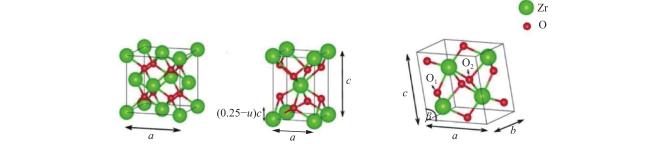
ZrO2具有三种晶相,即单斜相、四方相和立方相(见图1[10]。ZrO2的晶相随温度变化:室温下为单斜相,升温至1 170 °C以上转变为四方相,高于2 370 °C则变为立方相[11]。因此,ZrO2纤维在纺丝后的煅烧阶段会经历相应的相变。由于不同晶相的ZrO2存在密度差异(立方相为6.06 g·cm−3,四方相为6.10 g·cm−3,单斜相为5.83 g·cm−3),因此ZrO2在相变过程中存在体积变化,四方相至单斜相的转变会导致约5%的体积膨胀,进而导致材料开裂[12]。因此,ZrO2的晶相稳定至关重要。
图 1 ZrO2的三种晶相[17]

Fig.1 Three crystal phases of ZrO2[17]

稳定剂是ZrO2纤维的重要组成部分。通过添加稳定剂抑制相变,可将ZrO2稳定在四方相或立方相,从而避免相变引起的体积变化。基于此,稳定化的ZrO2可分为三类[13]:完全稳定ZrO2(Full Stabilized Zirconia,FSZ)指添加足量稳定剂得到的仅存在立方相的ZrO2[13];部分稳定ZrO2(Partially Stabilized Zirconia,PSZ)指添加一定量稳定剂后得到的稳定的立方相和未稳定的单斜相共存的ZrO2[14];四方ZrO2多晶体(Tetragonal Zirconia Polycrystalline,TZP)指加入少量稳定剂获得的全四方相的ZrO2[15-16]
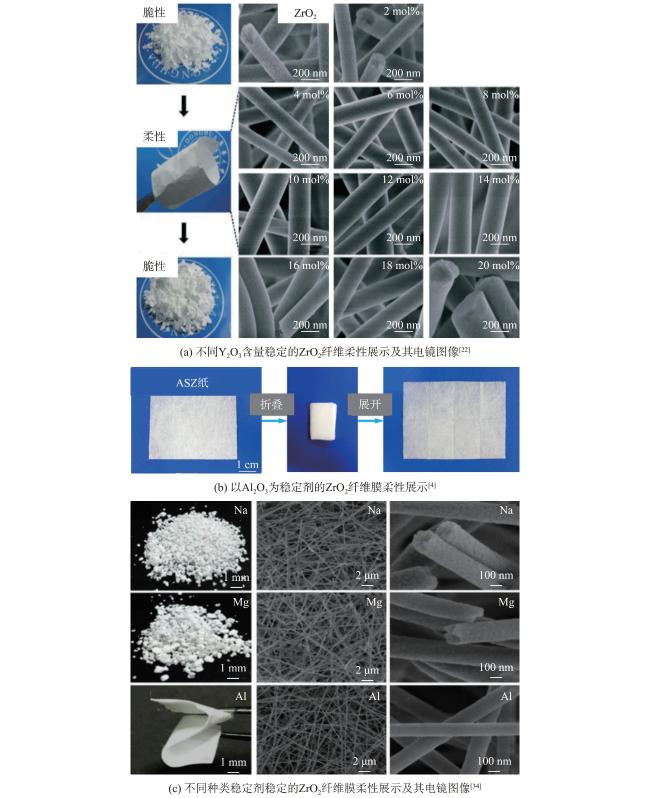
常用的稳定剂包括Y2O3[18]、Al2O3[19]、CaO[20]和MgO[21]等。稳定剂使ZrO2稳定的原理为:稳定剂中的阳离子(Y3+、Al3+、Ca2+、Mg2+等)替代Zr4+的晶格位置并形成置换固溶体,从而阻碍晶界滑移与晶相转变,实现对ZrO2晶格的稳定。由于不同稳定剂的离子半径和价位存在差异,其稳定效果也各不相同。此外,稳定剂用量对ZrO2的稳定性影响显著,用量不同会导致ZrO2相组成存在差异。用量过少无法稳定晶格,而用量过多则会使ZrO2中产生大量氧空位,从而产生缺陷,影响材料力学性能[22]。因此,稳定剂的种类及含量对ZrO2纤维的柔性有重要影响。
表1列出了添加不同稳定剂ZrO2纤维的制备方法。Y2O3是ZrO2最常用的稳定剂。Mao等[22]制备了一系列不同Y2O3含量的ZrO2纤维膜。结果显示,当Y2O3占ZrO2含量4~14 mol%时,纤维膜柔性良好;当Y2O3含量为6 mol%时,弯曲强度最低、柔性最佳(见图2(a))。ZrO2纤维的柔性受晶体结构、晶粒尺寸及纤维内部孔隙结构的影响[22]。Rodaev等[37]制备了CaO稳定的ZrO2纤维,发现随着CaO含量的增加,ZrO2由单斜相逐渐转变为立方相和四方相,且煅烧温度升高会降低四方相含量。Jia等[4]制备出柔性良好的Al2O3稳定的ZrO2纤维膜(见图2(b)),且该纤维膜能耐受1 100 °C高温。Al2O3可显著减小ZrO2晶粒尺寸,将其晶相稳定在四方相,有效抑制马氏体相变。
表 1 添加不同稳定剂的ZrO2纤维制备方法

Table 1 Preparation methods of ZrO2 fibers with different stabilizers

ZrO2纤维 前驱体 聚合物 溶剂 稳定剂前驱体 添加剂 制备方法 煅烧条件 参考
文献
Y2O3稳定的ZrO2纤维 PAZ PEO 乙醇、H2O Y(NO3)3·6H2O 静电纺丝 1 °C min−1, 600 °C, 2~5 °C min−1, 800~1 300 °C 保温 2.0 h [23]
Zr(CH3COO)4 PVP 乙酸 Y(NO3)3·6H2O 静电纺丝 5 °C min−1, 800 °C保温2.0 h [3]
Zr(CH3COO)4 PAN N,N-二甲基甲酰胺 Y(NO3)3·6H2O 静电纺丝 1 °C min−1, 800 °C保温3.0 h [24]
ZrOCl2 PVP H2O、 乙醇 Y(NO3)3·6H2O 静电纺丝 0.5 °C min−1, 500 °C保温1.0 h,
0.5 °C min−1, 1 500 °C保温1.0 h, −3°C min−1,室温
[25]
Zr(OnPr)4 PVA H2O Y(OAc)3·3H2O HCl 干法纺丝 5 °C min−1, 1 400 °C保温0.5 h [26]
Zr(CH3COO)4 PVP Y(NO3)3·6H2O 静电纺丝 5 °C min−1, 800 °C保温2.0 h [22]
ZrOCl2·8H2O PVP H2O、 乙醇 Y(NO3)3·6H2O 静电纺丝 500~1 500 °C保温2.0 h [27]
硝酸锆 黄麻纤维、
PVA
Y(NO3)3·6H2O 氢氧化铵 模板法 1 200 °C保温2.0 h [28]
Zr(C5H7O2)4 PAN DMF Y(NO3)3·6H2O 静电纺丝 1°C min−1, 500°C, 5°C min−1,
1 100~1 300°C保温1.0 h
[29]
Zr(C5H7O2)4 PVP H2O Y(NO3)3·6H2O 静电纺丝 1 °C min−1, 800 °C保温1.0 h,
5 °C min−1, 1 200 °C保温1.0 h
[30]
ZrOCl2·8H2O H2O Y(NO3)3·6H2O 氨水、冰醋酸 离心纺丝 150 °C保温1.0 h, 200~1 300 °C
保温1.0 h
[31]
PAZ, ZrOCl2·8H2O 甲醇 Y(NO3)3·6H2O 干法纺丝 0.5 °C min−1, 400 °C, 5°C min−1, 400~1 350 °C [32]
ZrOCl2·8H2O PVP H2O Y(NO3)3·6H2O 静电纺丝 0.5 °C min−1, 500 °C保温1.0 h,
0.5 °C min−1, 1 500°C保温1.0 h,
−3 °C min−1,室温
[33]
Al2O3稳定的ZrO2纤维 Zr(CH3COO)4 PVP Al2O3·6H2O 静电纺丝 5 °C min−1, 800 °C保温2.0 h [34]
Zr(CH3COO)4, ZrOCl2·8H2O PVA H2O Al2O3·6H2O 溶液喷射纺丝 2 °C min−1, 1 000 °C保温1.0 h [4]
TiO2稳定的ZrO2纤维 碳酸锆 PEO、 十六烷基三甲基
溴化铵
甲醇 聚丙酸钛 CH3COOH 静电纺丝 1 °C min−1, 450 °C保温5.0 h,在蒸汽气氛中, 2 °C min−1, 600~800°C保温2.0 h [35]
CaO稳定的ZrO2纤维 ZrOCl2·8H2O PEO H2O Ca(NO3)2·4H2O 静电纺丝 5 °C min−1, 800~1 200 °C
保温1.0 h
[36]
MgO稳定的ZrO2纤维 Zr(CH3COO)4 PVP MgCl2 静电纺丝 5 °C min−1, 800 °C保温2.0 h [34]
Na2O稳定的ZrO2纤维 Zr(CH3COO)4 PVP NaCl 静电纺丝 5 °C min−1, 800 °C保温2.0 h [34]
CeO2稳定的ZrO2纤维 碳酸锆 PEO、 十六烷基三甲基
溴化铵
甲醇 Ce(NO3)3⋅6H2O CH3COOH 静电纺丝 1 °C min−1, 450 °C保温5.0 h,
2 °C min−1, 600~800 °C保温2.0 h
[35]
SiO2稳定的ZrO2纤维 碳酸锆 PEO、十六烷基三甲基
溴化铵
甲醇 正硅酸乙酯 CH3COOH 静电纺丝 1 °C min−1, 450 °C保温5.0 h,在蒸汽气氛中, 2 °C min−1, 600~
800 °C保温2.0 h
[35]
La2O3稳定的ZrO2纤维 Zr(CH3COO)4 PVP DMF La(NO3)3·6H2O 柠檬酸 静电纺丝 650 °C保温4.0 h [36]
碳酸锆 PEO、十六烷基三甲基
溴化铵
甲醇 La(NO3)3·7H2O CH3COOH 静电纺丝 1 °C min−1, 450 °C保温5.0 h, 在蒸汽气氛中, 2 °C min−1, 600~
800 °C保温2.0 h
[35]
图 2 稳定剂对ZrO2纤维的影响

Fig.2 Impact of stabilizers on ZrO2 fibers

目前关于ZrO2纤维的研究表明,稳定剂在ZrO2纤维的研究中至关重要(见图2(c))[34]。以Y2O3和Al2O3为稳定剂时,可将ZrO2纤维稳定在四方晶相,这有助于提升ZrO2纤维的柔韧性。此外,与采用其他稳定剂制备的ZrO2纤维相比,以Y2O3和Al2O3为稳定剂的纤维连续性更好,柔韧性也更优。但是,以MgO、NaO和CaO为稳定剂得到的ZrO2存在单斜相,因此纤维材料中存在相变引起的体积膨胀,从而纤维连续性和柔韧性均较差。

2 ZrO2纤维制备方法

2.1 静电纺丝
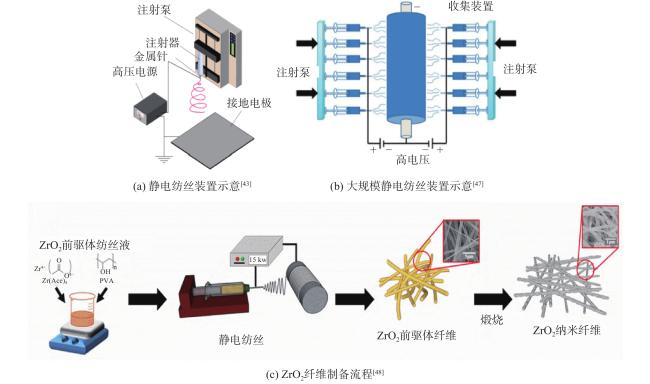
静电纺丝常用于纳米纤维的制备,同时是制备ZrO2纤维的主要方法[38-42]。典型的静电纺丝装置主要由高压电源、注射泵和收集器组成[42-43](见图3(a))。静电纺丝过程在强电场中进行,由于电场的存在,纺丝液在针头处形成泰勒锥,射流从泰勒锥顶端喷射而出[42, 44]。在射流射向收集器的过程中,纺丝液里的溶剂逐渐挥发,经过固化后得到纤维[42, 45]
图 3 静电纺丝制备ZrO2纤维

Fig.3 Preparation of ZrO2 fiber by electrospinning

静电纺丝技术具有工艺简单、材料适用广、成本较低等优点,其所制备的纳米纤维具有高比表面积、高孔隙率等特点,因此得到广泛的研究[42, 46]。但其低效率限制了大规模生产[42]。为提高效率,Wang等[47]研发出多针头的纺丝装置(见图3(b)),纺丝效率有所提高,但设备变得更为复杂,成本也相应提高[42]
静电纺丝制备ZrO2纤维主要包括纺丝液制备、前驱体纤维制备、煅烧三个步骤[48](见图3(c))。首先,需要配制具有良好可纺性的纺丝液。纺丝液的四个主要组成部分为助纺剂、ZrO2前驱体、稳定剂及溶剂[49]。其中,助纺剂通常选用聚合物材料,如PVP[50-53]、PEO[54]等。其次,采用静电纺丝制备前驱体纤维,通过调控静电纺丝工艺参数(如电压、接收距离、注射速度等),可控制前驱体纤维结构。最后,经过煅烧得到ZrO2纤维。Koo等[24]选用PAN为助纺剂,N,N-二甲基甲酰胺为溶剂,醋酸锆为ZrO2前驱体,硝酸钇为稳定剂前驱体,采用静电纺丝法制备出了性能良好的ZrO2纤维。

2.2 溶液喷射纺丝

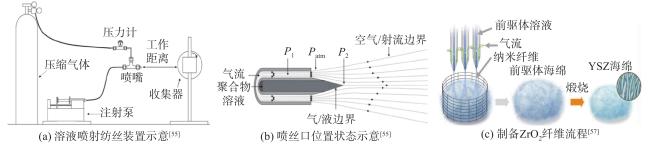
2009年,Medeiros等[55]提出了溶液喷射纺丝法,并阐述了该方法的设备与原理(见图4(a)和图4(b))。溶液喷射纺丝装置主要由空压机、注射泵、收集装置组成。在工作过程中,纺丝液在气流作用下,由液滴状转变为圆锥状,随后冲破表面张力形成射流,在收集器上形成纤维[42, 56]图4(c)展示了溶液喷射纺丝制备ZrO2纤维的过程[42, 57]。ZrO2纤维的结构同样受到助纺剂种类和工艺参数的影响。
图 4 溶液喷射纺丝制备ZrO2纤维

Fig.4 Preparation of ZrO2 fibers by solution blow spinning

Cheng等[58]以PVP和氧氯化锆为原料配制纺丝液,通过溶液喷射纺丝获得前驱体纤维,并在空气中800 °C的条件下进行煅烧,从而制备出ZrO2纤维。研究结果表明,在较高气压环境下能够得到更细的纤维;当注射速度增大时,纤维直径也会随之增大,若注射速度超过25 mL·h−1,会导致射流不稳定。本文提出采用羟丙基甲基纤维素(Hydroxypropyl Methyl Cellulose,HPMC)作为助纺剂来制备柔性ZrO2纤维材料[59],并研究了聚合物浓度以及HPMC含量对纤维结构与性能的影响。结果表明,纤维直径随聚合物浓度的升高而增大,但过高的浓度会使可纺性变差。由于HPMC本身不具有可纺性,随着HPMC含量的增加,纤维直径分布会变宽,当HPMC含量高于70%时,纤维无法进行纺丝。
溶液喷射纺丝因其高效、低成本且安全性高的特点而受到广泛关注[60]。与静电纺丝相比,该方法还可通过改变收集装置制备三维陶瓷纤维海绵[42, 61]。Wang等[62]选用笼状收集器,利用溶液喷射纺丝的特点制备出陶瓷纳米纤维海绵[42]

2.3 离心纺丝

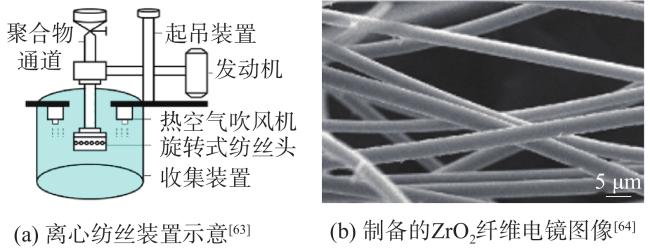
与静电纺丝相比,离心纺丝具有低成本、高效率的特点,是一种颇具前景的纺丝方法。然而,在实际的科学研究中,由于部件选择相对复杂,科研人员对它的研究远不及静电纺丝。离心纺丝装置主要由喷丝头和收集装置组成[42, 63]。离心纺丝是指由喷丝头高速旋转产生的离心力将纺丝液由喷丝口喷出,并进行牵伸、干燥,最后在收集装置中固化成纤维的纺丝过程[42, 64]。Sun等[63]采用离心纺丝法得到ZrO2前驱体纤维(见图5(a)),经过高温煅烧,制备出了无缺陷、晶粒尺寸为20~30 nm、直径5~7 µm的ZrO2纤维[42]
图 5 离心纺丝制备ZrO2纤维

Fig.5 Preparation of ZrO2 fibers by centrifugal spinning

高速与高效是离心纺丝最为突出的优势[65]。相较于静电纺丝的纺丝效率,离心纺丝的效率至少高出两个数量级。一个简易的、仅配备两个侧壁喷嘴的离心纺丝装置,其平均生产速率约可达50 g·h−1[42, 66]。Liu等[64]采用自制的超高速离心纺丝装置纺丝,该装置的纺丝盘直径为50 mm,空心转子的最高转速可达30 000 r/min,显著提高了纺丝效率。此外,由于离心纺丝设备的喷丝口直径较大,所得到的纤维直径通常为微米级(见图5(b))。

2.4 模板法

模板法工艺简单,只需将模板纤维,如碳纳米纤维[67]、牛角瓜纤维[68]、棉纤维[69]等,浸于ZrO2前驱体溶液中,干燥后进行煅烧,即可得到ZrO2纤维[42, 70-71]。该方法是较早用于制备ZrO2纤维的方法,20世纪70年代,美国的Zircar公司就采用模板法生产ZrO2纤维[42, 72]
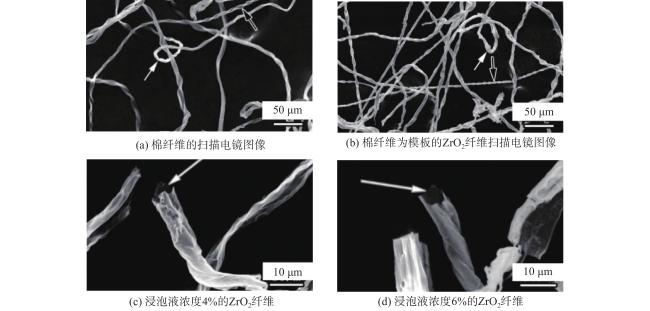
该模板法的特点在于,所制备的ZrO2纤维能够保持模板纤维的形态。Wang等[69]制备了保留棉纤维形态的ZrO2纤维(见图6(a)和图6(b))[42],其具有中空结构。然而,由于有机组分含量较高,在煅烧阶段结束后,纤维内部会出现孔隙,致密性变差(见图6(c)和图6(d)),因此所得到的ZrO2纤维力学强度欠佳[42]
图 6 模板法制备ZrO2纤维[69]

Fig.6 Preparation of ZrO2 fibers by template method[69]

2.5 干法纺丝

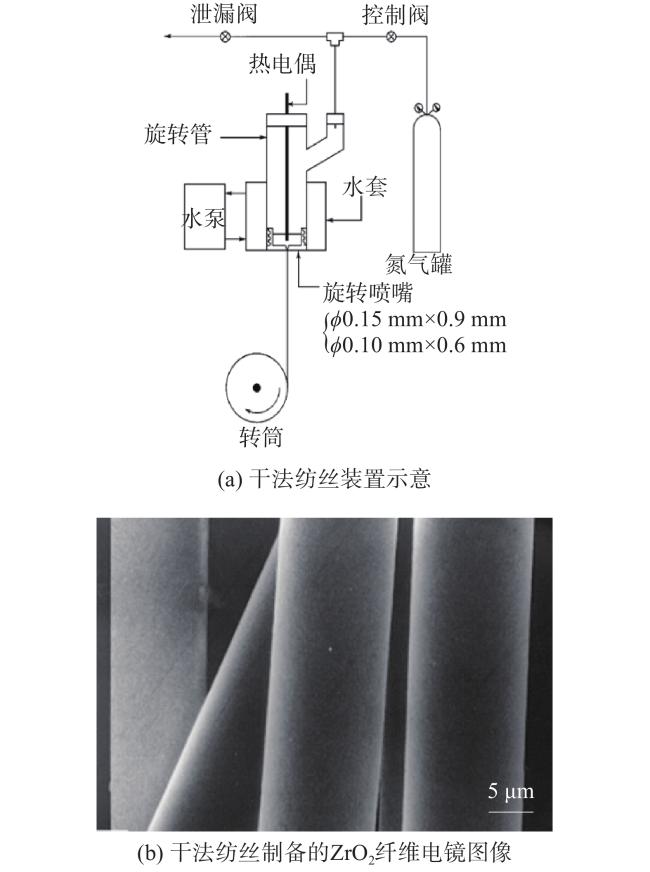
干法纺丝在制备ZrO2纤维方面的研究相对较少。该方法具备效率高、工艺灵活的优势,可制备异形纤维,所制备的纤维结构致密,且拥有良好的强度和韧性[42, 73]。干法纺丝主要是通过压力作用,使得有黏度的纺丝液从喷丝口挤出,经过干燥后进行煅烧,从而得到ZrO2纤维[42, 74](见图7(a))。
图 7 干法纺丝制备ZrO2纤维[74]

Fig.7 Preparation of ZrO2 fibers by dry spinning[74]

干法纺丝可制备直径较大的ZrO2纤维,且这类纤维强度较高[42]。Wang等[75]以Y2O3作为稳定剂,采用干法纺丝制得抗张强度1.299 GPa的ZrO2纤维[42]。Abe等[74]采用热蒸汽处理法去除前驱体纤维部分有机成分,得到了结构更致密、抗张强度达1.400 GPa的ZrO2纤维(见图7(b))[42]。Wang等[76]采用干法纺丝法制备的钇稳定的氧化锆(Yttria-Stabilized Zirconia,YSZ)纤维晶相较为稳定,抗张强度达到1.600 GPa,1 500 °C温度下处理后的强度保持率为54%。
目前,ZrO2纤维的制备方法呈现出蓬勃发展的态势。其中,静电纺丝仍是实验室阶段使用最为广泛的技术。溶液喷射纺丝具有较高的效率,无论是在实验研究还是产业化应用方面,均显示出良好的发展潜力。离心纺丝在ZrO2纤维制备中应用较少,但其适合规模化生产,具备工业推广的研究价值。模板法作为最早制备ZrO2纤维的工艺,所制得的纤维通常存在结构缺陷,致密性较差。因此,随着静电纺丝、溶液喷射纺丝等新技术的发展,其应用已逐步受到限制。干法纺丝工艺较为复杂,制备的纤维直径较大、柔性较低。综上所述,在比较各类制备方法后可知,溶液喷射纺丝在综合性能与发展前景方面更具优势。

3 ZrO2纤维应用

3.1 高温隔热

随着航空航天技术、先进发动机以及高温工业窑炉的迅猛发展,耐高温隔热材料的应用需求日益增长[42, 77]。传统隔热材料在极端环境下面临热稳定性差、隔热效率低、服役时间短等问题。与普通的耐高温材料相比,微观形貌可控的纳米纤维材料展现出了巨大的潜力[42]。其中,ZrO2纤维因其熔点高、化学性质稳定、热导率低等优势,被广泛应用于工业隔热领域,被视作最具潜力的高温保温材料之一[42, 78]
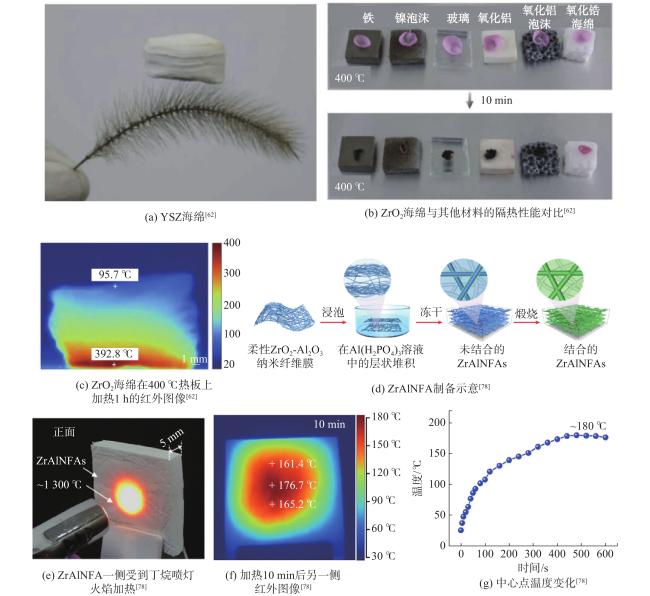
Wang等[62]采用溶液喷射纺丝法制备出低密度YSZ海绵(见图8(a)),这种陶瓷海绵具有良好的压缩回弹性能,其热导率仅为0.027 W·m−1·K−1。如图8(b)所示,ZrO2海绵的隔热性能优于铁、镍泡沫、玻璃、Al2O3陶瓷以及Al2O3多孔陶瓷。如图8(c)所示,厚度为1 cm的ZrO2海绵在400 °C下加热1 h后,其上表面温度为95 °C,表现出良好的隔热性能。Zhang等[78]通过浸渍堆叠、冷冻干燥和高温煅烧工艺,制备了Al2O3掺杂的ZrO2纳米纤维气凝胶(Lamellar Structure ZrO2-Al2O3 Nanofibrous Aerogels,ZrAlNFA)(见图8(d)),该气凝胶具有较低的热导率。5 mm厚的样品一侧用丁烷喷灯加热后,其另一侧温度稳定后大约仅为180 °C(见图8(e)~图8(g))。
图 8 ZrO2纤维在高温隔热中的应用

Fig.8 Application of ZrO2 fibers in high-temperature thermal insulation

3.2 空气过滤

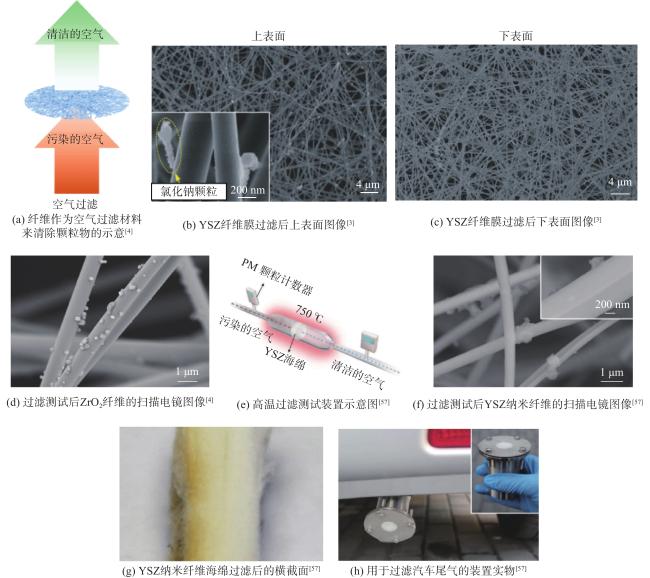
工业发展、汽车尾气、燃料燃烧所造成的空气污染问题。受到了全球各国民众的广泛关注。这些活动所产生的悬浮颗粒物是大气污染的主要污染源[42, 79],且通常其温度较高。因此,过滤材料的耐温性能成为衡量其过滤能力的一项重要指标。选用纳米纤维膜材料作为拦截颗粒物的材料,是解决大气污染问题的主要方法[42, 80](见图9(a))。因此,ZrO2纳米纤维膜在高温过滤领域具有极大的应用前景。Mao等[3]以NaCl气溶胶颗粒模拟污染物,对所制备的YSZ纤维膜进行过滤性能测试。结果表明,污染物主要集中在靠近进气口的一侧(见图9(b)和图9(c))。因此,经过反吹处理可将污染物与膜分离,实现纤维膜的重复使用[42]
图 9 ZrO2纤维在空气过滤中的应用

Fig.9 Application of ZrO2 fiber in air filtration

本文制备了具有柔性的ZrO2纤维膜,并将其应用于空气过滤(见图9(d)),过滤效率高达99.56%[4, 42]。经过6 h的耐久性测试,ZrO2纤维膜的过滤效率仍保持在99.38%,并且该材料可耐受1 100 °C高温。Wang等[57]将ZrO2纳米纤维海绵应用于高温气体过滤(见图9(e))。试验结果表明,该材料能捕获百纳米级的污染物(见图9(f)),而且颗粒物能够保留在材料的内部(见图9(g)),相较于膜材料,具有更高的容尘量[42]。此外,研究人员还将该海绵材料进行汽车尾气的试验,验证其具备良好的实际应用性能(见图9(h))。

3.3 水处理

除空气污染外,水资源的污染同样是一个备受关注的环境问题[42]。随着工业的发展,工业废水对人类健康构成了威胁,其中的颗粒和有机物是两大主要污染源[81]。现有的分离过滤膜,如聚偏氟乙烯膜、聚醚砜膜、聚丙烯腈膜等,化学稳定性较差[42, 82]。鉴于ZrO2纤维具有良好的化学稳定性,可将其应用于水处理领域。
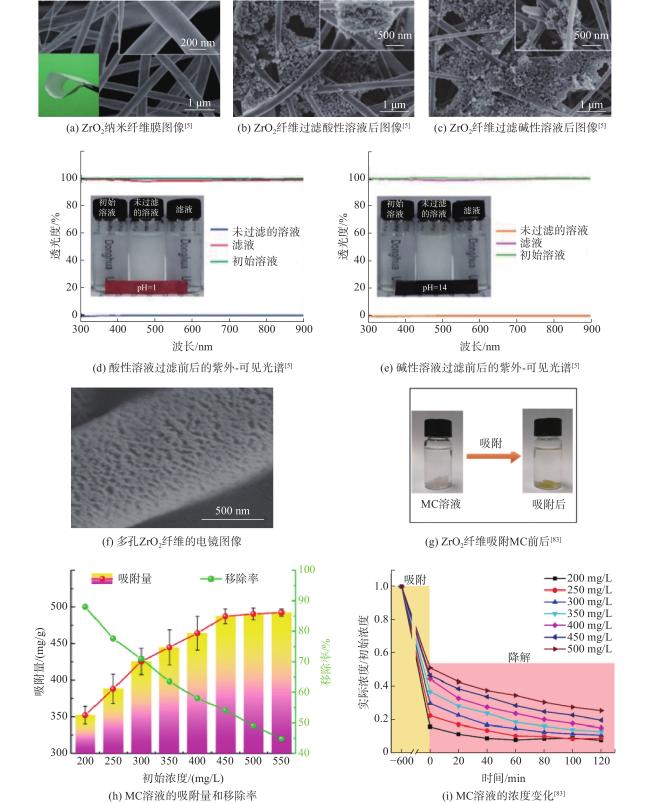
为了研究ZrO2纤维膜的过滤性能,Chen等[5]采用静电纺丝与溶胶凝胶相结合的方法,制备出柔性ZrO2纤维膜[42](见图10(a))。所制备的ZrO2纤维膜在酸碱溶液中对纳米颗粒的过滤效率分别为99.95%和99.92%[42](见图10(b)~图10(e))。Jin等[83]制备了具有高比表面积的多孔ZrO2纤维,其对盐酸米诺环素(Minocycline Hydrochloride,MC)表现出优异的吸附性能(见图10(f) ~ 图10(i))。结果表明,随着初始MC浓度的升高,吸附量随之增加,当初始浓度为550 mg·L−1时,吸附量高达492.3 mg·g−1,但去除率仅为45%。
图 10 ZrO2纤维在水处理中的应用(一)

Fig.10 Application of ZrO2 fibers in water treatment(Ⅰ)

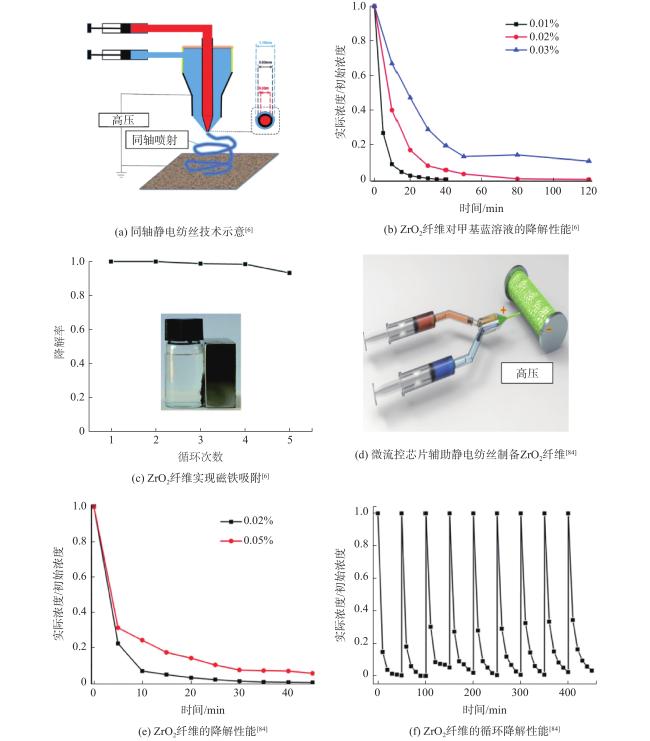
Zhou等[6]采用同轴静电纺丝技术,成功制备出负载Fe3O4磁性纳米颗粒的中空多孔ZrO2纳米纤维(见图11(a))。降解试验表明,ZrO2纤维能够对不同初始浓度的甲基蓝溶液实现高效降解(见图11(b))。此外,ZrO2纤维具有独特的磁性,可通过磁铁进行吸附并重复使用(见图11(c))。Zhou等[84]采用微流控芯片辅助静电纺丝法制备了ZrO2基纤维(见图11(d)),将其用作Fe2O3载体,如图11(e)所示,0.05%的甲基蓝溶液在30 min内降解率达到了90%,而且经过9次循环测试后,降解率仍保持在95%以上(见图11(f))。
图 11 ZrO2纤维在水处理中的应用(二)

Fig.11 Application of ZrO2 fibers in water treatment(Ⅱ)

3.4 电池隔膜

随着不可再生资源的不断消耗,新能源的研究与开发已刻不容缓[42]。锂离子电池因具有便携、能量密度高、循环寿命长等优势,受到了广泛的关注[42]。锂离子电池主要由电极材料、电解质溶液和隔膜三部分组成[85]。其中,隔膜是锂离子电池不可缺少的部件,其对电池的安全性和电化学性能具有重要影响[86]。目前,常用的电池隔膜多为多孔聚烯烃薄膜,如聚丙烯(Polypropylen,PP)、聚乙烯(Polyethylene,PE)等[87]。然而,聚烯烃类隔膜仍存在熔点较低、电解质润湿性差、高温下孔隙率降低且热收缩严重等问题。
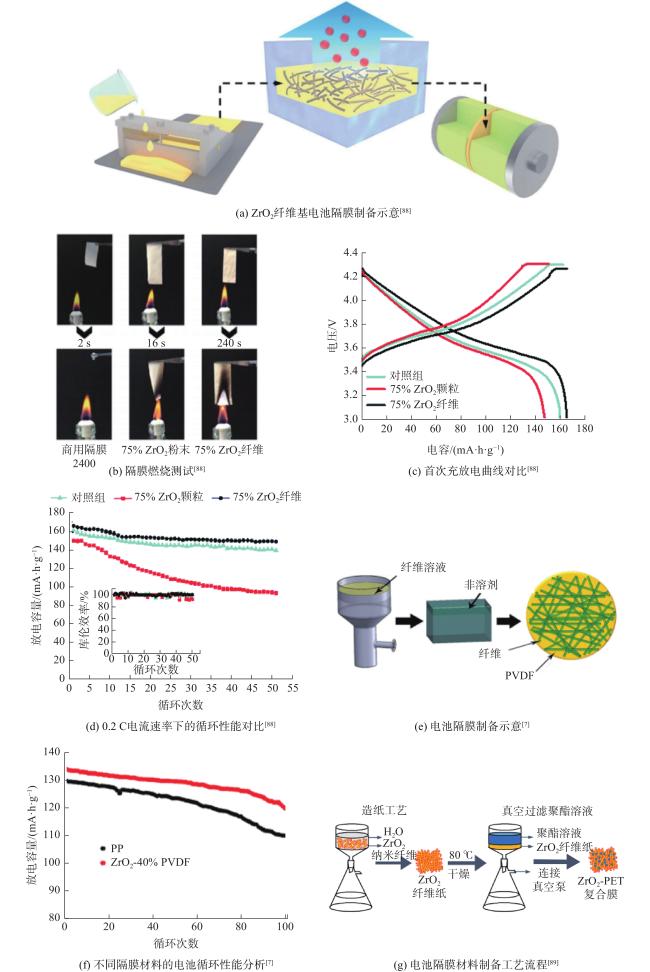
因此,构建无机有机复合隔膜并应用于电池隔膜领域的研究已得到广泛关注。Wang等[88]利用相变工艺制备了ZrO2纤维基隔膜(见图12(a))。经过燃烧试验可知,ZrO2纤维基隔膜具有更优异的阻燃性能(见图12(b))。此外,电化学性能测试表明,ZrO2纤维基隔膜离子电导率为0.320 mS·cm−1,放电容量为165.7 (mA·h·g−1)(见图12(c))。以0.2 C/0.2 C的速率充放电50次,ZrO2纤维基隔膜的容量保持率高达93%(见图12(d))。
图 12 ZrO2纤维在电池隔膜中的应用

Fig.12 Application of ZrO2 fibers in battery separators

Wang等[7]将ZrO2纤维与聚偏二氟乙烯(Polyvinylidene,PVDF)混合,制备出锂离子电池隔膜材料(见图12(e))。与常用的电池隔膜材料PP相比,电池初始放电容量高出4.0 mA·h·g−1。经过100次循环后,PP隔膜的容量保持率仅为84.5%,而ZrO2-40%PVDF的容量保持率达到了89.6%(见图12(f))。Liu等[89]制备了聚丙酸钛与ZrO2纤维复合薄膜材料(见图12(g)),将其用作电池隔膜时,电化学性能优于PP隔膜。

4 结 语

ZrO2纤维凭借其优异的性能,在诸多领域均展现出广阔的应用前景。然而,现有研究主要集中于其稳定化策略和制备方法,应用探索大多局限于高温隔热与空气过滤等方面,在其他领域的研究仍相对不足。鉴于当前柔性ZrO2纤维的研究现状,未来的工作亟需在以下几个方面予以重点关注。
(1)在ZrO2纤维制备的过程中,通常需要在纺丝溶液中加入聚合物作为成纤辅助剂。然而,原纤中聚合物的存在会显著降低ZrO2纤维的制备效率。尽管煅烧去除聚合物后ZrO2纤维直径会减小,但纤维的致密度也会受到影响。为减小聚合物的影响,探索利用ZrO2前驱体溶胶直接纺丝制备ZrO2纤维是一个重要的方向。
(2)晶粒尺寸是影响ZrO2纤维柔性的重要因素。在ZrO2纤维的制备过程中,稳定剂是抑制晶粒长大和马氏体转变的重要组分。为抑制晶粒在高温下生长,向已添加稳定剂的ZrO2纤维中掺杂其他添加剂(如La2O3等),可以进一步抑制晶粒的长大[90],提高ZrO2纤维的强度和耐高温性能。因此,有望通过添加复合稳定剂开发出耐更高温度的ZrO2纤维。
(3)更小的纤维直径可以提高纤维膜的过滤性能,通过工艺优化、配方改进等方式制备小直径ZrO2纤维,对于空气过滤及水处理领域的发展尤为重要。
(4)推动ZrO2纤维规模化应用的关键在于研发高效、简易、低成本的制备设备。随着无针头溶液喷射纺丝设备的研发成功,利用此类技术实现ZrO2纤维的规模化制备与实际应用指日可待。
(5)ZrO2纤维除具有优异的耐高温性能与化学稳定性外,还表现出良好的抗原子氧腐蚀及耐紫外与空间辐射能力,这使其有望用于飞行器隔热防护、热管理结构及极端环境适用性组件。未来可重点探索柔性ZrO2纤维在空天防护材料中的应用潜力。
(6)随着人工智能技术的飞速发展,我们正处于一场材料科学革命的前沿。通过深度学习“工艺-结构-性能”间的复杂映射关系,将实现材料的配方按需创成、量化可控改性、宏量智能制备,从而驱动新一代ZrO2纤维材料制备技术发展。
1
YANG M, DING Y, CHEN Z, et al. Layered ZrO2/SiO2 aerogel composite fibrous flexibility membrane for thermal insulation and sound absorption[J]. Journal of the American Ceramic Society, 2024, 107 (6): 4307- 4320.

DOI

2
PENG Y, XIE Y, DENG Z, et al. Dual-phasic, well-aligned, and strong flexible hydrophobic ceramic membranes for efficient thermal insulation in extreme conditions[J]. ACS Applied Materials & Interfaces, 2023, 15 (11): 14835- 14845.

3
MAO X, BAI Y, YU J, et al. Flexible and highly temperature resistant polynanocrystalline zirconia nanofibrous membranes designed for air filtration[J]. Journal of the American Ceramic Society, 2016, 99 (8): 2760- 2768.

DOI

4
JIA C, LIU Y, LI L, et al. A foldable all-ceramic air filter paper with high efficiency and high-temperature resistance[J]. Nano Letters, 2020, 20 (7): 4993- 5000.

DOI

5
CHEN Y, MAO X, SHAN H, et al. Free-standing zirconia nanofibrous membranes with robust flexibility for corrosive liquid filtration[J]. RSC Advances, 2014, 4 (6): 2756- 2763.

DOI

6
ZHOU Y M, SONG W T, ZHANG L J, et al. Preparation of hollow magnetic porous zirconia fibers as effective catalyst carriers for Fenton reaction[J]. Journal of Materials Chemistry A, 2018, 6 (26): 12298- 12307.

DOI

7
WANG Z, XIE Y, XU C, et al. Zirconia fiber membranes based on PVDF as high-safety separators for lithium-ion batteries using a papermaking method[J]. Journal of Solid State Electrochemistry, 2018, 23 (1): 269- 276.

8
刘久荣. Sol-gel法制备ZrO2连续纤维的烧结过程的研究[J]. 山东工业大学学报, 2001, 31 (2): 140- 146.

LIU J R. Studies of sintering process of zirconia fibers prepared by Sol-gel method[J]. Journal of ShanDong University of Technology, 2001, 31 (2): 140- 146.

9
刘和义. 聚乙酰丙酮合锆甩丝法制备氧化锆纤维棉[J]. 硅酸盐通报, 2011, 30 (6): 1410- 1414.

DOI

LIU H Y. Preparation of Zirconia fibers cotton by centrifugal spinning of polyacetylacetonatozirconium spinning solution[J]. Bulletin of the Chinese Ceramic Society, 2011, 30 (6): 1410- 1414.

DOI

10
GARVLE R C. Stabilization of the tetragonal structure in zirconia microcrystals[J]. The Journal of Physical Chemistry, 1978, 82 (2): 218- 224.

DOI

11
LI L, ZHANG P, LIANG J, et al. Phase transformation and morphological evolution of electrospun zirconia nanofibers during thermal annealing[J]. Ceramics International, 2010, 36 (2): 589- 594.

DOI

12
SUBBARAO E C, MAITI H S, SRIVASTAVA K K. Martensitic transformation in zirconia[J]. Physica Status Solidi A: Applications and Materials Science, 1974, 21 (1): 9- 40.

DOI

13
LI K, CHEN J, PENG J, et al. One-step preparation of CaO-doped partially stabilized zirconia from fused zirconia[J]. Ceramics International, 2020, 46 (5): 6484- 6490.

DOI

14
GUO S, CHEN G, PENG J, et al. Preparation of partially stabilized zirconia from fused zirconia using roasting[J]. Journal of Alloys and Compounds, 2010, 506 (1): L5- L7.

DOI

15
SOYGUN K, OZER A, ULUCAN M C, et al. An investigation of corrosive effects on zirconia with different crystal structures[J]. Microscopy Research and Technique, 2020, 84 (4): 796- 803.

16
GAUTAM C, JOYNER J, GAUTAM A, et al. Zirconia based dental ceramics: Structure, mechanical properties, biocompatibility and applications[J]. Dalton Transactions, 2016, 45 (48): 19194- 19215.

DOI

17
HUTAMA A S, MARLINA L A, CHOU C P, et al. Development of density-functional tight-binding parameters for the molecular dynamics simulation of zirconia, yttria, and yttria-stabilized zirconia[J]. ACS Omega, 2021, 6 (31): 20530- 20548.

DOI

18
SCOTT H G. Phase relationships in the zirconia-yttria system[J]. Journal of Materials Science, 1975, 10 (9): 1527- 1535.

DOI

19
YOGO T, KODAMA S, IWAHARA H. Synthesis of polycrystalline alumina-zirconia fibre using chelated aluminium-zirconium precursor[J]. Journal of Materials Science, 1993, 28 (1): 105- 110.

DOI

20
LI J, PENG J, GUO S, et al. Application of response surface methodology (RSM) for optimization of the sintering process of preparation calcia partially stabilized zirconia(CaO-PSZ) using natural baddeleyite[J]. Journal of Alloys and Compounds, 2013, 574 (1): 504- 511.

21
HAO L, LAWRENCE J, CHIAN K S, et al. The formation of a hydroxyl bond and the effects thereof on bone-like apatite formation on a magnesia partially stabilized zirconia(MgO±PSZ) bioceramic following CO2 laser irradiation[J]. Journal of Materials Science: Materials in Medicine, 2004, 15 (9): 967- 975.

DOI

22
MAO X, SHAN H, SONG J, et al. Brittle-flexible-brittle transition in nanocrystalline zirconia nanofibrous membranes[J]. CrystEngComm, 2016, 18 (7): 1139- 1146.

DOI

23
PENG Y, XIE Y, WANG L, et al. High-temperature flexible, strength and hydrophobic YSZ/SiO2 nanofibrous membranes with excellent thermal insulation[J]. Journal of the European Ceramic Society, 2021, 41 (2): 1471- 1480.

DOI

24
KOO J Y, HWANG S, AHN M, et al. Controlling the diameter of electrospun yttria-stabilized zirconia nanofibers[J]. Journal of the American Ceramic Society, 2016, 99 (9): 3146- 31450.

DOI

25
AZAD A M. Fabrication of yttria-stabilized zirconia nanofibers by electrospinning[J]. Materials Letters, 2006, 60 (1): 67- 72.

DOI

26
CLAUSS B, GRUB A, OPPERMANN W. Continuous yttria-stabilized zirconia fibers[J]. Advanced Materials, 1996, 8 (2): 142- 146.

DOI

27
CHOU C C, HUANG C F, YEH T H. Characterization and catalytic activity of La0.6Sr0.4Co0.2Fe0.8O3-δ-yttria stabilized zirconia electrospun nano-fiber as a cathode catalyst[J]. Ceramics International, 2013, 39, S549- S553.

DOI

28
DAS R N, NAD S, PRAMANIK P. Nanocrystalline yttria-stabilized zirconia fibers from plant fibers and their polymer composites[J]. Journal of the American Ceramic Society, 2008, 91 (3): 1034- 1036.

DOI

29
RODAEV V V, RAZLIVALOVA S S, TYURIN A I, et al. Microstructure and phase composition of yttria-stabilized zirconia nanofibers prepared by high-temperature calcination of electrospun zirconium acetylacetonate/yttrium nitrate/polyacrylonitrile fibers[J]. Fibers, 2019, 7 (10): 82- 90.

DOI

30
SUN Y, QU J, GUO Q, et al. Preparation of fine-grained silica-doped zirconia fibers by electrospinning[J]. Ceramics International, 2017, 43 (15): 12551- 12556.

DOI

31
CHAKRABARTY P K, CHATTERJEE M, NASKAR M K, et al. Zirconia fibre mats prepared by a sol-gel spinning technique[J]. Journal of the European Ceramic Society, 2001, 21 (3): 355- 361.

DOI

32
LIU H Y, HOU X Q, WANG X Q, et al. Fabrication of high-strength continuous zirconia fibers and their formation mechanism study[J]. Journal of the American Ceramic Society, 2004, 87 (12): 2237- 22341.

DOI

33
AZAD A M, MATTHEWS T, SWARY J. Processing and characterization of electrospun Y2O3-stabilized ZrO2 (YSZ) and Gd2O3-doped CeO2(GDC) nanofibers[J]. Materials Science and Engineering B-Solid State Materials for Advanced Technology, 2005, 123 (3): 252- 258.

DOI

34
MAO X, BAI Y, YU J, et al. Insights into the flexibility of ZrMxOy (M=Na, Mg, Al) nanofibrous membranes as promising infrared stealth materials[J]. Dalton Transactions, 2016, 45 (15): 6660- 6666.

DOI

35
JIN X, YUAN K, HAN W, et al. Enhanced surface area and thermal stability of mesoporous zirconia fibers modified by various oxides and the reinforcement mechanism[J]. Ceramics International, 2021, 47 (23): 32579- 32587.

DOI

36
HAN W, DING B, PARK M, et al. Insight into the precursor nanofibers on the flexibility of La2O3-ZrO2 nanofibrous membranes[J]. e-Polymers, 2017, 17 (3): 243- 248.

DOI

37
RODAEV V V, ZHIGACHEV A O, GOLOVIN Y I. Microstructure and phase composition of CaO doped zirconia nanofibers[J]. Ceramics International, 2017, 43 (1): 1200- 1204.

DOI

38
USLU İ, TUNç T, KESKIN S, et al. Synthesis and characterization of boron doped alumina stabilized zirconia fibers[J]. Fibers and Polymers, 2011, 12 (3): 303- 309.

DOI

39
JIAN K, CHEN Y, CUI Y, et al. Preparation of bionic porous zirconia fiber by microemulsion electrospinning and its infrared stealth property[J]. Russian Journal of Inorganic Chemistry, 2021, 66 (4): 510- 515.

DOI

40
LI J Y, TAN Y, XU F M, et al. Hollow fibers of yttria-stabilized zirconia(8YSZ) prepared by calcination of electrospun composite fibers[J]. Materials Letters, 2008, 62 (16): 2396- 2399.

DOI

41
FORMO E, CAMARGO P H C, LIM B, et al. Functionalization of ZrO2 nanofibers with Pt nanostructures: The effect of surface roughness on nucleation mechanism and morphology control[J]. Chemical Physics Letters, 2009, 476 (1-3): 56- 61.

DOI

42
绪哲. 溶液喷射纺柔性氧化锆纤维与性能研究[D]. 上海: 东华大学, 2024.

XU Z. Study on flexible zirconia fiber spun by solution blow and its properties[D]. Shanghai: Donghua University, 2024.

43
LI D, MCCANN J T, XIA Y, et al. Electrospinning: A Simple and versatile technique for producing ceramic nanofibers and nanotubes[J]. Journal of the American Ceramic Society, 2006, 89 (6): 1861- 1869.

DOI

44
LIU C, WANG S, WANG N, et al. From 1D nanofibers to 3D nanofibrous aerogels: A marvellous evolution of electrospun SiO2 nanofibers for emerging applications[J]. Nano-Micro Letters, 2022, 14 (1): 193- 232.

DOI

45
WU H, PAN W, LIN D, et al. Electrospinning of ceramic nanofibers: Fabrication, assembly and applications[J]. Journal of Advanced Ceramics, 2012, 1 (1): 2- 23.

DOI

46
BALINOVA Y A, VARRIK N M, ISTOMIN A V, et al. Electrospinning of zirconia fibers[J]. Glass and Ceramics, 2020, 77 (7-8): 313- 317.

DOI

47
WANG Y, HAN C, ZHENG D, et al. Large-scale, flexible and high-temperature resistant ZrO2/SiC ultrafine fibers with a radial gradient composition[J]. Journal of Materials Chemistry A, 2014, 2 (25): 9607- 9612.

DOI

48
SHAO C, GUAN H, LIU Y, et al. A novel method for making ZrO2 nanofibres via an electrospinning technique[J]. Journal of Crystal Growth, 2004, 267 (1-2): 380- 384.

DOI

49
XU Z, WANG F, YIN X, et al. Recent advances in ZrO2 nanofibers: From structural design to emerging applications[J]. Science China Materials, 2022, 66 (2): 421- 440.

50
HALABI M, NASER ELDEEN O, WANG J, et al. Application of ZrO2-based hierarchical nanofibers as a promoter in Ni catalyzed methane dry re-forming[J]. ACS Applied Energy Materials, 2024, 7 (2): 380- 389.

DOI

51
LI S, CHENG X, HAN G, et al. Elastic and compressible Al2O3/ZrO2/La2O3 nanofibrous membranes for firefighting protective clothing[J]. Journal of Colloid and Interface Science, 2023, 636 (2023): 83- 89.

52
DONG S, MACIEJEWSKA B, MILLAR R, et al. 3D Electrospinning of Al2O3/ZrO2 fibrous aerogels for multipurpose thermal insulation[J]. Advanced Composites and Hybrid Materials, 2023, 6 (5): 186- 203.

DOI

53
DANG W, LI Z, WANG B, et al. ZrO2/SiO2/C nanofiber aerogels with enhanced mechanical and thermal insulation properties fabricated by freeze casting[J]. Ceramics International, 2024, 50 (7): 12539- 12548.

DOI

54
WANG L, YANG L, MA D, et al. Grooved TiO2/ZrO2 ceramic fibers with thermal insulation and mechanical properties prepared by coaxial electrospinning[J]. Ceramics International, 2024, 50 (24): 53288- 53295.

DOI

55
MEDEIROS E S, GLENN G M, KLAMCZYNSKI A P, et al. Solution blow spinning: A new method to produce micro- and nanofibers from polymer solutions[J]. Journal of Applied Polymer Science, 2009, 113 (4): 2322- 2330.

DOI

56
HARTRIDGE A, TAYLOR M D, BHATTACHARYA A K. Synthesis and characterization of partially and fully stabilized zirconia fibers made from an inorganic precursor[J]. Journal of Materials Research, 2001, 16 (8): 2384- 2390.

DOI

57
WANG H L, LIN S, YANG S, et al. High-temperature particulate matter filtration with resilient yttria-stabilized ZrO2 nanofiber sponge[J]. Small, 2018, 14 (19): e1800258.

DOI

58
CHENG B, TAO X, SHI L, et al. Fabrication of ZrO2 ceramic fiber mats by solution blowing process[J]. Ceramics International, 2014, 40 (9): 15013- 15018.

DOI

59
XU Z, KONG W, SU X, et al. Solution blow spun flexible zirconia nanofibers toward high-performance 2D and 3D nanostructures[J]. Ceramics International, 2024, 50 (10): 17419- 17427.

DOI

60
ZHANG H, WANG R, LI P, et al. One-step, large-scale blow spinning to fabricate ultralight, fibrous sorbents with ultrahigh oil adsorption capacity[J]. ACS Applied Materials & Interfaces, 2021, 13 (5): 6631- 6641.

61
JIA C, LI L, LIU Y, et al. Highly compressible and anisotropic lamellar ceramic sponges with superior thermal insulation and acoustic absorption performances[J]. Nature Communications, 2020, 11 (1): 3732- 3745.

DOI

62
WANG H L, ZHANG, WANG N, et al. Ultralight, scalable, and high-temperature-resilient ceramic nanofiber sponges[J]. Science Advances, 2017, 3 (6): e1603170.

DOI

63
SUN G, DU X, ZHANG M, et al. Fabrication of zirconia fibers by a sol-gel combined rotational centrifugal spinning technique[J]. Transactions of the Indian Ceramic Society, 2014, 73 (3): 228- 232.

DOI

64
LIU H Y, CHEN Y, LIU G S, et al. Preparation of high-quality zirconia fibers by super-high rotational centrifugal spinning of inorganic sol[J]. Materials and Manufacturing Processes, 2013, 28 (2): 133- 138.

DOI

65
LIU H, LIU B, WANG X, et al. Rheological behavior, molecular structure of precursor and evolution mechanism: Zirconia fibers from polyaceticzirconium precursors[J]. Journal of Sol-Gel Science and Technology, 2015, 76 (3): 482- 491.

DOI

66
ZHANG X, LU Y. Centrifugal spinning: An alternative approach to fabricate nanofibers at high speed and low cost[J]. Polymer Reviews, 2014, 54 (4): 677- 701.

DOI

67
OGIHARA H, SADAKANE M, NODASAKA Y, et al. Shape-controlled synthesis of ZrO2, Al2O3, and SiO2 nanotubes using carbon nanofibers as templates[J]. Chemistry of Materials, 2006, 18 (21): 4981- 4983.

DOI

68
YU Q, LIU X, ZHANG J, et al. Preparation of zirconia fiber based on akund template[J]. Journal of Physics: Conference Series, 2020, 1681-1686.

69
WANG T, YU Q, KONG J. Preparation and heat-insulating properties of biomorphic ZrO2 hollow fibers derived from a cotton template[J]. International Journal of Applied Ceramic Technology, 2018, 15 (2): 472- 478.

DOI

70
DAI C H, ZHANG Z H, WANG T C. Preparation and heat-insulating properties of Al2O3-ZrO2(Y2O3) hollow fibers derived from cogon using an orthogonal experimental design[J]. RSC Advances, 2019, 9 (20): 11305- 11311.

DOI

71
YU G, ZHU L, ZHANG G, et al. Preparation and characterization of the continuous titanium-doped ZrO2 mesoporous fibers with large surface area[J]. Journal of Porous Materials, 2014, 21 (1): 105- 112.

DOI

72
陈代荣. 连续陶瓷纤维的制备、结构、性能和应用研究现状及发展方向[J]. 现代技术陶瓷, 2018, 39 (3): 152- 220.

DOI

CHEN D R. Fabrication, microstructure, properties and applications of continunous ceramic fibers: A review of present status and further directions[J]. Advanced Ceramics, 2018, 39 (3): 152- 220.

DOI

73
ABE Y, TOMIOKA H, GUNJI T, et al. A one-pot synthesis of polyzirconoxane as a precursor for continuous zirconia fibers[J]. Journal of Materials Science Letters, 1994, 13 (13): 960- 962.

DOI

74
ABE Y, KUDO T, TOMIOKA H, et al. Preparation of continuous zirconia fibres from polyzirconoxane synthesized by the facile one-pot reaction[J]. Journal of Materials Science, 1998, 33 (7): 1863- 1870.

DOI

75
WANG L, LIU B X, XIE Y S, et al. Effect of high-pressure vapor pretreatment on the microstructure evolution and tensile strength of zirconia fibers[J]. Journal of the American Ceramic Society, 2019, 102 (8): 4450- 4458.

DOI

76
WANG Y, QIN W, DENG Z, et al. High strength Y2O3-stabilized zirconia continuous fibers up to 1 500 °C: Crystalline phase and microstructure evolution as well as grain growth kinetics[J]. Journal of Alloys and Compounds, 2024, 976, 173165.

DOI

77
JIA C, XU Z, LUO D F, et al. Flexible ceramic fibers: Recent development in preparation and application[J]. Advanced Fiber Materials, 2022, 4 (4): 573- 603.

DOI

78
ZHANG X, WANG F, DOU L, et al. Ultrastrong, superelastic, and lamellar multiarch structured ZrO2-Al2O3 nanofibrous aerogels with high-temperature resistance over 1 300 °C[J]. ACS Nano, 2020, 14 (11): 15616- 15625.

DOI

79
LEE J, HA J H, SONG I H, et al. Electrospun YSZ/silica nanofibers with controlled fiber diameters for air/water filtration media[J]. Journal of the Korean Ceramic Society, 2021, 58 (4): 471- 482.

DOI

80
LIU H, ZHU Y, ZHANG C, et al. Electrospun nanofiber as building blocks for high-performance air filter: A review[J]. Nano Today, 2024, 55, 102161.

DOI

81
XU L, ZHANG H, XIONG P, et al. Occurrence, fate, and risk assessment of typical tetracycline antibiotics in the aquatic environment: A review[J]. Science of the Total Environment, 2021, 753, 141975.

DOI

82
KIM J, LEE J, HA J H, et al. Effect of silica on flexibility of yttria-stabilized zirconia nanofibers for developing water purification membranes[J]. Ceramics International, 2019, 45 (14): 17696- 17704.

DOI

83
JIN X, YUAN K, JI X, et al. Achieving surface structure modulation of ZrO2 fibers for highly efficient adsorption and catalytic activity in water purification[J]. Microporous and Mesoporous Materials, 2023, 360, 112709.

DOI

84
ZHOU Y, YANG W, WANG X, et al. Preparation of ZrO2-based catalytic fibers via the assistance of microfluidic chips[J]. Industrial & Engineering Chemistry Research, 2020, 59 (49): 21592- 21601.

85
ZHANG L, LI X, YANG M, et al. High-safety separators for lithium-ion batteries and sodium-ion batteries: Advances and perspective[J]. Energy Storage Materials, 2021, 41, 522- 545.

DOI

86
YU Y, LIU M, CHEN Z, et al. Advances in nonwoven-based separators for lithium-ion batteries[J]. Advanced Fiber Materials, 2023, 5 (6): 1827- 1851.

DOI

87
LINGAPPAN N, LEE W, PASSERINI S, et al. A comprehensive review of separator membranes in lithium-ion batteries[J]. Renewable and Sustainable Energy Reviews, 2023, 187, 113726- 113747.

DOI

88
WANG M, CHEN X, WANG H, et al. Improved performances of lithium-ion batteries with a separator based on inorganic fibers[J]. Journal of Materials Chemistry A, 2017, 5 (1): 311- 318.

DOI

89
LIU L, WANG Z, XIE Y, et al. Zirconia/polyethylene terephthalate ceramic fiber paper separator for high-safety lithium-ion battery[J]. Ionics, 2020, 26 (12): 6057- 6067.

DOI

90
KANGKANG Y, JIN X, WANG X, et al. Effect of La2O3 on grain refinement and thermal conductivity of 6 mol% Y2O3-ZrO2 fibers[J]. Russian Journal of Inorganic Chemistry, 2019, 64 (11): 1464- 1468.

DOI

文章导航

/