
0 引言
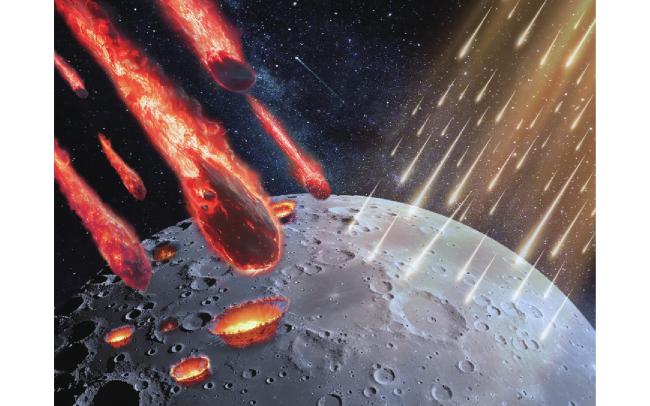
早期对Apollo月壤的研究发现,月壤颗粒表面积累的尺寸从纳米到微米不等的金属铁颗粒是改变遥感光谱信号的主要原因。随后几十年来,人们利用月壤样品、小行星返回样品和实验室模拟实验,围绕金属铁颗粒的形成机制及其对光谱的影响进行了大量研究。研究表明,不同尺寸的金属铁颗粒具有显著不同的光谱改造效应:尺寸较小的金属铁颗粒(直径小于10 nm)会使可见光反射谱变红,尺寸较大的金属铁颗粒(直径大于40 nm)会使所有波长的反射谱变暗,而中等尺寸的金属铁颗粒既会产生发红也会产生发暗的效果[2-3,7-8]。然而,金属铁颗粒的形成机制仍然饱受争议,尤其是(微)陨石撞击和太阳风辐照这两大太空风化过程在不同粒径金属铁颗粒形成过程中的具体作用仍不清晰,成为了制约修正暴露在不同空间环境下天体表面遥感光谱数据的关键问题。早期Apollo月壤的研究通常会在气相沉积层中发现小尺寸的金属铁颗粒,而在撞击形成的胶结物中发现大尺寸的金属铁颗粒,后续开展的一些(微)陨石撞击模拟实验也在沉积层中生成了小尺寸的金属铁[1,3,9-10]。这些早期的研究促使撞击主导金属铁颗粒形成,这一主流观点的形成:(微)陨石撞击引发的气相沉积作用是小尺寸金属铁颗粒形成的主要机制,而小尺寸金属铁颗粒在后续撞击导致的熔化过程中汇聚形成大尺寸金属铁颗粒[1,3,9-10]。然而,最新的遥感光谱观测发现,小尺寸金属铁颗粒引起的发红效果和太阳风通量密切相关[11-15],并且大尺寸和小尺寸金属铁颗粒有可能是独立产生的[12,16]。因此,亟须对不同尺寸金属铁颗粒的起源展开系统研究,并区分(微)陨石撞击和太阳风辐照在产生不同尺寸金属铁颗粒方面的各自作用,以深化对复杂太空环境下风化过程的理解[11-16]。
嫦娥五号采样区相比先前的Apollo和Luna采样区具有鲜明特征,包括最高的纬度、最年轻的地质年龄、最高的铁含量和最低的玻璃含量等[17]。值得注意的是,在新返回的嫦娥五号样品中,月壤颗粒表面并没有发现之前报道的含有大量纳米金属铁颗粒的气相沉积非晶层[1,3,9-10,18],这对经典的气相沉积产生小粒径金属铁颗粒的观点提出了挑战。此外,嫦娥五号样品中多种类型的玻璃物质从多个角度揭示了采样区相对温和的撞击环境[18],为认识不同风化区域的金属铁颗粒起源提供了新的机遇。本文聚焦嫦娥五号月壤中具有旋转特征的撞击玻璃颗粒,基于对大量玻璃颗粒显微结构的高精度表征,系统地分析了(微)陨石撞击和太阳风辐照对玻璃颗粒内不同尺寸金属铁颗粒的形成所发挥的各自作用,为理解和预测不同空间环境下无大气天体的光谱变化提供了重要指导。
1 研究方法
本研究使用的样品为中国国家航天局分配的嫦娥五号月壤样品,编号为CE5C0400。该样品是从月表铲取的月壤细粒,经过分散后置于扫描电子显微镜(Scanning Electron Microscope,SEM)中进行初步观察。利用二次电子(Secondary Electron,SE)模式、背散射电子(Back-Scattered Electron,BSE)模式以及能谱(Energy-Dispersive Spectroscopy,EDS)技术,初步完成对样品的形貌观察、成分分析和筛选。对于选定的样品,采用聚焦离子束(Focused Ion Beam,FIB)技术提取样品剖面。为保护样品表面,在表面沉积了Pt,以确保可以从表面到内部进行详细观测。FIB技术处理后的样品厚度通常小于100 nm,以便适合透射电子显微镜(Transmission Electron Microscope,TEM)分析。通过高分辨成像(High-Resolution Transmission Electron Microscope,HR-TEM)、高角环形暗场扫描透射成像(High-Angle Annular Dark-Field Scanning Transmission Electron Microscope,HAADF-STEM)、明场扫描透射成像(Bright-Field Scanning Transmission Electron Microscope,BF-STEM)以及EDS分析,进行详细的微观形貌、结构和成分表征分析。实验方法的具体细节可参考文献[19]。
2 研究结果
2.1 具有旋转特征的撞击玻璃珠
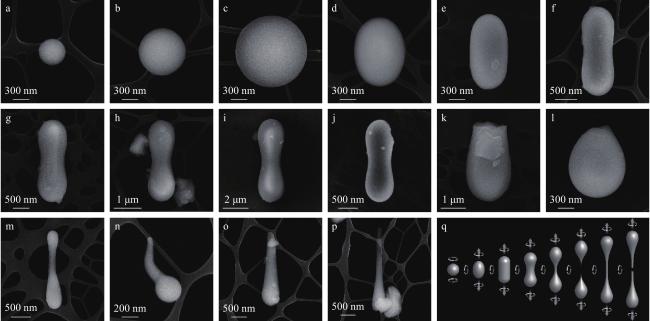
在众多玻璃物质中,撞击玻璃珠为研究金属铁的潜在多重起源提供了理想载体。一方面,撞击玻璃珠有着明确的撞击成因,在撞击熔体冷却形成玻璃过程中能够包裹储存相应撞击产物;另一方面,这些撞击玻璃形成后可以长时间暴露在月球表面,从而记录、保存太阳风辐照带来的改造特征。并且,太阳风的影响通常局限于表层百纳米左右,并不会对撞击玻璃珠内部预先存在的结构进行干扰。因此,月壤中的撞击玻璃可以同时记录撞击和辐照带来的风化改造,使得一颗撞击玻璃珠可能包含多种来源的金属铁颗粒。这为揭示金属铁的不同起源,厘清(微)陨石撞击和太阳风辐照在金属铁颗粒形成过程中发挥的各自作用创造了良好的条件。
2.2 撞击成因的大粒径金属铁颗粒
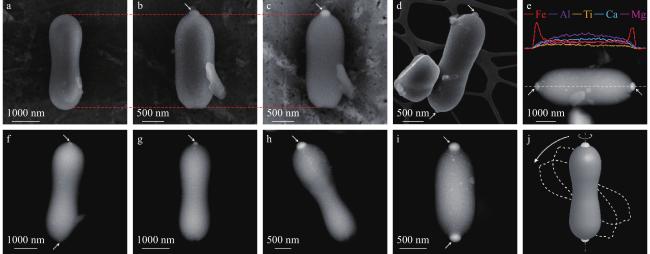
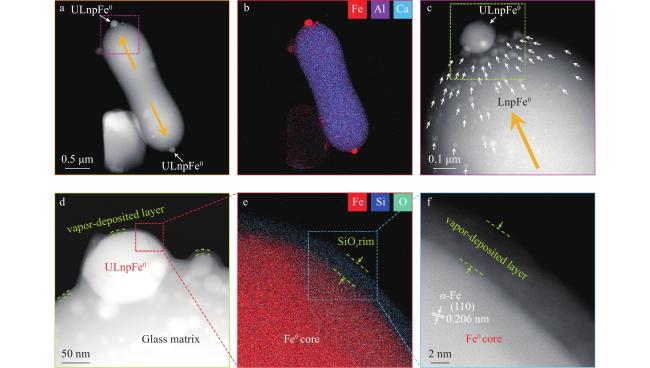
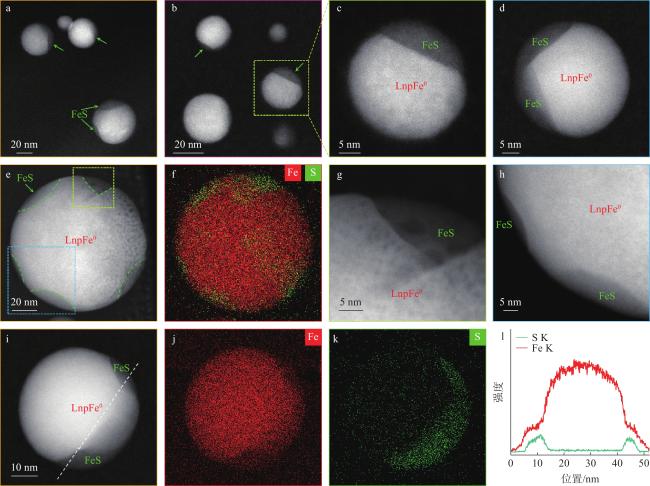
基于上述分析,我们将研究重点集中在具有旋转特征的椭球状和哑铃状撞击玻璃珠。通过仔细地观察和筛选,我们发现一些玻璃珠的端部通常具有半球形凸起,如图3 所示,不同玻璃珠可以表现出不同程度的突出,当这些凸起脱落后会形成凹坑[19],意味着这些凸起不是来自外部的附着物,而是伴随着玻璃形成时的旋转过程,从玻璃内部向两端迁移形成的。BSE图像显示凸起与玻璃基体属于不同的相,EDS线扫描进一步证实这些凸起是金属铁,如图3 (e)所示。图4 中的HAADF-STEM图像也清晰地显示出玻璃珠两端的凸起是镶嵌在玻璃珠两端,由内部突出的,并且这些凸起为近圆形的小球体。EDS面扫描再次揭示了这些小球主要由铁元素组成,如图4 (b)所示,而晶格条纹进一步确认了它们是体心立方结构的α-Fe,如图4 (f)所示。这些金属铁颗粒的直径超过百纳米,我们在此称其为超大粒径金属铁颗粒。进一步观察发现,超大粒径金属铁颗粒周围的玻璃基体上还密集分布着许多直径为几十纳米的金属铁颗粒,如图4 (c)所示,我们称其为大粒径金属铁颗粒。这些大粒径金属铁颗粒由于高的原子序数在HAADF图像中呈现为较亮的圆球,并显示出向玻璃端部汇聚的趋势。这些结果显示了撞击玻璃珠在撞击飞溅过程中凝固时定格的状态,表明这些超大粒径金属铁是在撞击作用下形成的,由于旋转离心作用,在撞击玻璃熔体凝固前发生迁移和汇聚。
2.3 辐照成因的小粒径金属铁颗粒
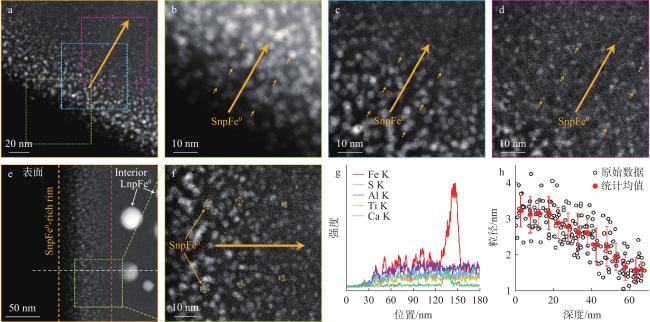
撞击玻璃珠在形成后的漫长岁月中,只要暴露在月球最表层,就会持续遭受太阳风辐照。为了揭示太阳风在金属铁颗粒形成中发挥的作用,我们详细研究了玻璃珠的表面结构特征。如图6 所示,玻璃珠表面密布着直径仅数纳米的金属铁颗粒,我们称之为小粒径金属铁颗粒。这些密集分布的小粒径金属铁在玻璃珠表面形成了一个明显的富含铁颗粒的表面层。EDS显示该表面层和内部的玻璃基体成分一致,如图6 (g)所示,说明该表面层是太阳风辐照损伤层,而非外来的气相沉积非晶层。这些小金属铁的分布随着深度显著变化,它们的尺寸和密集程度都随着深度的增加逐渐减小,并且仅存在于表面约120 nm的深度范围内。这一特征与太阳风的改造作用类似,随着深度的增加,太阳风离子的注入量逐渐减少,而且太阳风的穿透深度与富含金属铁表面层的深度相吻合[29-31]。这些实验结果证明太阳风辐照而非气相沉积是嫦娥五号月壤颗粒中小粒径金属铁颗粒的主要起源。
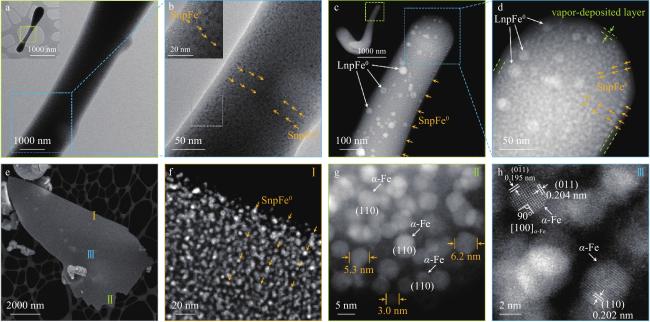
可以推测,如果颗粒足够小,以至于太阳风可以贯穿整个月壤颗粒,那么太阳风辐照产生的小粒径金属铁将会填充整个颗粒。图7 中的透射电镜结果证实了这一推论。特别地,图7 (e)~(h)中的玻璃薄片具有锐利的边缘和明显的断裂特征,说明它是某个大块玻璃破碎形成的碎片,并且之后没有再经历高温熔化的过程。它的内部充满了尺寸均匀的小粒径金属铁颗粒,说明在没有撞击高温的情况下,太阳风辐照可以单独产生丰富的金属铁颗粒,这对理解月表不同区域以及撞击作用比较温和的小天体表面的太空风化效应具有重要意义。
2.4 金属铁颗粒的尺寸分布统计
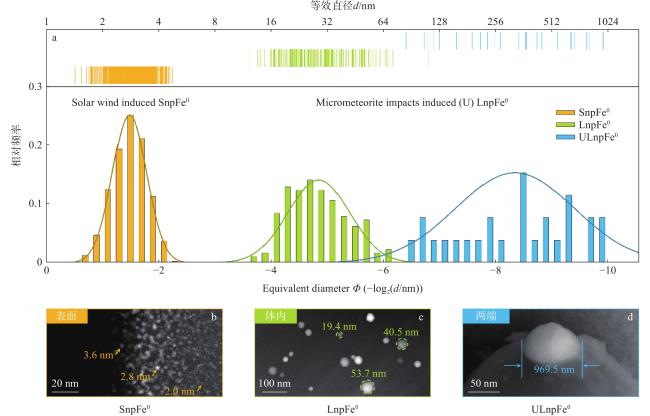
我们统计分析了撞击玻璃珠内包含的不同粒径的金属铁颗粒的尺寸分布规律。如图8 所示,玻璃珠内可以包含着3种特征尺寸、不同分布规律的金属铁颗粒,包括表面分布的小粒径金属铁颗粒、体内分布的大粒径金属铁颗粒以及玻璃珠两端的超大粒径金属铁颗粒。其中,太阳风辐照诱导的小粒径金属铁颗粒的尺寸分布相对集中,大部分尺寸约为3 nm,而撞击产生的大粒径金属铁颗粒和超大粒径金属铁颗粒的尺寸分布较宽,在几十纳米到数百纳米不等。以上统计结果表明,表面小粒径金属铁颗粒的尺寸较小且分布相对均匀,这可能是由于铁颗粒在固相中扩散和生长较慢所致;相比之下,大粒径金属铁颗粒在撞击产生的高温熔体中能够快速形核、长大,并进一步汇聚成更大粒径的金属铁颗粒。伴随着高温熔体冷却形成玻璃珠,这些撞击成因的大粒径铁颗粒“冻结”保存在玻璃珠内;形成后的玻璃珠长期暴露于极端太空环境,太阳风辐照作用会在太阳风离子有效注入深度内在大粒径铁颗粒上形成囊泡或气孔缺陷,同时在玻璃基体析出小粒径铁颗粒(如图9 所示)。
3 结论
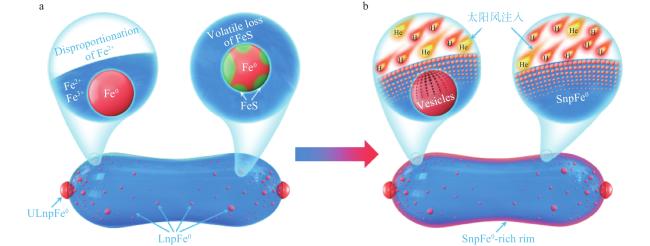


(1)(微)陨石撞击作用:撞击产生的高温高压条件可以将含铁矿物,如铁的氧化物或硫化物等转化为尺寸在几十纳米的大粒径单质金属铁颗粒。这些大粒径金属铁颗粒在撞击的短时间内形成,可能在撞击过程中融合汇聚成更大尺寸的金属铁颗粒。
(2)太阳风辐照作用:太阳风中的高能离子注入月壤颗粒表面,可以产生尺寸在几纳米的小粒径金属铁颗粒。这些小粒径金属铁颗粒在辐照的长时间内逐渐积累并达到饱和。
(3)撞击与辐照的协同作用:(微)陨石撞击和太阳风辐照既可各自独立产生金属铁颗粒,还可协同作用进一步促进太空风化。如撞击破碎作用可以增加月壤颗粒的比表面积,提高太阳风辐照产生小粒径金属铁颗粒的效率,而辐照作用形成的小粒径金属铁颗粒也可作为后续撞击熔融汇聚形成大粒径金属铁颗粒的前驱体。